
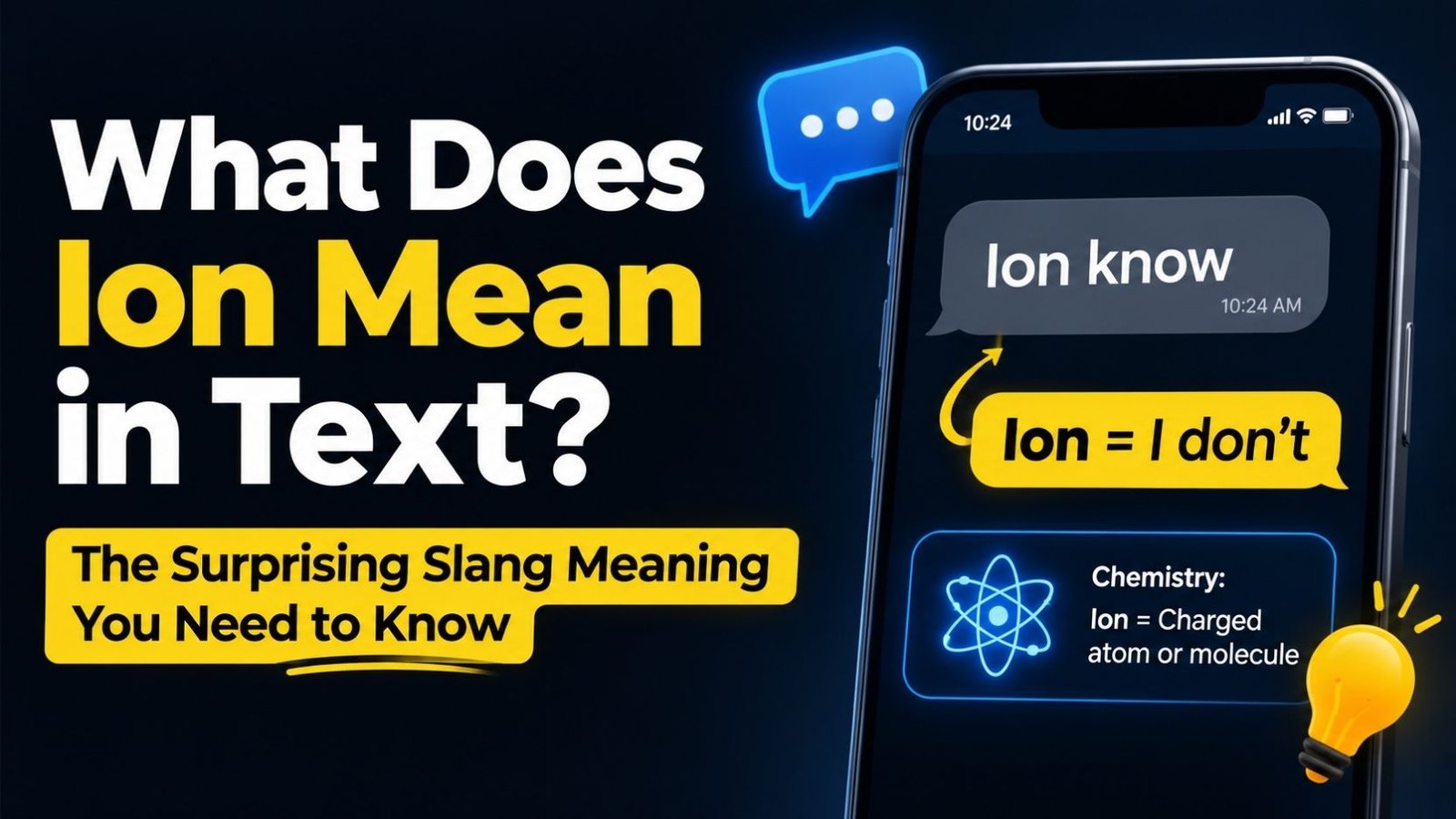
When you see “ion” in a text message, it rarely means the chemistry term. In slang, ion is a short, casual way of saying “I don’t.” People say it fast in real speech, and that fast pronunciation carries over into texting. So “ion know” means “I don’t know,” and “ion care” means “I don’t care.”
This spelling shows up everywhere online now. You will see it on Snapchat, TikTok, Instagram, and in regular text messages between friends. It comes from natural spoken English, not from a made-up internet trend. Understanding it helps you read casual messages correctly and avoid confusing it with the science word “ion.”
What Does Ion Mean in Text?
In texting and casual chat, ion means “I don’t.” It is not a typo and it is not the chemistry word. It is an eye dialect spelling, which means it spells out how a phrase actually sounds when spoken quickly.
Say “I don’t” out loud at a normal, relaxed pace. The “d” often softens or nearly disappears. What is left sounds close to “I on” or “ion.” Texters simply wrote down that sound.
So when someone types “ion feel like going out,” they mean “I don’t feel like going out.” The word carries the full weight of “I do not,” compressed into one quick syllable.
Here is the core definition in one line.
Ion (text slang) = I don’t. It is almost always followed by a verb, such as know, care, mind, think, or want.
See More: DPWM Meaning In Text
Ion Meaning Text Slang: Where It Comes From
This spelling did not start as internet slang for fun. It reflects a real speech pattern from African American Vernacular English (AAVE), where “I don’t” is commonly pronounced closer to “I on” or “ion” in fast, casual speech. AAVE has shaped a large amount of modern American slang, and this contraction is one clear example.
Over time, social media pulled this pronunciation into writing. Texting favors short forms. Once people started spelling words the way they sound instead of the way formal grammar says they should look, “ion” became the standard way to write “I don’t” in casual chat.
This is part of a bigger pattern in text speech. Words like “finna” (fixing to), “ain’t” (is not, are not), and “tryna” (trying to) follow the same idea: write the sound, skip the formal spelling.
Ion Meaning Text Message: How People Actually Use It
In everyday texting, ion almost always sits at the front of a sentence, right where “I don’t” would normally go. It replaces the full phrase without changing the meaning.
A few real patterns you will see constantly:
- Ion know = I don’t know
- Ion care = I don’t care
- Ion mind = I don’t mind
- Ion think so = I don’t think so
- Ion want to = I don’t want to
- Ion feel like it = I don’t feel like it
Notice that “ion” always needs a verb after it. On its own, “ion” is not a complete sentence. It works the same way “I don’t” needs something after it in standard English.
Ion Meaning Text Slang Variations
“Ion” has several close cousins. These variations show up in searches and in real texts, and they all trace back to the same root phrase, “I don’t.”
| Slang Form | Full Meaning | Example |
| Ion | I don’t | Ion like that show |
| Ionk | I don’t know | Ionk what happened |
| Iono | I don’t know | Iono, ask her yourself |
| Ion know | I don’t know | Ion know why he left |
| Ion mind | I don’t mind | Ion mind waiting |
| Ions | Plural or possessive use is rare; usually a typo for “ion” or “I don’t” in a longer message | Ions really care what they think |
A quick note on “ionk” and “iono”: both mean “I don’t know.” “Ionk” blends “ion” with “know” into one fast syllable, while “iono” softens the “know” part into an “o” sound. Neither is more correct than the other. They are both informal spellings shaped by how people talk.
Ion know meaning in text: this is simply “I don’t know,” written as it sounds when spoken quickly.
Ion mind meaning in text: this means “I don’t mind,” often used to agree to something casually, like “ion mind either way.”
Ion Meaning On Snapchat
On Snapchat, “ion” works exactly the same way it does in any other text message. There is nothing Snapchat-specific about the word itself. What changes is the tone of the platform.
Snapchat conversations tend to be short, quick, and informal, often between close friends. That environment is exactly where slang like “ion” thrives. A typical Snapchat caption or reply might read: “ion even know why I’m awake rn” (I don’t even know why I’m awake right now).
If someone asks “what does ion mean Snapchat,” the answer is the same definition: I don’t. The platform does not give the word a different meaning; it just makes the word more common because of how casual the chats tend to be.
Ion Meaning On TikTok
TikTok comment sections and captions use “ion” constantly, especially in Gen Z slang. You will see it in comments like “ion trust these comments” (I don’t trust these comments) or in captions like “ion do relationships like that.”
TikTok has also helped spread AAVE-rooted slang to a much wider audience, since the platform’s algorithm exposes viewers to creators and dialects they might not otherwise encounter in daily life. “Ion” is one of many words, alongside terms like “bussin” and “no cap,” that moved from spoken slang into mainstream text through short-form video culture.
Ion Meaning On Instagram
On Instagram, “ion” appears most often in comments, captions, and direct messages. The tone is usually the same: casual, quick, and unbothered.
A caption like “ion post enough but I’m working on it” simply means “I don’t post enough but I’m working on it.” In DMs, it often shows up in short replies, such as “ion know, we’ll see” when someone is uncertain about plans.
Because Instagram mixes formal brand content with casual personal posts, seeing “ion” in a comment or caption is a strong signal that the tone is meant to be relaxed and informal, not professional.
See More: BBW Meaning In Text
Ion Meaning In WhatsApp
WhatsApp is used globally, including in many professional and family group chats, so “ion” appears less consistently there than on Snapchat or TikTok. Still, among younger users texting friends, it shows up the same way it does everywhere else.
If a friend sends “ion think I can make it tonight,” it means “I don’t think I can make it tonight.” The meaning does not shift based on the app. What changes is simply how likely you are to see it, depending on who you are messaging.
What Does Ion Mean In Text From A Girl Or A Guy
A common search is “what does ion mean in text from a girl.” The honest answer is that “ion” means exactly the same thing regardless of who sends it. It is not a gendered word, and it does not carry a hidden romantic meaning by itself.
What matters is the sentence around it, not the word itself. Context decides the tone.
- “Ion know, maybe” often signals genuine uncertainty.
- “Ion care fr” (I don’t care, for real) can signal indifference, or it can be a joking response, depending on the conversation.
- “Ion mind hanging out” is a relaxed, open way of agreeing to plans.
If you are trying to read into a text that uses “ion,” look at the full message, the emojis, and the conversation history, not the slang word alone. “Ion” tells you the sentence is casual. It does not tell you the sender’s feelings by itself.
Ion Meaning Text Funny Uses
“Ion” also shows up a lot in jokes, memes, and exaggerated reactions, which is why people search for “ion meaning text funny.” The humor usually comes from pairing “ion” with something dramatic or absurd.
Examples of this playful pattern:
- “Ion know her, I never met her, this isn’t even my final form” (a joking way to fully deny involvement in something).
- “Ion do mornings” used as an exaggerated complaint.
- “Ion trust nobody named Karen” used as a lighthearted joke.
In these cases, “ion” keeps its normal meaning, “I don’t,” but the humor comes from the exaggerated or ironic statement that follows it, not from the word changing meaning.
How To Pronounce Ion As Slang
The slang word “ion” is pronounced “eye-on,” rhyming closely with “iron” said quickly, or like the letters “I” and “on” pushed together into one syllable.
This is different from how the chemistry word “ion” is pronounced. The science term is pronounced “EYE-on” as well, but it is spoken more clearly and deliberately, with each part slightly more separated, since it is a formal scientific word rather than a fast contraction.
💡 Tip: If you are unsure whether “ion” in a sentence is slang or chemistry, check the sentence. Slang “ion” is followed by a verb like know, care, or mind. Chemistry “ion” is usually followed by words like charge, atom, or molecule.
Ion Vs Ionic: Avoiding A Common Mix-Up
“Ionic” is a completely different word from slang “ion.” Some readers search “ionic meaning in text,” expecting it to relate to the slang term, but the two are not connected.
- Ion (slang): short for “I don’t,” used casually in texting.
- Ionic: an adjective related to ions in chemistry (as in “ionic bond”) or a term describing a style in classical architecture (Ionic columns).
If you see “ionic” in a casual text, it is far more likely to be either a typo, autocorrect changing “ion” to “ionic,” or a genuine reference to chemistry or design. It does not carry the “I don’t” slang meaning on its own.
What Does Ion Mean in Chemistry
Since “ion” is also a real scientific word, it is worth explaining clearly so the two meanings never get confused.
In chemistry, an ion is an atom or molecule that has an electrical charge because it has gained or lost one or more electrons.
- A cation is a positively charged ion, formed when an atom loses electrons.
- An anion is a negatively charged ion, formed when an atom gains electrons.
This scientific meaning has nothing to do with the texting slang. They are simply spelled the same way, which is why context always matters when you are figuring out which meaning someone intends.
Grammar: What Part of Speech Is Ion in Texting
In formal grammar, “ion” as slang is not a single part of speech on its own. It functions as a contraction that stands in for a pronoun plus a negative auxiliary verb, specifically “I” plus “don’t.”
Because of that, “ion” behaves grammatically like “I don’t” would in a sentence:
- It needs a verb after it to form a complete thought.
- It cannot stand alone as a full sentence (an answer of just “ion” is understood as short for “I don’t know,” but it depends heavily on context).
- It is only used in casual, spoken-style writing, never in formal English.
| Form | Grammar Role | Example |
| I don’t | Pronoun + negative auxiliary verb | I don’t know the answer |
| Ion | Informal contraction of “I don’t” | Ion know the answer |
Common Mistakes With Ion in Text
Understanding “ion” correctly avoids a few easy mix-ups.
❌ Incorrect: Treating “ion” as a random abbreviation with no clear meaning.
✅ Correct: Reading “ion” as “I don’t,” then reading the rest of the sentence normally.
❌ Incorrect: Assuming “ion” in a text is always about chemistry.
✅ Correct: Checking context. Slang “ion” is followed by verbs like know, care, or mind, not by words like charge or electron.
❌ Incorrect: Using “ion” in formal writing, such as an email, essay, or work message.
✅ Correct: Saving “ion” for casual texting with friends, since it is informal slang, not standard English.
⚠️ Common mistake: Autocorrect sometimes changes “ion” to “iron” or “ionic.” If a text looks strange, check whether autocorrect changed the intended slang word.
See More: HG Meaning Text
Similar And Related Slang Words
“Ion” fits into a larger family of texting shortcuts that compress common phrases into one quick word. Knowing a few related terms helps with reading casual messages overall.
| Word | Meaning | Difference From Ion |
| Idk | I don’t know | Idk is a letter abbreviation; ion is a sound-based spelling |
| Iono | I don’t know | Iono is close to ion, but specifically means “I don’t know,” not general “I don’t” |
| Nvm | Never mind | Different meaning; used to drop a topic, not to state “I don’t” |
| Finna | Going to, about to | Different root phrase, but same style of phonetic slang |
| Tryna | Trying to | Also phonetic slang, but expresses effort, not negation |
Examples Of Ion In A Sentence
A few natural, real-style examples make the meaning easier to lock in.
- “Ion know if I can come tonight, I have a lot going on.”
- “Ion care what people think about it anymore.”
- “Ion mind sharing my notes with you before the test.”
- “Ion feel like cooking, let’s just order food.”
- “Ion think that’s a good idea, honestly.”
In every example, simply replace “ion” with “I don’t” and the sentence still makes complete sense.
Frequently Asked Questions
What does ion mean in text?
It means “I don’t.” It is an informal spelling of how “I don’t” sounds when spoken quickly.
What does ion mean on Snapchat?
The same thing it means everywhere else: “I don’t.” Snapchat does not change the definition; it just uses casual language often.
Is ion a real word?
Yes, but with two separate meanings. In chemistry, an ion is a charged atom or molecule. In texting slang, ion is short for “I don’t.”
How do you pronounce ion in slang?
It is pronounced “eye-on,” said quickly, similar to how “I don’t” sounds when spoken fast in casual speech.
What does ionk mean in text?
Ionk means “I don’t know.” It blends “ion” and “know” into one short word.
What does iono mean in text?
Iono also means “I don’t know.” It is a slightly different spelling of the same idea as ionk.
What does ion mean in text from a girl or a guy?
It means the same thing no matter who sends it: “I don’t.” The tone depends on the full message, not the word alone.
Is it okay to use ion in a formal message?
No. Ion is informal slang. Use it with friends in casual texting, but avoid it in emails, school work, or professional messages.
What is the difference between ion and ionic in a text?
Ion (slang) means “I don’t.” Ionic is an unrelated word tied to chemistry or architecture, and it does not carry the slang meaning.
Where did ion as slang come from?
It comes from a natural pronunciation of “I don’t” in casual American speech, rooted in African American Vernacular English, later spread widely through texting and social media.
Conclusion
Ion, as text slang, simply means “I don’t.” It comes from the way “I don’t” naturally sounds when spoken quickly, and it has become one of the most common casual contractions across Snapchat, TikTok, Instagram, and everyday text messages. Related forms like ionk and iono extend the same idea to mean “I don’t know,” while the word stays completely separate from the scientific term ion, which refers to a charged atom or molecule.
Once you know that ion equals “I don’t,” reading casual texts becomes much easier, since every sentence built around the word will make sense the moment you mentally swap it back in. It is informal, friendly, and built for quick conversation, so it belongs in relaxed chats with friends rather than formal writing, and recognizing the difference keeps your own communication clear in every setting.

Hassan Ibrahim is the author behind Mean Fixer, with 4 years of experience researching and writing about names, words, slang, meanings, and everyday language. Their goal is to make confusing words and meanings simple, clear, and easy to understand through accurate, useful, and reader-friendly explanations.
4 Comments