
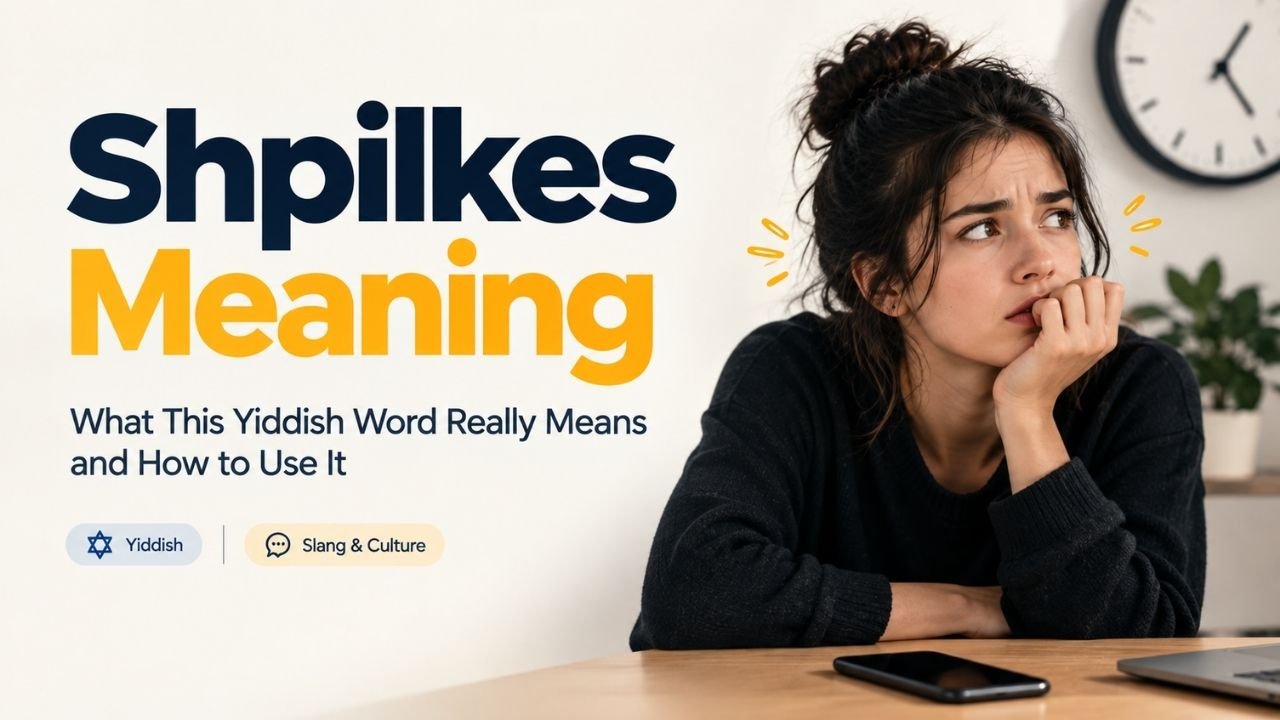
If someone says they have shpilkes, they mean they feel restless, jumpy, or unable to sit still. Shpilkes is a Yiddish word for nervous energy, impatience, or anxious anticipation. It describes that fidgety feeling you get while waiting for news, sitting through a long meeting, or waiting on a phone call that just will not come.
The word matters because it captures a very specific kind of discomfort that English does not name as neatly. Shpilkes is not general worry. It is the physical, twitchy version of anxiety: the leg bouncing, the nail biting, the pacing. Understanding this word helps you read Yiddish-influenced English more accurately, and it explains why native speakers reach for it instead of a plainer word like “nervous.”
What Does Shpilkes Mean?
At its core, shpilkes means a state of restlessness, impatience, or nervous agitation. Standard reference sources describe it as a condition of impatience, agitation, and mild anxiety, often tied to waiting for something to happen.
The word is almost always used with a verb like “have” or a phrase like “sitting on.” You do not simply “feel shpilkes” the way you feel sad. You “have shpilkes” or you are “on shpilkes,” the way English speakers say someone is “on pins and needles.”
Here is the simple version:
- Shpilkes = restless, nervous energy, especially while waiting for something
- It shows up as physical fidgeting, not quiet worry
- It is almost always informal and conversational
- It is most common in American Yiddish-English communities, especially in Jewish American speech
The Literal Meaning Behind Shpilkes
The literal meaning of the word is “pins” or “needles.” Language researchers who study Yiddish loanwords trace the everyday usage back to a Yiddish phrase that describes sitting as though perched on pins, which is where the English expression “sitting on shpilkes” comes from.
That image explains everything. Picture sitting on a chair full of pins. You would not stay still. You would shift, squirm, and shuffle around. That physical restlessness is exactly what the word describes when it is used about a person’s mood.
See More: WTMS Meaning
Shpilkes Meaning In English
In English, shpilkes meaning translates most closely to “ants in your pants” or “sitting on pins and needles.” Dictionary sources define it as a state of impatience or agitation, and several note that it is commonly used as a lighthearted way to describe someone who cannot stop moving or waiting nervously.
There is no single-word English equivalent that captures it perfectly. “Anxious” is too broad. “Fidgety” is close but misses the anticipation part. “Antsy” is probably the nearest one-word match, since both phrases point to that same image of being unable to sit still.
A useful way to think about it: shpilkes sits at the intersection of three feelings.
| Feeling | How It Relates to Shpilkes |
| Impatience | Waiting for an outcome you cannot control |
| Physical restlessness | Fidgeting, pacing, leg shaking |
| Mild anxiety | Nervous anticipation, not full-blown fear |
Shpilkes Pronunciation
Getting the pronunciation right matters, because this is a word people usually hear before they read it. According to Chabad.org, the pronunciation closest to the original Yiddish is roughly “SHPIL-kess” or “SHPIL-kiss,” while many English speakers instead say “SHPIL-keys.”
Here is a simple breakdown:
- Yiddish-accurate pronunciation: SHPIL-kess (rhymes loosely with “will guess”)
- Common English pronunciation: SHPIL-keys
- Stress: always on the first syllable, SHPIL
💡 Tip: If you are unsure which version to use, SHPIL-kess is closer to the original Yiddish and is the version most often used by Yiddish speakers and in Jewish communities. SHPIL-keys is common among English speakers who learned the word secondhand, and it will still be understood everywhere.
There is no single official body governing Yiddish loanword pronunciation in English, so both versions are considered acceptable in everyday conversation.
Shpilkes Grammar: What Part of Speech Is It?
Shpilkes is a noun. Specifically, it behaves as a plural-only noun in English, similar to words like “news” or “scissors.” You do not say “a shpilke” to describe the feeling in casual English, even though the singular Yiddish word shpilke technically means one pin.
In practice, shpilkes almost always appears in one of these patterns:
- Have shpilkes — “I have shpilkes waiting for the results.”
- Give someone shpilkes — “This delay is giving me shpilkes.”
- Sitting on shpilkes — “She’s sitting on shpilkes until he calls.”
- On shpilkes — “We were on shpilkes all afternoon.”
It is not typically used as a verb or an adjective. You would not say “I am shpilkes” or “That was very shpilkes.” The word stays a noun, almost always paired with a small set of fixed expressions.
Sitting on Shpilkes: Meaning and Usage
“Sitting on shpilkes” is the most common full expression built around this word, and it is worth explaining on its own. It means waiting anxiously, unable to relax, often while anticipating news or a decision.
The image comes directly from the word’s literal meaning of “pins.” If you were actually sitting on pins, you could not sit comfortably. You would keep shifting. “Sitting on shpilkes” borrows that image for an emotional state: you cannot settle down because you are waiting for something important.
A close variant, “oif shpilkes,” uses the Yiddish word for “on” instead of the English “sitting on.” Both phrases describe the same feeling of being highly agitated while waiting for something to happen. “Sitting on shpilkes” is simply the more Anglicized version, and it is the phrasing you are more likely to hear from English speakers outside Yiddish-fluent circles.
Shpilkes in a Sentence
Seeing the word in real examples makes the meaning click faster than any definition alone. Here are natural examples that reflect how the word is actually used:
- “I’ve had shpilkes all day waiting to hear back about the job.”
- “My mother gets shpilkes every time my flight is delayed.”
- “The kids had shpilkes by the end of the long car ride.”
- “He was sitting on shpilkes outside the courtroom, waiting for the verdict.”
Notice the pattern: shpilkes almost always shows up next to a reason for the restlessness, whether it is a delayed flight, a pending decision, or a long wait. The word rarely appears on its own without some context explaining what is causing the nervous energy.
See More: What Does Chuzz Mean?
Shpilkes Yiddish Origin And Etymology
The word has a traceable path through several languages before reaching English. Language reference sources including Wiktionary explain that shpilkes was borrowed from the Yiddish word for “needles,” which itself likely developed from a Slavic term related to the Polish word for a pin. That Polish word, in turn, is thought to trace back through Italian to a Late Latin term meaning “little thorn.”
Here is that chain laid out simply:
| Stage | Language | Word | Meaning |
| 1 | Late Latin | spinula | Little thorn |
| 2 | Italian | spilla | Pin or brooch |
| 3 | Polish | szpilka | Pin |
| 4 | Yiddish | shpilkes | Pins, needles |
| 5 | English | shpilkes | Restless, nervous energy |
This is a common pattern in Yiddish vocabulary. Yiddish absorbed words from German, Hebrew, Aramaic, and Slavic languages over centuries of Jewish life in Central and Eastern Europe, then carried many of those words into American English through waves of Jewish immigration, especially in the late nineteenth and early twentieth centuries.
Shpilkes in Jewish Culture and Everyday Life
Shpilkes is more than a dictionary entry. It describes a feeling many people recognize instantly once they hear the word, and it has become a small piece of shared cultural shorthand, especially in Jewish American communities.
Writers who cover Yiddish and Jewish culture often describe the physical side of the feeling in vivid terms: the inability to stop bouncing a leg under a table, biting nails, or pacing back and forth. The literal image behind the word, that of pins and needles poking repeatedly, is used to explain why the resulting movements are so sharp and fidgety rather than calm.
Common everyday situations where people describe having shpilkes include:
- Waiting for medical test results
- Waiting to hear if a job offer came through
- Sitting through a long flight delay
- Waiting for a child to call after a first date or a trip
- Sitting in a waiting room before an important appointment
A frequently cited example involves a parent waiting to hear from a grown child after a big event, like a first date, checking the phone repeatedly and unable to relax until the call comes in. The same restless feeling applies to courtroom settings, where anyone waiting on a judge or jury to reach a decision experiences a very literal version of shpilkes.
Related Yiddish Words
Shpilkes belongs to a small family of Yiddish emotion words that English speakers, especially in American Jewish communities, have borrowed to describe feelings that do not translate neatly. Knowing a few neighboring words helps you use shpilkes correctly and avoid mixing it up with similar-sounding terms.
| Word | Meaning | How It Differs From Shpilkes |
| Tsuris | Serious troubles or worries | Deeper and heavier; shpilkes is lighter, more physical restlessness |
| Nudnik | A pestering, annoying person | Describes a person, not a feeling |
| Kvetch | To complain | Describes an action, not a state of waiting |
| Plotz | To collapse from strong emotion | Describes a reaction, not ongoing restlessness |
Writers who explain Yiddish vocabulary to English speakers often draw this same distinction: shpilkes is restlessness and nervous energy, literally rooted in the image of pins, while tsuris points to real trouble or suffering rather than fidgety waiting.
⚠️ Common mistake: Do not use shpilkes to describe deep grief, serious hardship, or major trouble. That is what tsuris is for. Shpilkes is specifically about restless, nervous waiting, not heavy emotional pain.
Not to Be Confused With: Dybbuk
Shpilkes is sometimes mentioned near another Yiddish-origin word, dybbuk, simply because both come from Yiddish and Jewish folklore. They mean completely different things. A dybbuk refers to a spirit in Jewish folklore believed to possess a living person.
Shpilkes refers to a feeling of restlessness. There is no meaningful overlap between the two beyond their shared language of origin, so it is worth keeping them separate if you come across both terms while researching Yiddish vocabulary.
Shpilkes Crossword Clue
Shpilkes occasionally shows up as an answer in crossword puzzles, usually clued along the lines of “Yiddish for nervous energy” or “state of restless impatience.” If you see a clue referencing Yiddish words for anxiety, agitation, or “pins and needles,” shpilkes is a strong candidate, particularly in puzzles that favor Yiddish loanwords common in American English.
Common Mistakes With Shpilkes
Because shpilkes is a borrowed word, English speakers sometimes use it slightly differently than its original form. Here are a few points worth knowing.
❌ Incorrect: “I am so shpilkes about this.”
✅ Correct: “I have such shpilkes about this.”
Shpilkes is a noun, not an adjective, so it needs a verb like “have” rather than “am.”
❌ Incorrect: “He has a shpilke.”
✅ Correct: “He has shpilkes.”
In everyday English usage, the plural form shpilkes is standard for describing the feeling, even though shpilke is technically the singular word for one pin in Yiddish.
❌ Incorrect: Treating shpilkes as a synonym for serious anxiety disorder or deep depression.
✅ Correct: Using shpilkes for short-term, situational restlessness, such as waiting for news.
Synonyms and Similar English Expressions
If you want an English phrase that lands close to shpilkes, a few options work well depending on tone:
- On pins and needles — nearly identical in meaning and imagery
- Ants in your pants — casual, often used for children or lighthearted restlessness
- Antsy — a shorter, more modern equivalent
- Jittery — closer to nervous energy without the waiting element
- Champing at the bit — closer to eager impatience than anxious waiting
None of these is a perfect substitute. Shpilkes carries a specific cultural flavor and a physical, pins-and-needles image that makes it distinct even from its closest English equivalents.
See More: What Does BB Mean In Text?
Frequently Asked Questions
What does shpilkes mean?
Shpilkes means a state of restlessness, impatience, or nervous agitation, especially while waiting for news or an outcome.
What does shpilkes mean in English?
In English, shpilkes is closest in meaning to “ants in your pants” or “sitting on pins and needles.”
How do you pronounce shpilkes?
The Yiddish-accurate pronunciation is roughly SHPIL-kess, though many English speakers say SHPIL-keys.
Is shpilkes a noun or a verb?
Shpilkes is a noun. It is almost always used with “have” or in the phrase “sitting on shpilkes.”
What does “sitting on shpilkes” mean?
It means waiting anxiously and restlessly, unable to relax, usually while anticipating important news.
What language does shpilkes come from?
Shpilkes comes from Yiddish, where it literally means “pins” or “needles.” The Yiddish word itself traces back through Polish and Italian to Late Latin.
Can shpilkes describe a happy kind of excitement?
It can, if the excitement includes restlessness, such as a child unable to sit still before a birthday party. The core meaning still centers on physical fidgeting and impatience.
Is shpilkes formal or informal?
It is informal and conversational. You would not typically use it in a formal report or academic writing.
What is the difference between shpilkes and tsuris?
Shpilkes describes restless, nervous waiting. Tsuris describes deeper troubles, worries, or suffering. They are not interchangeable.
Does shpilkes have a singular form?
The literal singular in Yiddish is shpilke, meaning one pin, but in English the word is almost always used in its plural form, shpilkes, to describe the feeling.
Final Thoughts
Shpilkes means restless, nervous energy, most often felt while waiting for news or an outcome you cannot control. It comes from the Yiddish word for pins, and that image of sitting on pins explains the fidgety, cannot-sit-still quality the word describes. Whether you say SHPIL-kess or SHPIL-keys, the meaning stays the same: an anxious, physical kind of impatience that most people recognize the moment they feel it.
The next time you catch yourself bouncing your knee while waiting for a text back, or pacing the kitchen during a long phone call, you now have the right word for it. Shpilkes is a small piece of Yiddish that fills a real gap in English, naming a feeling that everyone has experienced but few words describe quite this precisely.

Hassan Ibrahim is the author behind Mean Fixer, with 4 years of experience researching and writing about names, words, slang, meanings, and everyday language. Their goal is to make confusing words and meanings simple, clear, and easy to understand through accurate, useful, and reader-friendly explanations.
One Comment