
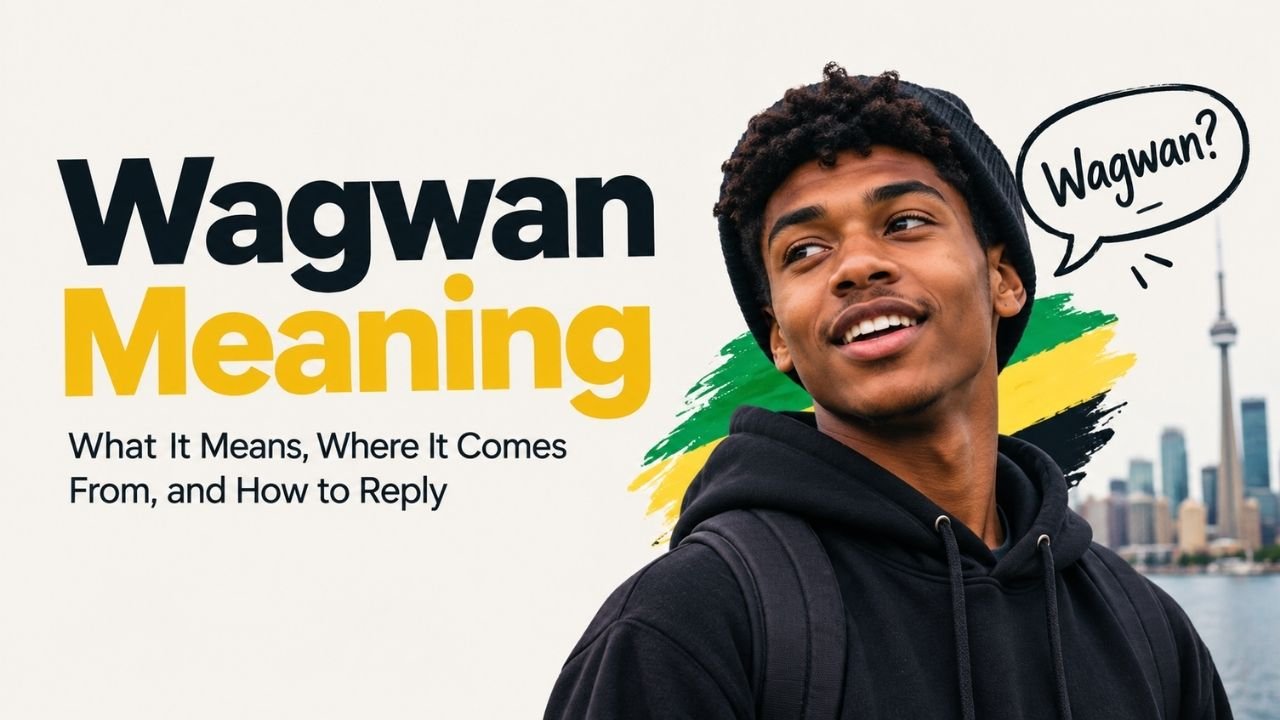
Wagwan means “what’s going on” or “what’s happening.” It is a casual greeting that comes from Jamaican Patois. People use it the same way English speakers use “what’s up” or “how’s it going.”
You will hear wagwan most in Jamaica, the UK, and Canada. It also shows up often in music, social media, and everyday text messages. Understanding it helps you follow modern slang across English speaking communities.
The word matters because it carries real cultural history, not just internet trend value. It began in Jamaican English and travelled through migration, music, and youth culture into mainstream British and North American speech. Knowing where wagwan comes from helps you use it with more understanding and respect. This guide explains the meaning, grammar, pronunciation, origin, and correct ways to reply.
What Does Wagwan Mean?
Wagwan is an informal greeting. It asks the other person what is happening in their life right now.
The closest English equivalents are:
- What’s up?
- What’s happening?
- How’s it going?
It works both as a question and as a general hello. Someone might text “Wagwan” simply to open a conversation, without expecting a detailed answer about what is actually happening.
Example sentences:
- “Wagwan, you coming out tonight?”
- “Just texted my cousin, wagwan with him lately?”
- “Wagwan fam, long time no see.”
Wagwan Meaning in Jamaican Patois
Wagwan comes directly from Jamaican Patois, also called Jamaican Creole. The full phrase behind it is “wha a gwaan,” which itself comes from “what is going on.”
Here is how the phrase shortened over time:
| Stage | Form | Meaning |
| Standard English | What is going on? | Full question |
| Jamaican Patois | Wha a gwaan | Same question, Patois grammar |
| Shortened Patois | Wah gwaan | Faster, casual spoken form |
| Common spelling online | Wagwan | Single-word spelling used in texting and music |
In Jamaican Patois, “gwaan” comes from the English word “going on,” pronounced and spelled the Patois way. “Wha a” is the Patois form of “what is.” Put together, the phrase keeps its original meaning even as the spelling changed.
This is why you will sometimes see the word spelled “wah gwan,” “wagwaan,” or “whagwan.” All of these point to the same greeting. Wagwan has simply become the most common spelling in UK slang and on social media.
See More: What Does IDM Mean In Text
Is Wagwan in the Dictionary?
Yes, several major dictionaries recognize wagwan, though they list it in different ways.
| Dictionary | Listed? | Notes |
| Oxford English Dictionary | Yes | Lists wagwan as an interjection used in Jamaican English, with earliest documented use from 1983 |
| Collins English Dictionary | Yes | Defines it simply as slang for “what is happening” |
| Dictionary.com | Yes (slang section) | Explains it as informal Jamaican English, popular in the Jamaican diaspora, especially South London |
| YourDictionary | Yes | Labels it Jamaican and Multicultural London English (MLE), meaning “what’s up” |
| Cambridge Dictionary | Not currently listed | Cambridge Dictionary does not have a dedicated entry for wagwan at this time |
If you search “cambridge dictionary wagwan meaning,” you will not currently find a standalone entry. Cambridge Dictionary tends to add slang terms gradually, and wagwan has not yet been included as of this writing. This may change, since dictionaries regularly update their slang and informal word lists. For now, Oxford, Collins, and Dictionary.com are the more reliable dictionary sources for a formal definition.
Wagwan Grammar and Part of Speech
Wagwan works as an interjection. An interjection is a short word or phrase used to express a reaction or greeting, rather than to build a full sentence.
- It does not change form for tense, number, or subject.
- It does not need a subject or verb around it to function.
- It can stand completely alone as a full message.
Correct usage:
- “Wagwan?” (used alone, as a greeting)
- “Wagwan, everything good?” (used to open a sentence)
Incorrect usage:
- “He is wagwanning right now.” ❌ (Wagwan is not a verb and cannot be conjugated this way)
- “That was so wagwan.” ❌ (Wagwan is not an adjective and does not describe a noun)
Because it is Patois in origin, wagwan does not follow standard English grammar rules. It is best treated as a fixed greeting phrase, similar to “hello” or “hey,” rather than a flexible grammatical building block.
How to Pronounce Wagwan
Wagwan is pronounced as one smooth word, not two separate syllables spoken slowly.
- Simple pronunciation: WAG-wahn
- IPA: /wɒɡˈwɒn/ (British) or /wɑːɡˈwɑːn/ (general spoken form)
The stress usually falls on the second syllable, “wahn,” though in fast casual speech both syllables can blend together almost evenly. In Jamaica, the pronunciation follows Patois vowel sounds, so the word can sound closer to “wah-gwahn” with a softer, quicker delivery. In the UK, especially in London street slang, it is often said fast and clipped, almost like one syllable.
💡 Tip: If you are unsure, say it quickly and naturally, the way you would say “what’s up,” rather than pronouncing each letter carefully.
Origin of Wagwan
Wagwan’s roots trace back to Jamaican Patois, a Creole language that developed in Jamaica from a mix of English and West African language influences during the colonial period.
The Oxford English Dictionary records the earliest known written use of wagwan in the 1980s, with documented evidence from 1983. From Jamaica, the phrase travelled abroad through Jamaican migration.
Key points in wagwan’s history:
- Jamaican Patois speakers used “wha a gwaan” or “wah gwaan” as an everyday greeting for generations before it appeared in wider English media.
- Jamaican immigrants brought the phrase to the UK, especially London, from the 1980s and 1990s onward.
- The word became strongly linked to Multicultural London English (MLE), a dialect shaped by Caribbean, South Asian, and other immigrant communities in London.
- Grime and UK rap music in the 2000s and 2010s spread wagwan far beyond Caribbean communities, introducing it to a much wider British audience.
- Television shows, music videos, and social media later carried the word to international audiences, including the United States and Canada.
So while wagwan is often called “British slang” today, its true origin is Jamaican. British usage is a later development that grew out of Jamaican diaspora communities settling in the UK.
See More: HYB Meaning In Text
Wagwan Meaning in British Slang
In the UK, wagwan is one of the most recognizable greetings in informal youth and street culture. It is closely tied to Multicultural London English, sometimes just called “MLE” or loosely “roadman slang.”
In British usage, wagwan usually appears with other slang words, such as:
- “Wagwan, bruv?”
- “Wagwan fam, you good?”
- “Wagwan g, long time.”
It is casual and friendly. It is common among younger speakers, in group chats, and in music, but it is not typically used in professional or formal settings.
Some British commentators have discussed whether non Caribbean people using wagwan is a form of cultural appropriation, since the word has deep roots in Jamaican identity. Others argue it simply reflects how much Caribbean culture has shaped British youth culture, especially in cities like London. Both views appear in public discussion, and there is no single settled answer. If you are unsure whether to use it, context and audience matter more than any fixed rule.
Wagwan Meaning in Toronto and Canada
Wagwan is also common in Toronto, largely because Toronto has one of the largest Caribbean and Jamaican diaspora communities in North America.
In Toronto slang, wagwan carries the same core meaning as in Jamaica and the UK: a casual way to ask what’s happening. It blends naturally with Toronto’s own slang scene, which already mixes Caribbean, Black North American, and hip hop influences.
You will hear it in:
- Everyday greetings between friends
- Toronto rap and R&B music
- Social media captions and comments from Canadian creators
The word did not originate in Toronto, but the city’s strong Jamaican Canadian population helped keep it in regular, natural use rather than treating it only as a trend.
How to Reply to Wagwan
Replying to wagwan is simple. You are not expected to give a long update on your life. A short, casual reply works best.
Common replies:
- “Nothing much, wagwan with you?”
- “All good, just chilling.”
- “Same old, you good?”
- “Wagwan, all is well.”
Note: The most natural reply often just answers briefly and then bounces the question back, the same way you would respond to “what’s up?” in standard English.
⚠️ Common mistake: Treating wagwan like a deep, serious question. In most casual contexts, it is a greeting first and a real question second. A long, detailed answer can feel out of place unless the conversation naturally goes there.
Wagwan in Music and Pop Culture
Wagwan has appeared widely across reggae, dancehall, grime, and UK rap music, which helped push the word into mainstream slang.
It has also appeared in British television, most notably in UK dramas set in London street culture, where characters use it as natural, everyday dialogue. This kind of media exposure is a major reason people outside Jamaica and the UK now recognize and search for the word.
Because song lyrics and screenplay dialogue are copyrighted material, this guide does not reproduce exact lines from songs or shows. If you want to see wagwan used in a specific song or scene, searching the artist or show name alongside “wagwan” will lead you to the original source.
Common Phrases That Use Wagwan
Wagwan often combines with other slang words to create a specific tone or audience.
| Phrase | Meaning |
| Wagwan fam | Greeting to a close friend or “family,” meaning “what’s up, friend” |
| Wagwan g | Casual greeting to a friend, “g” being short for a term of familiarity |
| Wagwan bruv | Greeting to a male friend, “bruv” being British slang for “brother” |
| Wagwan mandem | Greeting directed at a group of male friends, “mandem” meaning “the guys” |
| Wagwan my yute | Greeting to a younger person, “yute” being Patois for “youth” |
| Wagwan crodie | Greeting to a close friend, “crodie” being Jamaican slang for a trusted friend |
These combinations do not change the core meaning of wagwan. They simply add warmth, familiarity, or a specific audience to the greeting.
Wagwan vs Similar Greetings
Wagwan shares its basic function with several other casual English greetings, but each carries its own cultural background.
| Greeting | Meaning | Cultural Origin |
| Wagwan | What’s going on | Jamaican Patois |
| What’s up | What’s going on | General American and British English |
| Sup | What’s up (shortened) | American informal speech |
| Wassup | What’s up (stylized) | American slang, popularized by media |
| Ayy | Casual hello or attention grabber | General informal English |
The biggest difference is cultural weight. “What’s up” and “sup” are now considered fully mainstream and culturally neutral. Wagwan still carries a clear connection to Jamaican and British Caribbean identity, even when used casually by people outside that community.
Common Mistakes With Wagwan
❌ Incorrect: Using wagwan in a formal email or business meeting. ✅ Correct: Save wagwan for casual texts, conversations with friends, or informal social posts.
Wagwan is strictly informal. Using it in professional writing can come across as out of place or confusing to the reader.
❌ Incorrect: Spelling it as one rigid, “official” spelling in every context. ✅ Correct: Accepting that wah gwaan, wah gwan, and wagwan are all accepted spellings of the same Patois phrase.
Because wagwan comes from spoken Patois, spelling varies. Wagwan is simply the most common form used in UK slang, texting, and online content.
❌ Incorrect: Assuming wagwan only means a literal question about someone’s day. ✅ Correct: Understanding that wagwan often functions as a general hello, similar to “hey,” without requiring a detailed answer.
See More: SPWM Meaning In Text
Frequently Asked Questions
What does wagwan mean?
Wagwan means “what’s going on” or “what’s happening.” It is a casual greeting from Jamaican Patois.
Is wagwan Jamaican or British slang?
Wagwan originated in Jamaican Patois. It later became a major part of British slang, especially Multicultural London English, through Jamaican migration to the UK.
How do you reply to wagwan?
A short, casual answer works best, such as “nothing much, you?” or “all good, wagwan with you?”
Is wagwan a real word in the dictionary?
Yes. Oxford English Dictionary, Collins English Dictionary, and Dictionary.com all recognize wagwan as an informal or slang term. Cambridge Dictionary does not currently have a standalone entry for it.
What part of speech is wagwan?
Wagwan functions as an interjection. It is used as a greeting and does not change form like a verb, noun, or adjective.
How do you pronounce wagwan?
It is pronounced WAG-wahn, said quickly as one smooth greeting rather than two separate, carefully spoken syllables.
Is it rude to say wagwan if you are not Jamaican?
Not automatically. It is widely used across British and Canadian youth culture today. Some people view non Caribbean use as cultural appropriation, while others see it as a natural result of Caribbean cultural influence. Being mindful of context and audience is a reasonable approach.
Where did wagwan come from originally?
It comes from the Jamaican Patois phrase “wha a gwaan,” itself rooted in the English phrase “what is going on.”
Is wagwan the same as “what’s up”?
The meaning is very close, but wagwan carries specific Jamaican and British Caribbean cultural roots, while “what’s up” is culturally neutral, general English slang.
Can you use wagwan in writing?
Yes, in informal writing such as texts, social media captions, or casual dialogue. It is not appropriate for formal or academic writing.
Conclusion
Wagwan means “what’s going on,” and it comes directly from the Jamaican Patois phrase “wha a gwaan.” It works as a casual greeting, most common in Jamaica, the UK, and Canada, and it functions grammatically as an interjection rather than a verb or adjective. Dictionaries including Oxford, Collins, and Dictionary.com now recognize it, even though Cambridge Dictionary has not yet added a dedicated entry.
Understanding wagwan means understanding more than a definition. It means recognizing a word with real cultural history, shaped by Jamaican identity, migration, and music. Whether you are learning it for a conversation, a song lyric, or simple curiosity, using wagwan correctly, and with awareness of where it comes from, is the most respectful and accurate way to bring it into your own vocabulary.

Hassan Ibrahim is the author behind Mean Fixer, with 4 years of experience researching and writing about names, words, slang, meanings, and everyday language. Their goal is to make confusing words and meanings simple, clear, and easy to understand through accurate, useful, and reader-friendly explanations.
2 Comments