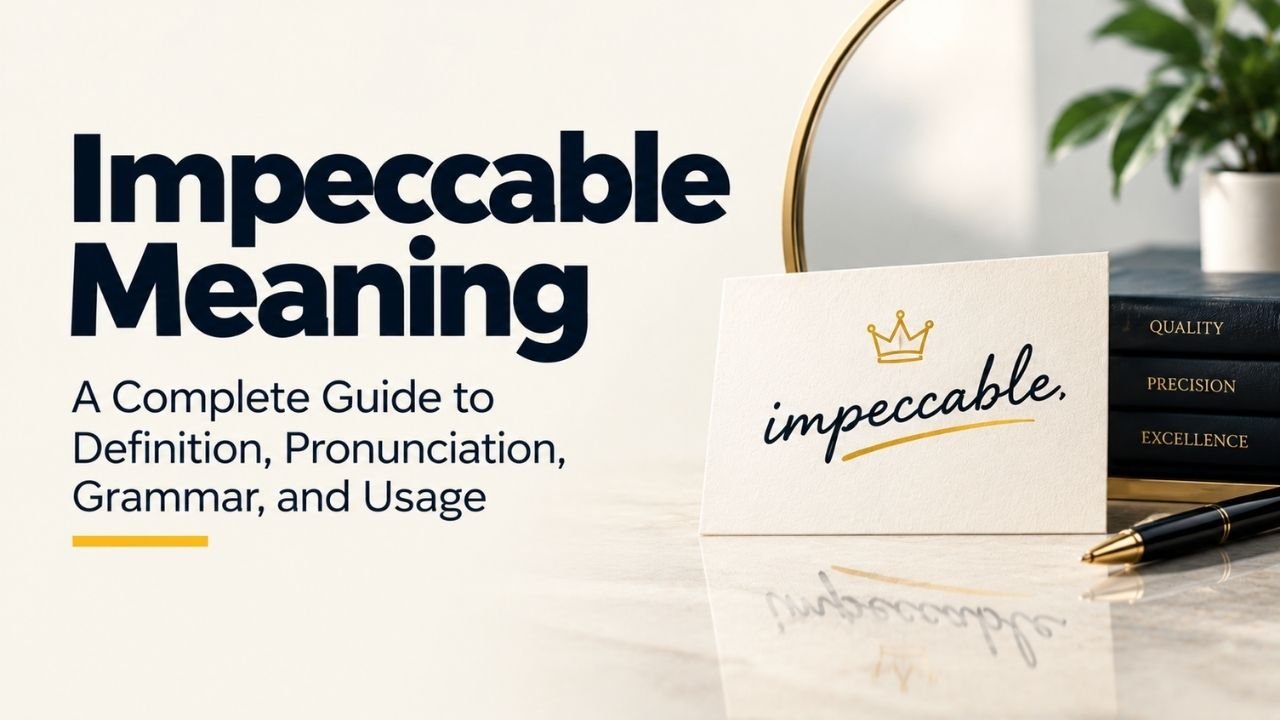
Impeccable means flawless, perfect, or without any fault at all. When something is impeccable, there is nothing wrong with it that anyone could reasonably point out. A person’s manners can be impeccable. A meal can be impeccable. A piece of writing can be impeccable. In every case, the word tells you that something has reached the highest possible standard, with no visible mistake anywhere.
This word shows up constantly in everyday English, from compliments about someone’s timing to praise for excellent service at a restaurant. It also travels well across languages, since many cultures have their own word for “flawless” or “without sin.” Understanding impeccable meaning properly will help you use the word with confidence, avoid common mistakes, and recognize it in different contexts, whether you are reading a review, a novel, or a business email.
What Does Impeccable Mean?
Impeccable is an adjective. It describes something that is completely free of faults, errors, or flaws. It can also describe a person’s character or conduct as beyond reproach, meaning nobody could accuse that person of doing anything wrong.
Here is the simplest way to think about it:
- If something is impeccable, it is perfect in the way that matters.
- If someone’s behavior is impeccable, they have done nothing that anyone could criticize.
- If a skill or performance is impeccable, it shows no visible weakness.
Dictionaries generally give two closely related senses:
- Flawless or faultless: without any error, defect, or mistake. Example: “Her grammar is impeccable.”
- Blameless or incapable of wrongdoing: morally beyond criticism. Example: “His reputation for honesty was impeccable.”
The first sense is by far the more common one in modern English. Most people use impeccable to praise quality, skill, taste, or precision rather than to talk about sin or morality, even though that moral sense is where the word originally came from.
Quick Definition Box
💡 Impeccable, in one line: So good, so accurate, or so proper that no fault can be found in it.
Impeccable Meaning in English: A Closer Look
In everyday American and British English, impeccable usually appears before a noun, describing a quality that someone or something possesses. You will most often see it paired with words like manners, taste, timing, style, service, credentials, and record.
A few natural examples:
- The waiter’s service was impeccable from start to finish.
- She has impeccable taste in interior design.
- His impeccable timing saved the entire presentation.
- The report was written in impeccable English, without a single typo.
Notice that impeccable rarely stands completely alone. English speakers tend to attach it to a specific quality (taste, manners, timing) rather than simply saying “the person is impeccable” without any further detail, although that shorter phrasing is also grammatically correct and does appear in writing.
See More: Inspo Meaning
Part of Speech and Word Forms
Impeccable is an adjective. Like most adjectives, it has related forms that shift its part of speech:
| Word Form | Part of Speech | Meaning |
| Impeccable | Adjective | Without fault; flawless |
| Impeccably | Adverb | In a flawless or faultless way |
| Impeccability | Noun | The quality of being flawless |
| Impeccant | Adjective (rare) | Free from sin; blameless |
Impeccable does not have a verb form. There is no such word as “to impeccate.” If you need a verb, you would say something like “to perfect” or “to refine” instead.
Comparative and Superlative Forms
Impeccable is typically treated as an absolute adjective, similar to “perfect” or “unique.” Something is either impeccable or it is not; there are not supposed to be varying degrees of flawlessness. Because of this, careful writers avoid saying “more impeccable” or “most impeccable.”
That said, in relaxed, informal speech, people do sometimes say “more impeccable” for emphasis, much like people sometimes say “more perfect.” Formal writing and grammar guides generally recommend against this, since the word already expresses the highest possible degree on its own.
✅ Correct in formal writing: His manners were impeccable. ❌ Avoid in formal writing: His manners were more impeccable than hers. ✅ Acceptable alternative: His manners were even more consistently impeccable than hers.
How to Pronounce Impeccable
Getting the pronunciation right helps you use the word confidently in conversation.
- American English: im-PEK-uh-buhl
- British English: im-PEK-uh-buhl
- IPA (American): /ɪmˈpɛkəbəl/
- IPA (British): /ɪmˈpɛkəbl̩/
The stress falls on the second syllable, “PEK.” Many learners mistakenly stress the first syllable (“IM-peckable”), which sounds unnatural to native speakers. Practice saying it in four syllables: im, PEK, uh, buhl.
⚠️ Common mistake: Do not pronounce it as “im-PEK-uh-bul” with a long “u” sound. The last syllable is short and soft, closer to “buhl.”
Origin and Etymology of Impeccable
The word impeccable has a clear and well documented history. It comes from the Late Latin word impeccabilis, which meant “not liable to sin” or “incapable of error.” This Latin word is built from two parts:
- in-, a prefix meaning “not”
- peccare, a verb meaning “to sin” or “to make a mistake”
So the literal, original meaning of impeccable was something closer to “not able to sin” or “not able to err.” The word entered English in the 1530s, most likely by way of French, and originally carried this strong moral and religious sense, describing someone who was incapable of doing wrong.
By the early 1600s, English speakers had broadened the meaning. It grew from a strictly religious or moral term into a general word for anything flawless, whether or not sin had anything to do with it. That expanded, everyday sense is the one people use today when they praise a flawless performance, a perfect outfit, or excellent service.
This is also why the word shares a root with “peccadillo,” a small, minor fault or sin, and “peccant,” meaning sinning or guilty. All three words trace back to the same Latin root, peccare.
Impeccable Meaning in Different Contexts
The core meaning of impeccable stays the same everywhere: flawless, without fault. But the flavor of the word shifts slightly depending on what it is describing. Here are the most common contexts.
Impeccable Timing
“Your timing is impeccable” is one of the most frequent phrases built around this word. It means someone did or said something at exactly the right moment, with no delay and no mistake in judgment. This phrase can be sincere praise, or it can be lightly sarcastic when someone’s timing was actually terrible.
- Sincere: “Your timing is impeccable, we needed that answer right now.”
- Sarcastic: “Your timing is impeccable, the meeting just ended two minutes ago.”
Context and tone of voice usually make it clear which meaning is intended.
Impeccable Attention to Detail
“Your attention to detail is impeccable” praises someone’s carefulness and precision. It suggests that the person noticed small things that others would have missed, and made no errors in the process. This phrase is common in professional feedback, performance reviews, and academic praise.
Impeccable Style
“Your style is impeccable” is a compliment about someone’s fashion sense, personal presentation, or overall aesthetic choices. It suggests that everything about how the person dresses or presents themselves looks deliberate, well matched, and free of any obvious mistake.
Impeccable Service
In hospitality and customer service writing, “impeccable service” describes an experience where every part of the interaction, from greeting to farewell, went smoothly and professionally, with no complaints.
Impeccable Character or Reputation
This is the context closest to the word’s original moral meaning. “Impeccable character” or “impeccable reputation” describes someone whose honesty, integrity, and behavior cannot reasonably be questioned.
“You Are Impeccable” Meaning
When someone says “you are impeccable,” they usually mean the listener’s overall presentation, behavior, or performance in that moment was flawless. This phrasing treats the person as a whole rather than pointing to one specific trait like timing or taste. It is a broad, warm compliment, often used after someone has done something impressively well or looked especially polished.
Grammar of Impeccable
Impeccable follows the normal rules for English adjectives.
Sentence Structure
Impeccable can appear in two main positions:
- Attributive position, directly before a noun:
- “She wore an impeccable suit.”
- Predicative position, after a linking verb like “is,” “was,” “seems,” or “looks”:
- “Her suit was impeccable.”
Both positions are correct. The attributive position tends to sound slightly more formal or descriptive, while the predicative position often reads as a direct evaluation or compliment.
What Impeccable Usually Modifies
Impeccable typically modifies nouns related to quality, behavior, or performance, rather than physical objects with no abstract quality attached. It is far more natural to say “impeccable manners” than “impeccable chair,” because manners involve a standard of correctness, while a chair does not carry the same kind of quality judgment.
Common nouns paired with impeccable include:
- Manners
- Taste
- Timing
- Style
- Service
- Reputation
- Character
- Credentials
- English (or another language)
- Grammar
- Record
- Judgment
Using Impeccable With “With”
A well known phrase, “impeccable with your word,” comes from certain self-help and philosophy writing, most famously The Four Agreements by Don Miguel Ruiz. Here, “impeccable with your word” means speaking only with integrity, avoiding gossip, lies, or careless promises. This usage extends the moral sense of the word: being impeccable with your word means never using speech to harm yourself or others.
Impeccable Meaning and Sentence Examples
Seeing the word in full sentences makes the meaning click faster than any definition alone.
- The chef’s plating was impeccable, with every element placed perfectly.
- He answered every interview question with impeccable confidence.
- The lawyer built an impeccable case, leaving no room for doubt.
- Their hospitality was impeccable, and we felt welcome the entire trip.
- The violinist gave an impeccable performance without a single wrong note.
- Despite the pressure, her composure remained impeccable throughout the trial.
Notice how each example pairs impeccable with a specific quality: plating, confidence, case, hospitality, performance, composure. This pattern is the most natural and common way to use the word.
Impeccable Person Meaning
When people describe someone as “an impeccable person,” they usually mean that this person’s behavior, values, and conduct are consistently above criticism. This is a strong compliment, suggesting years of trustworthy behavior rather than a single good moment.
It is worth noting that some style guides point out that impeccable technically describes qualities, actions, or performances more naturally than it describes a person directly, since a person is complex and made up of many qualities, not all of which can be judged as “flawless” at once. Even so, “an impeccable person” is widely understood and commonly used, especially in casual speech, to mean someone whose behavior and character seem beyond reproach.
Common Mistakes With Impeccable
Even confident English speakers sometimes misuse this word. Here are the most frequent errors.
Mistake 1: Using it with sensory verbs like taste or feel.
❌ Incorrect: The food tasted impeccable. ✅ Correct: The food was prepared with impeccable skill.
Impeccable describes a standard of correctness or quality, not a direct sensory experience. You do not usually say food “tastes impeccable,” because taste is subjective, while impeccable implies an objective absence of fault.
Mistake 2: Adding “very” before impeccable.
❌ Incorrect: Her manners were very impeccable. ✅ Correct: Her manners were impeccable.
Since impeccable already means completely flawless, adding “very” is redundant. The word does not need intensifying, because it already expresses the maximum degree.
Mistake 3: Using comparative or superlative forms in formal writing.
❌ Incorrect (formal register): This report is more impeccable than the last one. ✅ Correct: This report is impeccable, with no errors at all.
Mistake 4: Confusing impeccable with “impeachable.”
These two words look and sound somewhat similar, but they mean opposite things.
- Impeccable means flawless, beyond criticism.
- Impeachable means capable of being formally accused of wrongdoing, often used for public officials.
❌ Incorrect: The senator’s impeccable conduct led to a formal inquiry. ✅ Correct: The senator’s impeachable conduct led to a formal inquiry.
If the sentence is about a fault, an accusation, or a formal charge, “impeachable” is likely the correct word. If the sentence is about praise and flawless quality, “impeccable” is correct.
Impeccable Synonyms
Several words overlap closely with impeccable, though each carries a slightly different shade of meaning.
| Synonym | Shared Meaning | Slight Difference |
| Flawless | Without any fault | Slightly more common for physical appearance or objects |
| Faultless | Without any fault | Often used for performance, technique, or logic |
| Perfect | Complete and without fault | Broader, more general, and less formal |
| Immaculate | Completely clean or without fault | Frequently used for cleanliness or purity |
| Spotless | Free of stains or faults | More informal, often literal about cleanliness |
| Exemplary | Excellent enough to serve as a model | Focuses on setting a standard for others |
| Unblemished | Without any mark or flaw | Common for reputation or physical surfaces |
None of these words are perfect substitutes in every sentence. “Flawless skin” sounds natural, while “impeccable skin” sounds slightly unusual. Choosing the right synonym depends on the noun you are describing and the tone you want.
See More: Nebbish Meaning
Opposite of Impeccable
The opposite of impeccable describes something with visible faults, errors, or moral failings.
Common antonyms include:
- Flawed
- Imperfect
- Faulty
- Blemished
- Deficient
- Careless (for behavior)
- Sloppy (for work or presentation)
Example: “Unlike his impeccable first draft, the second version was full of careless mistakes.”
Impeccable Meaning for Kids
For a younger reader or English learner, impeccable can be explained very simply:
Impeccable means something is done so well that there is nothing wrong with it at all.
If a student turns in an impeccable homework assignment, it means every answer is correct, neat, and complete. If a friend has impeccable manners, it means they always say please and thank you, and never behave rudely.
A simple classroom example: “The gymnast’s routine was impeccable, she did not make a single mistake.”
Impeccable Meaning in Hindi
In Hindi, impeccable is commonly translated using words that express the idea of being without fault or flawless, such as निर्दोष (nirdosh, meaning faultless) or त्रुटिरहित (trutirahit, meaning error-free). It can also be rendered as बेदाग़ (bedaag), which literally means “without a stain,” used the same way English speakers use “spotless” for reputation.
Example usage: “Your style is impeccable” would be understood in Hindi as a compliment meaning the person’s dressing sense is completely flawless, with no fault to point out.
Impeccable Meaning in Urdu
In Urdu, impeccable is generally expressed as بے عیب (be-aib), meaning “without fault,” or کامل (kaamil), meaning “perfect” or “complete.” Both words carry the same core idea: something so well done that no defect can be found.
Impeccable Meaning in Bengali
In Bengali, impeccable is often rendered as নিখুঁত (nikhũto), meaning flawless or perfect, or ত্রুটিহীন (truti-hin), meaning without error. These words are used the same way in Bengali as impeccable is used in English, to praise work, manners, or performance that shows no visible mistake.
Impeccable Meaning in Marathi
In Marathi, impeccable can be translated as निर्दोष (nirdosh), meaning faultless, or त्रुटीविरहित (trutivirahit), meaning without any error. Both terms convey the same sense of complete correctness found in the English word.
Impeccable Meaning in Gujarati
In Gujarati, impeccable is typically expressed as ખામી વિનાનું (khaami vinaanu), meaning “without any flaw,” or નિર્દોષ (nirdosh), meaning faultless. As with the other Indian languages listed here, the underlying idea stays the same: total absence of fault.
Impeccable Meaning in Punjabi
In Punjabi, impeccable is commonly translated as ਬੇਦਾਗ਼ (bedaag), meaning “spotless” or “without a stain,” or ਨਿਰਦੋਸ਼ (nirdosh), meaning faultless. Both are used to praise conduct, work, or character that cannot reasonably be criticized.
Impeccable Meaning in Farsi
In Farsi (Persian), impeccable is most commonly translated as بی عیب و نقص (bi eyb o naghs), which literally means “without fault and without deficiency.” Persian dictionaries also list related words such as بیکموکاست (bi-kam-o-kaast, meaning “without anything missing or lacking”) and منزه (monazzah, meaning “pure” or “beyond reproach”), which lean closer to the word’s original moral sense of being incapable of wrongdoing.
Impeccable Meaning in Chinese
In Chinese, impeccable is generally translated as 完美无缺 (wánměi wúquē), meaning “perfect and without any lack,” or 无瑕疵的 (wú xiácī de), meaning “without blemish or flaw.” Chinese-English dictionaries also list 无可挑剔 (wúkě tiāotī), meaning “nothing can be picked at or criticized,” which captures the everyday, complimentary use of impeccable extremely well.
Impeccable Meaning in Tagalog
In Tagalog, impeccable is often expressed as walang kapintasan, meaning “without any flaw,” or walang kamalian, meaning “without any mistake.” Both phrases directly mirror the English meaning of complete flawlessness.
Impeccable Meaning in Swahili
In Swahili, impeccable is generally rendered using phrases such as bila dosari, meaning “without a flaw,” or kamili kabisa, meaning “completely perfect.” These phrases are used the same way impeccable is used in English, to describe work, conduct, or presentation that has reached a flawless standard.
Impeccable Meaning Across Languages: Quick Comparison
| Language | Common Translation | Literal Sense |
| Hindi | निर्दोष / त्रुटिरहित | Faultless / error-free |
| Urdu | بے عیب | Without fault |
| Bengali | নিখুঁত | Flawless |
| Marathi | निर्दोष | Faultless |
| Gujarati | ખામી વિનાનું | Without flaw |
| Punjabi | ਬੇਦਾਗ਼ | Spotless / without stain |
| Farsi | بی عیب و نقص | Without fault and deficiency |
| Chinese | 完美无缺 | Perfect, without any lack |
| Tagalog | walang kapintasan | Without flaw |
| Swahili | bila dosari | Without a flaw |
Across every one of these languages, the underlying concept stays remarkably consistent: something so correct, complete, or well done that no error can be found in it.
Impeccable Meaning in a Sentence: Practice Examples
Reading the word in varied sentence types helps lock in its usage.
- Statement: The architect’s design was impeccable, blending function and beauty perfectly.
- Question: How does she manage to keep such impeccable handwriting?
- Compliment: Your attention to detail is impeccable, I did not notice a single error.
- Negative form: His usually impeccable manners slipped for just a moment at the dinner.
- Comparison: Unlike the rushed first attempt, the final version was impeccable.
See More: Convo Meaning
Frequently Asked Questions About Impeccable Meaning
What does impeccable mean?
Impeccable means completely without fault, flaw, or error. It describes something or someone that has reached the highest standard, with nothing left to criticize.
Is impeccable a noun or an adjective?
Impeccable is an adjective. It describes a quality of a noun, such as manners, taste, or timing. The related noun form is impeccability, and the related adverb form is impeccably.
How do you pronounce impeccable?
It is pronounced im-PEK-uh-buhl, with the stress on the second syllable. In IPA, this is written as /ɪmˈpɛkəbəl/.
What does “your timing is impeccable” mean?
It means someone did or said something at exactly the right moment, with perfect judgment about when to act. Depending on tone, it can be sincere praise or gentle sarcasm.
What does “your attention to detail is impeccable” mean?
It is a compliment that praises someone’s precision and carefulness, suggesting they caught small things that others might have missed and made no visible errors.
What is the opposite of impeccable?
Common opposites include flawed, imperfect, faulty, and sloppy. These words all point toward the presence of visible mistakes, which is the exact opposite of what impeccable describes.
What is the difference between impeccable and perfect?
Both words describe something without fault, but impeccable is slightly more formal and is used especially often for manners, taste, timing, and conduct. Perfect is broader and can describe almost anything, including physical objects, situations, or even weather.
Where does the word impeccable come from?
Impeccable comes from the Late Latin word impeccabilis, formed from “in-” (not) and “peccare” (to sin). It originally meant “incapable of sin” before broadening to its modern sense of “flawless” by the early 1600s.
Can impeccable describe a person directly?
Yes, informally. People commonly say “she is impeccable” or “you are impeccable.” However, many style guides note that impeccable more naturally describes a specific quality, such as someone’s manners or taste, rather than the whole person at once.
Is it correct to say “very impeccable”?
No. Since impeccable already means completely without fault, adding “very” is unnecessary and considered redundant in careful writing.
Conclusion
Impeccable means flawless, faultless, and beyond criticism, whether describing a person’s manners, a flawless performance, or a piece of writing with no visible mistake. The word traces back to a Latin root meaning “incapable of sin,” and while that moral sense still survives in phrases about character and reputation, most modern usage focuses on quality, precision, and correctness in everyday situations like style, service, and timing.
Once you understand the grammar rules around impeccable, including its common pairings with words like manners, taste, and timing, and once you know the small mistakes to avoid, such as adding “very” or confusing it with “impeachable,” you can use this word naturally and confidently in both speech and writing. Whether you encounter impeccable meaning in Hindi, Farsi, Chinese, or any other language, the underlying idea remains the same everywhere: something so well done that nothing about it can be faulted.

Hassan Ibrahim is the author behind Mean Fixer, with 4 years of experience researching and writing about names, words, slang, meanings, and everyday language. Their goal is to make confusing words and meanings simple, clear, and easy to understand through accurate, useful, and reader-friendly explanations.