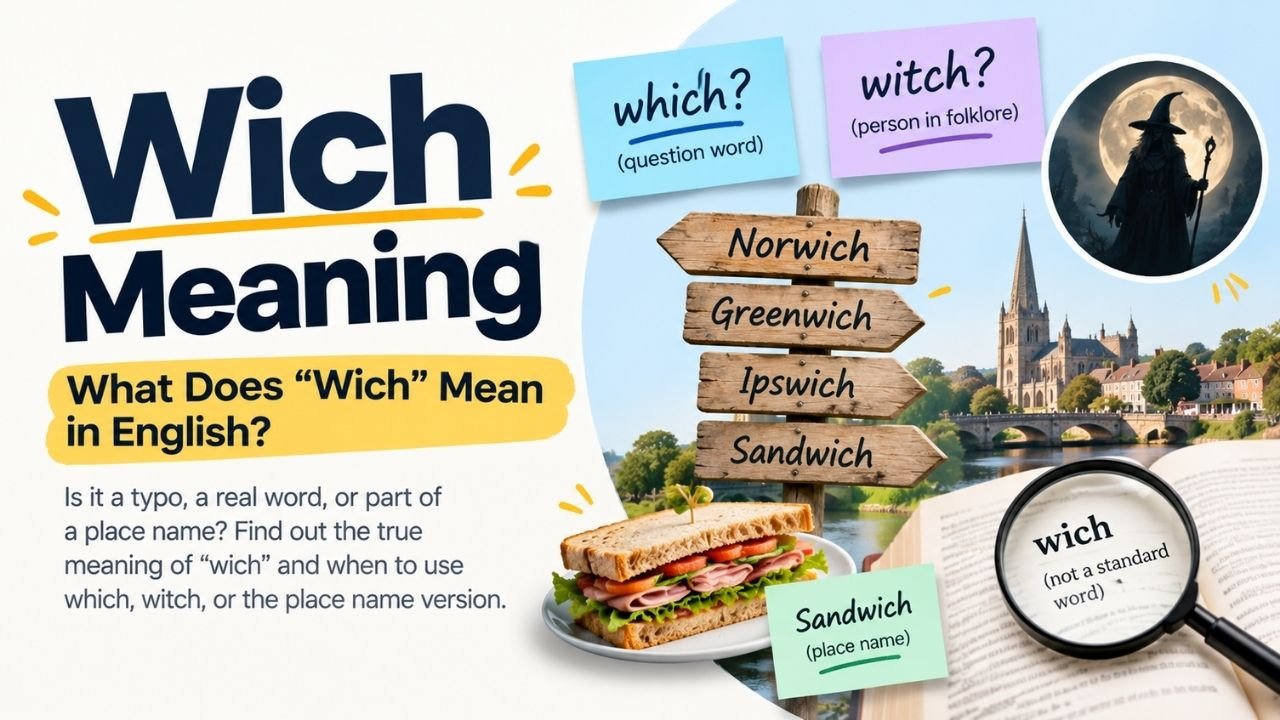
“Wich” is not a standard English word on its own. Most of the time, it is a misspelling of “which” (the question word) or “witch” (a person in folklore). It also appears as an ending in place names such as Norwich, Greenwich, and Sandwich.
So the right meaning depends on where you saw it. If it stands alone in a sentence, it is almost certainly a typo. If it sits at the end of a longer word, it comes from an old word for a settlement, trading place, or salt works.
Many people search for this word after seeing it in a text message, a username, a song title, or a place name. Others type it by accident when they mean “which.” This guide covers every common case, along with pronunciation, origin, examples, and translations. Read the section that matches what you saw.
Quick Answer: What Does Wich Mean?
| Where you saw it | What it usually means |
| Alone in a sentence | A typo for “which” or “witch” |
| At the end of a place name (Norwich) | An old English word for a settlement or trading place |
| In Cheshire towns (Nantwich, Middlewich) | Linked to salt springs and salt making |
| In “sandwich” | Part of a town name, not a separate word |
| In older English texts | An old spelling of “which” |
💡 Tip: Check the words around “wich.” If it replaces a question word or the word “witch,” it is a spelling error.
Is “Wich” a Real Word?
Not in modern standard English. General dictionaries list “which” and “witch” as headwords, and “wich” is treated as a misspelling. You can confirm this by searching Collins, Merriam-Webster, or Oxford directly.
People still type it for three common reasons:
- Sound: “Which” and “witch” are pronounced the same in most American speech. Spelling by ear leads to “wich.”
- Fast typing: The letter “h” is easy to drop on a phone.
- Place names: People see “wich” in names like Greenwich and think it is a word.
Wich as a Misspelling of “Which”
“Which” is a question word and a relative pronoun. It asks for a choice or points to a specific thing. This is the most common reason people type “wich.”
| Use | Example |
| Asking a question | Which road should we take? |
| Adding extra information | The book, which I bought last week, is great. |
| Choosing between options | Tell me which one you want. |
❌ Incorrect: Wich one do you like?
✅ Correct: Which one do you like?
The phrase “which one” simply asks someone to pick from a group. That is why “which one meaning” is a common search.
See More: ICL Meaning Slang
Wich as a Misspelling of “Witch”
“Witch” is a noun. It usually means a woman in folklore or fairy tales who has magical powers. The word is also used in religion and modern spiritual practice, where it can refer to practitioners of witchcraft.
❌ Incorrect: The wich flew over the village.
✅ Correct: The witch flew over the village.
Which vs. Witch
These two words sound alike but have different jobs.
| Word | Part of speech | Meaning | Example |
| Which | Pronoun or determiner | Asks or points to a choice | Which bag is yours? |
| Witch | Noun | A person with magical powers in folklore | The witch stirred the pot. |
Words that sound the same but are spelled differently are called homophones. “Which” and “witch” are a classic pair. Some speakers pronounce “which” with a slight breathy start, but most Americans say both words the same way.
Wich as an Ending in Place Names
This is the only case where “wich” has a real historical meaning. You see it in:
- Norwich
- Greenwich
- Ipswich
- Sandwich
- Nantwich
- Middlewich
- Northwich
The ending usually goes back to an Old English word, wīc. Reference works describe it as meaning a dwelling, a farm, or a place where trade or a special activity happened. Over time it often became a “town” or “trading place” ending. The exact origin of each name can differ, so check a place name dictionary for any one town.
Wich and Salt
Some Cheshire towns, including Nantwich, Middlewich, and Northwich, are known as “the wiches.” They sit near brine springs, and salt was made there for centuries. Because of this, “wich” in these towns is linked with salt making and salt works.
Historians and linguists do not fully agree on how the older meaning connects to salt. Some sources treat the salt meaning as a local development of the same old word. That is why a search for “wich meaning salt” leads here.
The Word “Sandwich”
“Sandwich” is named after the Earl of Sandwich, a title taken from the town of Sandwich in Kent, England. The common story says the 4th Earl, John Montagu, popularized eating meat between slices of bread. So “wich” in “sandwich” is just part of a place name. It is not a separate word for bread or food.
See More: GBTS Meaning in Text
Wich in Older English
In Middle English, spelling was not fixed. “Wich” appeared in some old texts as a spelling of “which.” You may also find similar forms for “witch.” Old books and manuscripts can look odd because of this, and it is a spelling difference rather than a new word.
If you are reading an old text and see “wich,” the sentence usually makes clear whether it means “which” or “witch.”
How to Pronounce Wich and Related Words
If you mean “which” or “witch,” the pronunciation is the same.
- Simple sound: “witch”
- IPA: /wɪtʃ/
Place names are trickier because the “w” is often silent or softened.
| Place name | Common pronunciation | Note |
| Greenwich | GREN itch (UK), GREEN wich (also heard in the US) | The UK form is the standard one for the London borough |
| Norwich | NOR itch (UK) | Many Americans say NOR wich |
| Ipswich | IP swich | Often said as IP sitch |
| Sandwich | SAND wich or SAN wich | The Kent town is usually SAND wich |
| Nantwich | NANT wich | The “w” is pronounced |
⚠️ Common mistake: Do not assume every “wich” ending sounds the same. Local pronunciation often drops sounds.
Examples of Wich in a Sentence
Because “wich” is mostly a typo, examples are best shown as corrections and place name uses.
| Situation | Sentence |
| Fixing a typo | Which seat is mine? |
| Fixing a typo | The witch in the story was kind. |
| Place name | We visited Greenwich on our trip to London. |
| Place name | Norwich is a city in eastern England. |
Wich Meaning in Other Languages
Since “wich” is not a standard English word, translation sites usually translate “which” instead. Here are the common translations people look for. Spellings in other scripts may vary by dialect.
| Language | “Which” | Pronunciation guide |
| Hindi | कौन सा | kaun sa |
| Urdu | کون سا | kaun sa |
| Bengali | কোনটি | konti |
| Tamil | எது | edhu |
| Telugu | ఏది | edi |
| Malayalam | ഏത് | eth |
| Kannada | ಯಾವುದು | yaavudu |
| Marathi | कोणता | konta |
| Punjabi | ਕਿਹੜਾ | kihda |
| German | welche, welcher, welches | VEL-kheh |
For “witch,” the Hindi word is often chudail (चुड़ैल) or daayan (डायन). In Urdu, chudail (چڑیل) is common. Words for “witch” can carry different cultural meanings in different regions.
Similar Words That Cause Confusion
Some searches that include “wich” are really about other words. These are real words with different meanings.
| Word | Meaning | Note |
| Wichita | A city in Kansas, also the name of a Native American people | Pronounced WICH ih taw |
| Wichtig | German for “important” | Pronounced roughly VIKH tikh |
| Wicht | A German word for a small creature, fellow, or wretch | Context decides the tone |
| Wichen | A German verb form of “weichen,” meaning to give way | Not related to English “wich” |
| Wiches | Usually a typo for “witches” | Or a plural of the place ending |
Wichita Lineman Meaning
“Wichita Lineman” is a 1968 song written by Jimmy Webb and recorded by Glen Campbell. It describes a worker who repairs telephone lines. While he works, he thinks about the person he misses. The song is often read as a quiet story about loneliness and longing. I won’t quote the lyrics here because they are protected by copyright.
Common Mistakes with Wich
- ❌ Using “wich” to ask a question: Wich is better?
✅ Which is better? - ❌ Writing “wich” for the folklore character: The wich cast a spell.
✅ The witch cast a spell. - ❌ Spelling the food as “sandwhich” or “sanwich.”
✅ Sandwich - ❌ Writing “wich is wich” when you mean a choice: Wich is wich?
✅ Which is which?
“Which is which” is a real phrase. It means being able to tell two similar things apart, as in: The twins look alike, so I can’t tell which is which.
Spelling Tips to Avoid the Mistake
- Think of the “h.” In “which,” the “h” follows the “w,” just like in “what,” “when,” and “where.” These are all question words.
- Link “witch” to “itch.” If you mean the folklore figure, the ending “itch” is a helpful clue.
- Proofread on a phone. Autocorrect can miss “wich” because it looks like a name or a place.
See More: BFFR Meaning
Frequently Asked Questions
What does wich mean?
Usually nothing on its own. It is a common misspelling of “which” or “witch.” It is also an ending in place names such as Norwich and Greenwich.
Is wich a word in the dictionary?
Not as a regular English word. Standard dictionaries list “which” and “witch.” The ending appears in place names, which may be covered by name references.
What does wich mean in Hindi or Urdu?
There is no direct translation because “wich” is not a standard word. If you meant “which,” it is kaun sa in both Hindi and Urdu.
What does wich mean in salt towns?
In some Cheshire towns, “wich” is linked with brine springs and salt making. Experts differ on the exact history, so treat it as a local use of an old word.
Is wich the same as witch?
No. “Wich” is a spelling error. “Witch” is the correct noun for a person in folklore who has magical powers.
How do you pronounce wich?
If you mean “which” or “witch,” say /wɪtʃ/. In place names, the “w” is often silent or softened, as in Greenwich and Norwich.
What is the difference between “which” and “witch”?
“Which” is a question word and pronoun. “Witch” is a noun for a magical person in stories. They sound alike but are used differently.
Does wich mean anything in slang?
There is no widely accepted slang meaning for “wich.” In texts and usernames, it is usually just a misspelling.
Conclusion
“Wich” is not a standard English word. Most of the time, it is a typo for “which” or “witch.” It also appears at the end of place names, where it comes from an old English word for a settlement or trading place, and in some Cheshire towns it is tied to salt making.
The easiest way to understand any “wich” you see is to look at where it appears. If it is in a sentence, fix the spelling. If it is in a town name, you are looking at a piece of English history. Keep that in mind, and the wich meaning will rarely confuse you again.

Hassan Ibrahim is the author behind Mean Fixer, with 4 years of experience researching and writing about names, words, slang, meanings, and everyday language. Their goal is to make confusing words and meanings simple, clear, and easy to understand through accurate, useful, and reader-friendly explanations.