
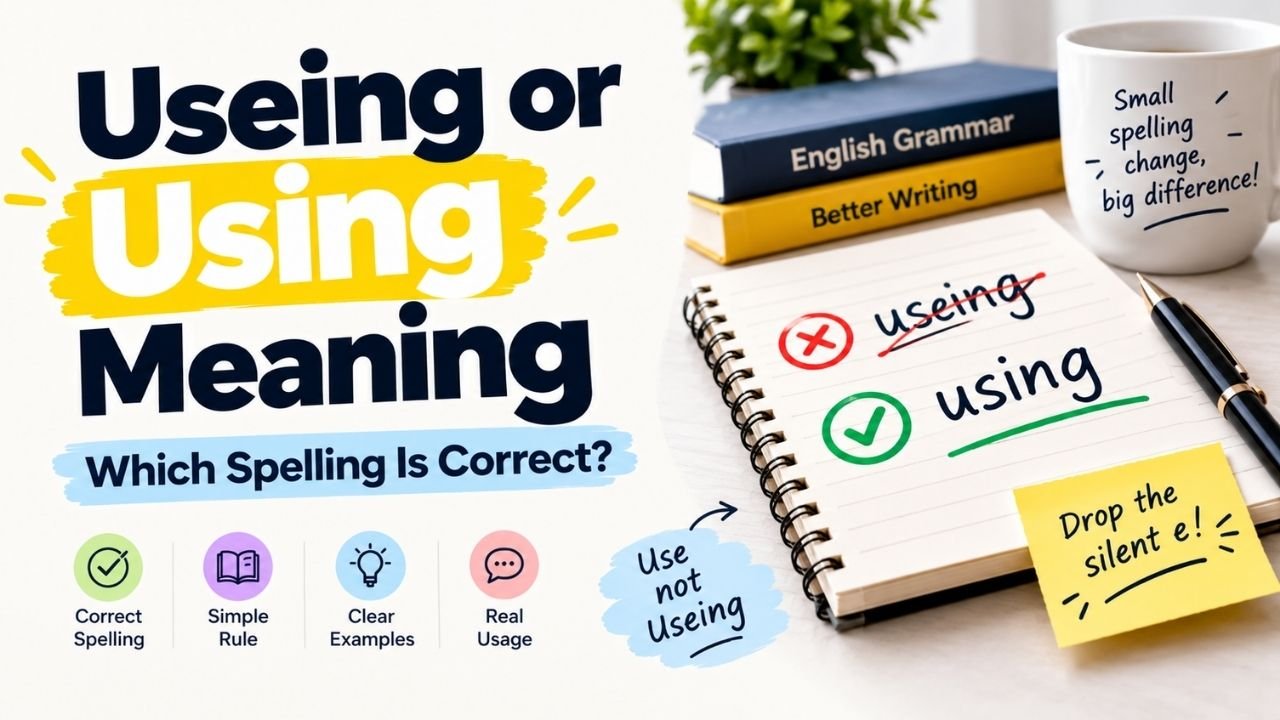
“Using” is the correct spelling. “Useing” is a common misspelling and is not a standard English word. “Using” is the present participle of the verb “use,” and it means employing something for a purpose.
The mix-up happens because “use” ends in a silent e, and many people forget to drop it before adding ing. English has a simple rule for this. If you know it, you will spell “using,” “making,” “writing,” and “taking” correctly every time.
What Does “Using” Mean?
Using means employing, applying, or making use of something to get a result. It is the ing form of the verb “use.”
Here are its main meanings:
- Employing something for a purpose. “She is using a pencil to sketch the plan.”
- Consuming or spending something. “We are using too much water.”
- Taking unfair advantage of someone. “He felt his friend was only using him.”
- Taking drugs regularly. This is a less common sense, as in “He admitted he was still using.”
Most of the time, the first meaning is the one you need.
Useing or Using: Which Is Correct?
✅ Correct: using
❌ Incorrect: useing
The rule is simple. When a word ends in a silent e, drop the e before adding ing.
| Base verb | Correct ing form | Incorrect form |
| use | using | useing |
| make | making | makeing |
| write | writing | writeing |
| take | taking | takeing |
| have | having | haveing |
💡 Tip: If you are unsure, say the word aloud. “Using” has no separate “e” sound, so the spelling has no “e” either.
See More: HG Meaning Text
When You Keep the Silent E
A few words keep the e before ing. This helps avoid confusion or keeps the sound right.
- be becomes being
- see becomes seeing
- agree becomes agreeing
- dye becomes dyeing, which keeps it different from “dying”
- singe becomes singeing, which keeps it different from “singing”
“Use” does not belong to this group. It always becomes “using.”
“Using” Grammar: Part of Speech and Word Forms
“Using” is a verb form. It works in a few different ways in a sentence.
As a present participle, it shows an action in progress.
“They are using the new software.”
As a gerund, it acts like a noun.
“Using a map makes the trip easier.”
As an introduction to a phrase, it explains how something was done.
“Using a simple test, the team found the error.”
All Forms of the Verb “Use”
| Form | Word | Example |
| Base form | use | I use a laptop for work. |
| Third person singular | uses | She uses it every day. |
| Present participle | using | He is using it now. |
| Past tense | used | We used it yesterday. |
| Past participle | used | It has been used before. |
💡 Tip: The noun “use” is pronounced differently from the verb. More on that below.
How to Use “Using” in a Sentence
Here are a few natural examples.
- “I am using my phone to check the weather.”
- “Using fresh herbs makes the dish taste better.”
- “She wrote the report using only official data.”
⚠️ Watch for dangling phrases. The doer of the action must be clear.
❌ Using a hammer, the nail went into the wall.
✅ Using a hammer, he drove the nail into the wall.
In the first sentence, the nail seems to be using the hammer. In the second, “he” is clearly the one doing it.
See More: What Does Chuzz Mean?
“Using” Meaning in Hindi, Tamil, and Urdu
Many readers search for the meaning of “using” in their own language. These are the closest everyday equivalents.
| Language | Meaning of “using” | Pronunciation guide |
| Hindi | इस्तेमाल करना, उपयोग करना | istemaal karna, upyog karna |
| Tamil | பயன்படுத்துதல் | payanpaduthuthal |
| Urdu | استعمال کرنا | istemaal karna |
Exact wording changes with the sentence. “I am using a phone” and “He is using me” would be translated differently, because the second one carries the sense of exploitation.
How to Pronounce “Using” and “Use”
“Using” is pronounced YOO zing. The IPA is /ˈjuːzɪŋ/. American and British speakers say it almost the same way.
The word “use” has two pronunciations, depending on its role.
| Word | Part of speech | Pronunciation | Sounds like |
| use (verb) | Verb | /juːz/ | yooz |
| use (noun) | Noun | /juːs/ | yoose |
The verb ends with a “z” sound. The noun ends with an “s” sound. “Using” always follows the verb, so it keeps the “z” sound.
Origin of “Use”
The word “use” came into English during the Middle English period. It came from Old French, which took it from the Latin verb uti, meaning “to use.” The form “using” developed naturally by adding the ing ending to “use.”
The silent e in “use” is a spelling feature, not a sound. That is why it drops away when ing is added.
Synonyms for “Using”
These words are close in meaning, but they are not always interchangeable.
| Word | Meaning | How it differs |
| Employing | Putting something to work | Slightly formal |
| Applying | Putting a method or tool into action | Common with ideas or rules |
| Utilizing | Making practical use of something | More formal than “using” |
| Operating | Running a machine or system | Used with equipment |
| Exercising | Putting a skill or right into action | Used with rights or abilities |
| Consuming | Using up a resource | Suggests the supply is reduced |
Use vs Utilize: What Is the Difference?
“Use” is the everyday word. “Utilize” is a more formal word that often suggests making practical use of something, sometimes in a way it was not first meant for.
- “We use email every day.” (simple and natural)
- “The team utilized leftover materials to build the stage.” (practical, resourceful use)
Many style guides recommend choosing “use” when both words fit. It is shorter and clearer. “Utilize” works best when you want to stress that something was put to good, practical purpose.
Utilising or Utilizing: Which Is Correct?
Both can be correct, but they belong to different spelling styles. American English uses utilizing. British English often uses utilising, though some British publishers also accept the ize spelling.
Since this article targets American readers, “utilizing” is the standard choice.
When to Use ise or ize
Most verbs of this type take ize in American English: organize, recognize, realize, and utilize. A small group of words ends in ise in both American and British English, because the ending is part of the word itself.
- advise
- revise
- surprise
- supervise
- exercise
- improvise
💡 Tip: If you write for a US audience, choose ize for verbs like “utilize,” but keep ise in the words listed above.
Usage vs Use: What Is the Difference?
These two words overlap, but they are not the same.
“Use” refers to the act of using something, or to a purpose.
“The use of a calculator is allowed.”
“Usage” usually refers to the way something is used over time, or to the way words are used in a language.
“Data usage went up this month.” “That word has a formal usage.”
| Word | Common meaning | Example |
| use | An act of using; a purpose | “This tool has many uses.” |
| usage | How something is used, or how a word is normally used | “Check the usage notes in a dictionary.” |
Usage or Usages?
“Usage” is most often uncountable, so it does not take a plural. You say “water usage,” not “water usages.” The plural “usages” appears when you discuss several distinct patterns or customs, especially in language. For example: “The dictionary lists three usages of the word.”
When to Use “Usage”
Choose “usage” when you mean:
- the amount of something consumed, like electricity usage
- the accepted way words are used, like English usage
- an established custom or habit
If you simply mean “the act of using,” “use” is usually the better choice.
Common Mistakes With “Using”
Mistake 1: Keeping the silent e
❌ I am useing a new app.
✅ I am using a new app.
Mistake 2: Writing “usage” when “use” is clearer
❌ The usage of seat belts is required.
✅ The use of seat belts is required.
Mistake 3: Writing “use to” instead of “used to”
❌ I use to walk to school.
✅ I used to walk to school.
In questions and negatives, “use to” is correct: “Did you use to live here?” The d returns when the sentence is positive.
Mistake 4: Dangling phrases
❌ Using this method, the results improved.
✅ Using this method, we improved the results.
See More: DPWM Meaning In Text
Frequently Asked Questions
Is it useing or using?
“Using” is correct. “Useing” is a misspelling. Drop the silent e from “use” before adding ing.
What does using mean?
“Using” means employing or applying something to get a result. It can also mean consuming a resource or taking advantage of a person.
Is using a noun or a verb?
“Using” is a verb form. When it acts as a gerund, it can work like a noun, as in “Using a map is helpful.”
How do you pronounce using?
It is pronounced YOO zing. The IPA is /ˈjuːzɪŋ/.
What is the difference between use and utilize?
“Use” is the simple, everyday word. “Utilize” is more formal and often stresses practical or resourceful use. In most cases, “use” is the better choice.
Is it utilising or utilizing?
“Utilizing” is standard in American English. “Utilising” is common in British English.
Is it usage or usages?
“Usage” is usually uncountable. “Usages” appears when you discuss several different patterns of use, mostly in language.
Why do the noun and verb “use” sound different?
English often separates a noun and a verb of the same spelling by sound. The noun ends in an “s” sound, and the verb ends in a “z” sound.
Conclusion
“Using” is the correct spelling, and “useing” is simply a spelling error. The word is the ing form of the verb “use,” and it follows the rule of dropping the silent e. Its main meaning is employing something for a purpose, and it can also mean consuming a resource or taking advantage of someone.
When you are unsure, check three things. Drop the e from “use,” choose “use” over “utilize” for simple writing, and pick “usage” only when you mean how something is used over time. With those habits, you will never need to wonder about the useing or using meaning again.

Hassan Ibrahim is the author behind Mean Fixer, with 4 years of experience researching and writing about names, words, slang, meanings, and everyday language. Their goal is to make confusing words and meanings simple, clear, and easy to understand through accurate, useful, and reader-friendly explanations.
One Comment