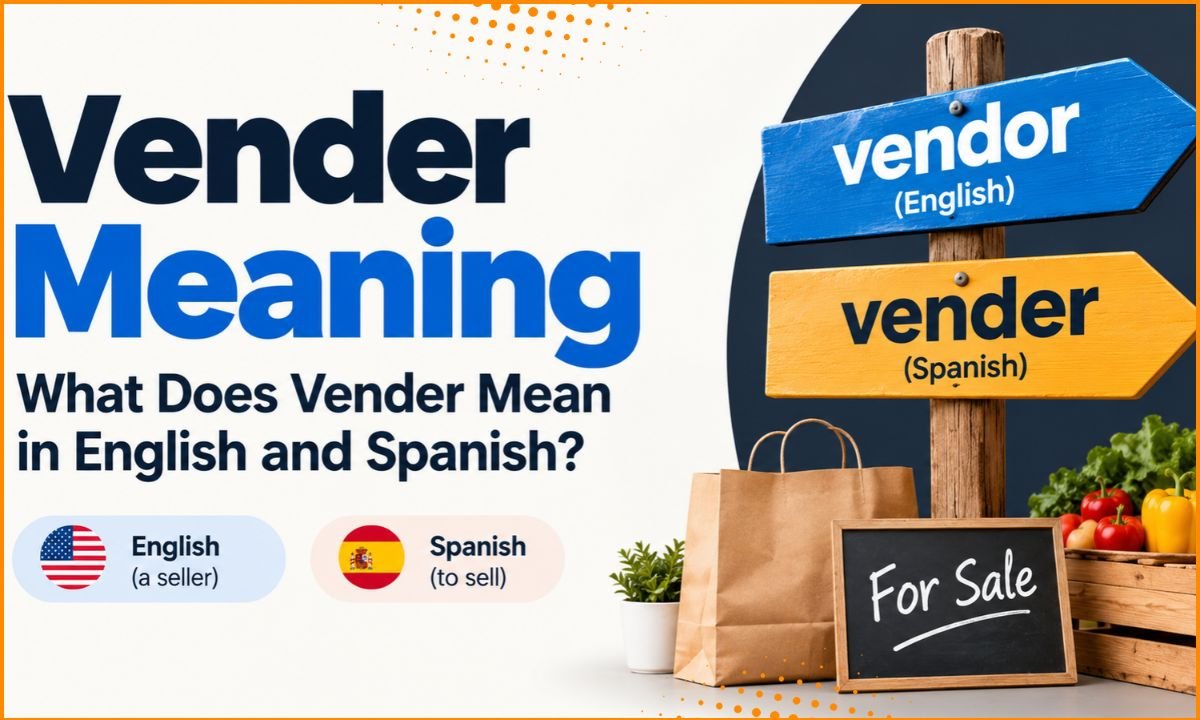
Vender has two main meanings, depending on the language. In English, it is a less common spelling of “vendor,” a person or business that sells goods or services. In Spanish, “vender” is a verb that means “to sell.”
Many readers search this word after seeing it on a form, a sign, or in a Spanish sentence. The two meanings are related but not interchangeable. This guide explains both, shows how to use them, and clears up the most common confusion between “vender” and “vendor.”
Quick Answer: Vender Meaning at a Glance
| Language | Word | Meaning | Example |
| English | vender | A seller (variant spelling of vendor) | The vender set up a stall near the gate. |
| English | vendor | A seller, supplier, or business that sells | We pay each vendor monthly. |
| Spanish | vender | To sell (verb) | Quiero vender mi coche. |
💡 Tip: In English, use “vendor” unless you have a reason to match another writer’s spelling. It is the standard form in the United States.
What Does Vender Mean in English?
In English, “vender” is a noun. It means a person or company that sells something. It is a variant spelling of “vendor,” and some major dictionaries, such as Merriam-Webster, list it that way.
Here is how it appears in real use:
- A street vender sells snacks or goods from a cart or stand.
- A food vender sells meals at a fair or market.
- A vender can also be a business that supplies products to another business.
The spelling “vender” is much rarer than “vendor” in modern American writing. Many readers will see it as a typo. If you are writing for work, school, or a website, “vendor” is the safer choice.
Is Vender a Word?
Yes. “Vender” is recorded as a variant of “vendor” in dictionaries. It is also accepted in word games. Scrabble word lists generally include it, though you should check the specific list your game uses, since rules differ by edition.
See More: Arc or Arch Meaning
Vender or Vendor: Which Spelling Is Correct?
Both forms exist, but they are not equally common. “Vendor” is the standard spelling in American English. “Vender” is a minor variant.
| Feature | Vendor | Vender |
| Status | Standard spelling | Variant spelling |
| Usage in the USA | Very common | Rare |
| Business and legal writing | Preferred | Rarely used |
| Safe to use? | Yes | Acceptable, but may look like a typo |
Why Do People Mix Them Up?
There are three common reasons:
- The two words sound almost the same when spoken.
- Many English nouns for people end in “er,” like “seller” and “buyer.”
- The Spanish verb “vender” looks identical to the English variant.
⚠️ Common mistake: Writing “vender” in a purchase order, contract, or invoice. Use “vendor” in formal business documents.
Vendor Meaning in Different Contexts
The word “vendor” appears in several settings. The core idea stays the same: someone who sells.
Street Vendor
A street vendor sells goods in public places. This can include food, drinks, flowers, or small items. They often work from a cart, stall, or truck.
Food Vendor
A food vendor sells prepared or packaged food. You often see them at fairs, stadiums, and festivals. The term can cover a single stall or a large catering business.
Business Vendor
In business, a vendor is a company that supplies goods or services to another company. For example, an office might buy printers from a vendor. A vendor name on an invoice is simply the name of the seller being paid.
VAT Vendor
“VAT vendor” is used in countries that charge value added tax. It refers to a seller who is registered to collect that tax. The exact rules depend on each country’s tax law, so check official tax authority guidance if you need details.
Legal Use
In property law, “vendor” can mean the person selling land or property. The buyer is called the “vendee.” This use is more formal and mostly appears in legal documents.
See More: Redo Meaning
Vender Meaning in Spanish
In Spanish, “vender” is a regular verb that means “to sell.” It does not mean a person who sells. For that, Spanish uses “vendedor” (male seller) or “vendedora” (female seller).
Examples in Spanish
- Quiero vender mi casa. (I want to sell my house.)
- Ella vende frutas en el mercado. (She sells fruit at the market.)
What Does “Para Vender” Mean?
“Para vender” means “to sell” or “for sale” in the sense of purpose. For example, “Tengo cosas para vender” means “I have things to sell.” For a sign that says something is for sale, Spanish often uses “Se vende.”
How to Conjugate Vender
“Vender” follows the regular pattern for verbs ending in “er.”
| Tense | Form | Meaning |
| Present (yo) | vendo | I sell |
| Present (tú) | vendes | you sell |
| Present (él, ella) | vende | he or she sells |
| Present (nosotros) | vendemos | we sell |
| Present (ellos) | venden | they sell |
| Past (yo) | vendí | I sold |
| Future (él, ella) | venderá | he or she will sell |
The word “venderá” is the future form for he, she, or you (formal). People sometimes search it as “vendera,” but the accent mark matters in correct Spanish.
Related Spanish and Italian Words
- Vendedor: a seller, the Spanish word closest to the English “vendor.”
- Vendido: sold (past participle).
- Vendere: the Italian verb for “to sell.” It comes from the same Latin root as the Spanish verb.
Vender Meaning in Other Languages
Many readers search for “vender meaning” in their own language. They are usually asking how to say “vendor” or “seller.” The table below gives common translations of the English word “vendor.”
| Language | Word | Pronunciation guide |
| Hindi | विक्रेता | vikreta |
| Urdu | بیچنے والا | bechne wala |
| Bengali | বিক্রেতা | bikreta |
| Telugu | విక్రేత | vikreta |
| Tamil | விற்பனையாளர் | virpanaiyalar |
| Nepali | बिक्रेता | bikreta |
| Arabic | بائع | baa’i’ |
| Swahili | muuzaji | muu-zah-jee |
📝 Note: Translations can vary by region and context. A native speaker or a trusted bilingual dictionary can confirm the best choice for a specific sentence.
How Do You Pronounce Vender?
The English word has two syllables. The stress falls on the first syllable.
- English (American): VEN-der, roughly /ˈvɛndər/
- Spanish: ben-DEHR, roughly /benˈdeɾ/
In Spanish, the stress falls on the last syllable. The “v” sounds close to a soft “b.”
The English words “vender” and “vendor” sound nearly identical in everyday speech. That is why the spelling is so easy to mix up.
Origin of Vender and Vendor
Both words trace back to Latin. The Latin verb “vendere” means “to sell.” Spanish and Italian kept this verb almost unchanged.
English took the word through French. Old and Anglo French forms of “vendre” gave English words like “vend” and “vendor.” Over time, the “or” ending became standard for the person who sells, while “er” remained as a rarer variant.
Vender vs. Vendetta: Are They Related?
No. “Vendetta” comes from Italian and means a long feud or a deep desire for revenge. It is not connected to the Latin root for selling. The similar letters are only a coincidence.
Similar Words and How They Differ
| Word | Meaning | Difference |
| Seller | Anyone who sells something | The most general term |
| Vendor | A seller, often in business or public settings | Common in commerce and trade |
| Merchant | A person who buys and sells goods, often at scale | Suggests regular trade as a business |
| Supplier | A source that provides goods to a business | Focuses on supplying, often to other companies |
| Retailer | A seller who sells directly to the public | Usually has a shop or online store |
| Peddler | A person who sells small goods, often traveling | Can sound old fashioned or negative |
Common Mistakes With Vender
Mistake 1: Using “vender” in formal business writing
❌ Incorrect: Please send the invoice to the vender.
✅ Correct: Please send the invoice to the vendor.
The standard spelling looks more professional and avoids confusion.
Mistake 2: Using the English noun in a Spanish sentence
❌ Incorrect: Ella es una vender de flores.
✅ Correct: Ella es una vendedora de flores.
Spanish uses “vendedora” for a female seller. “Vender” is the verb.
Mistake 3: Forgetting the accent in the Spanish future form
❌ Incorrect: Ella vendera la casa.
✅ Correct: Ella venderá la casa.
See More: Jit Meaning Slang
Frequently Asked Questions
What does vender mean?
In English, “vender” is a variant spelling of “vendor,” meaning a seller. In Spanish, it is a verb meaning “to sell.”
Is vender a word in English?
Yes. Dictionaries list it as a variant of “vendor.” It is much less common, and “vendor” is the preferred spelling.
Is vender a Scrabble word?
It is generally accepted in Scrabble word lists. Always check the official list used in your game, because lists can differ.
What is the difference between vender and vendor?
They mean the same thing in English. “Vendor” is the standard form, and “vender” is a rare variant.
What does vender mean in Spanish?
It means “to sell.” The person who sells is a “vendedor” or “vendedora.”
How do you say “to sell” in Spanish?
You say “vender.” For example, “Voy a vender mi bicicleta” means “I am going to sell my bicycle.”
Is vender a noun or a verb?
In English, it is a noun. In Spanish, it is a verb.
What is a food vendor?
A food vendor is a person or business that sells food to the public. You often see them at markets, fairs, and events.
What does vendor name mean?
A vendor name is the name of the business or person that sells to you. You often see it on invoices and purchase records.
Is vender related to vendetta?
No. “Vendetta” comes from Italian and refers to a feud. It has a different meaning and origin.
Conclusion
The vender meaning depends on the language. In English, it is a rare spelling of “vendor,” a person or business that sells. In Spanish, it is a common verb that means “to sell.” Both come from the same Latin root, but they work differently in a sentence.
For everyday English writing, choose “vendor.” It is the standard spelling and the safest option for work, school, and online content. If you are learning Spanish, remember that “vender” is the action, while “vendedor” is the person who does it.

Hassan Ibrahim is the author behind Mean Fixer, with 4 years of experience researching and writing about names, words, slang, meanings, and everyday language. Their goal is to make confusing words and meanings simple, clear, and easy to understand through accurate, useful, and reader-friendly explanations.