
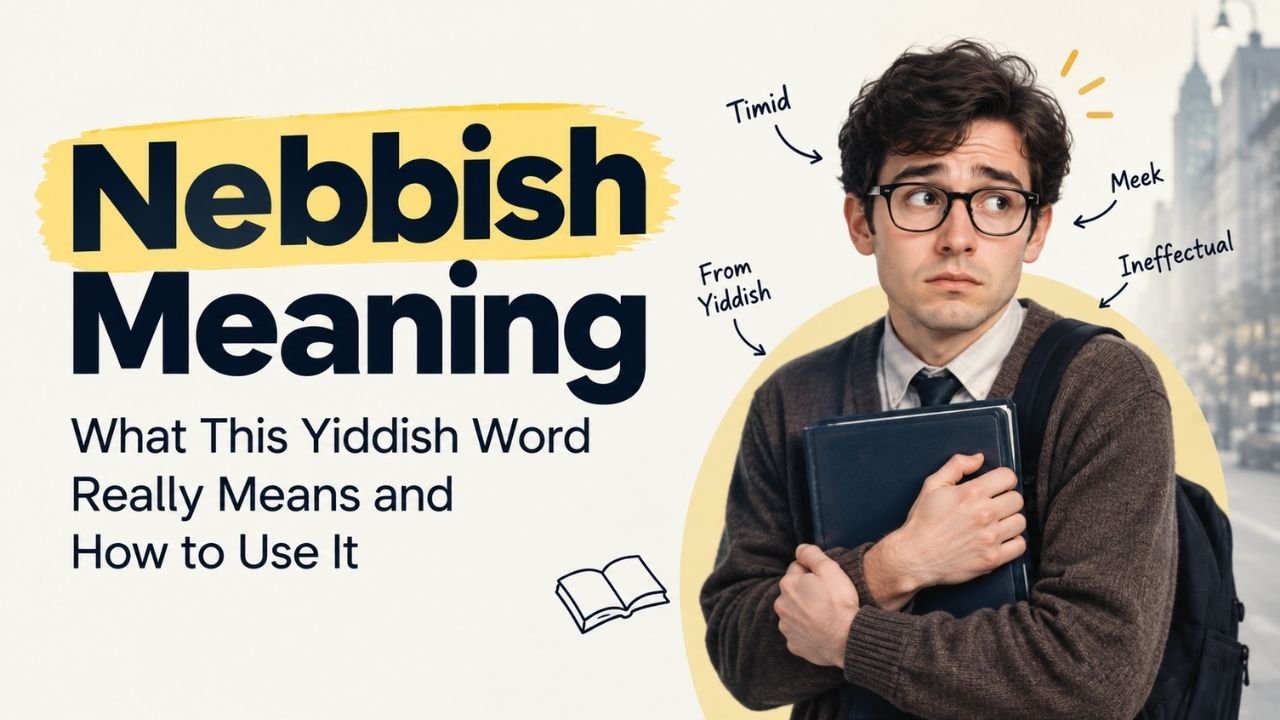
If someone calls you a nebbish, they are not paying you a compliment. The nebbish meaning centers on a timid, meek, or ineffectual person, usually someone who fades into the background rather than standing out. It is a noun borrowed from Yiddish, and English speakers have used it for over a century to describe a certain kind of harmless, unassertive character.
Understanding this word matters because it carries real cultural weight. It comes from Jewish immigrant communities in America, it shows up constantly in film and comedy, and it mixes pity with mild mockery in a way few English words do. Knowing the nebbish meaning helps you read older New York fiction, understand a joke in a sitcom, or simply use the word correctly instead of guessing at it.
What Does Nebbish Mean?
In plain English, a nebbish is a person who is:
- Timid or shy
- Socially awkward or easily overlooked
- Ineffectual, meaning not very capable of getting things done
- Someone people feel sorry for, rather than someone they admire
Merriam-Webster defines it simply as a timid, meek, or ineffectual person. Dictionary.com adds a bit more color, describing a nebbish as a pitifully ineffectual, luckless, and timid person, often a man so mild and submissive that other people feel sorry for him.
💡 Quick Tip: Think of the classic “forgettable guy in the room.” A nebbish is not cruel, not dangerous, and not particularly interesting. He is just… there, and usually struggling.
See More: What Does BB Mean In Text?
Nebbish Meaning In A Sentence
Here are two natural examples:
- “He’s such a nebbish that he apologized to the guy who stepped on his foot.”
- “The film cast a nebbish accountant as the unlikely hero.”
Both examples show the core idea: a person too passive to assert himself, even in situations that call for it.
Nebbish Meaning in English: Grammar and Part of Speech
Grammatically, nebbish is most commonly used as a noun.
| Feature | Detail |
| Part of speech | Noun (most common), rarely used as an adjective |
| Plural form | Nebbishes |
| Adjective form | Nebbishy |
| Countable? | Yes, it refers to a person |
| Typical usage | Describes a person, almost always informally |
So “nebbishes meaning” simply refers to more than one nebbish, as in: “The office was full of nebbishes who never spoke up in meetings.”
The adjective form, nebbishy, describes qualities associated with a nebbish. A film critic might write that a character is “a nebbishy dullard,” meaning he behaves in a meek, unremarkable way.
Older sources also note that nebbish first entered English as an adjective in the 1800s, meaning “harmless or ineffectual,” before the noun form became the dominant usage in the twentieth century. Today, nearly all English usage treats it as a noun.
How to Pronounce Nebbish
Pronunciation is straightforward for English speakers:
- Standard English pronunciation: NEB-ish
- IPA: /ˈnɛbɪʃ/
The stress falls on the first syllable. In the original Yiddish, the word is pronounced closer to “NEH-bikh,” with a soft guttural sound at the end (similar to the “ch” in the Scottish word “loch”). English speakers dropped that guttural sound and softened it into the “-ish” ending familiar today.
Nebbish Meaning In Yiddish: Where the Word Comes From
The nebbish meaning in Yiddish is a little different from the English meaning, and understanding that difference clears up a lot of confusion.
In Yiddish, the word is nebekh (also spelled nebech or nebich). It was originally used as an interjection, roughly meaning “you poor thing!” or “how unfortunate.” Someone might say “nebekh” the way an English speaker might say “oh no, poor guy” on hearing bad news.
Etymology Of Nebbish
According to etymological references, including Merriam-Webster and the Online Etymology Dictionary, the word traces back further than Yiddish itself:
- Yiddish nebekh meant “poor” or “unfortunate.”
- This came from a Slavic source, likely related to the Czech word nebohý, meaning “poor” or “unfortunate.”
- The deeper root breaks down as a negative prefix (“not”) plus a root connected to prosperity or being blessed, so the underlying idea is something close to “not blessed” or “luckless.”
The word entered English usage in the 1890s, first recorded as an adjective, and the noun sense was established by the early 1900s. Merriam-Webster records the first known use of the noun form in 1907.
From Interjection To Noun
This shift from “poor thing!” (an exclamation of pity) to “a poor, ineffectual person” (a label for a type of man) is a natural one in language. English speakers heard Yiddish speakers use nebekh to express sympathy so often that they assumed it described the person being pitied, and the noun sense of nebbish was born.
⚠️ Common Mistake: Some assume nebbish is simply a synonym for “Jewish person.” That is incorrect. Nebbish describes a personality type, and while the word has strong roots in Jewish American culture, it is not a term for Jewish identity itself.
Nebbish Meaning: Jewish And Cultural Context
The nebbish jewish connection is real, but it needs some care to explain accurately.
Nebbish comes directly from Yiddish, the language historically spoken by Ashkenazi Jews across Eastern Europe and later in Jewish immigrant communities in the United States. Because of this origin, the word carries strong cultural associations:
- It is almost always used to describe a man, rarely a woman.
- Writers and comedians have long used the nebbish as a recognizable character type in American Jewish humor, from Woody Allen films to sitcom characters.
- According to Jewish cultural commentary, the nebbish character has become associated with a certain stereotype of Jewish manhood in popular entertainment, even when the character in question is not explicitly identified as Jewish.
This means the word sits in a slightly sensitive space. It is not a slur, and it is used casually and often affectionately in everyday speech and comedy. But because it draws on a specific ethnic stereotype, it works best when used with some awareness of that background, rather than as a careless insult aimed at someone’s ethnicity.
Nebbish Meaning Slang: How People Use It Today
In modern slang, nebbish meaning slang usage leans casual and often comedic. People use it to describe:
- A coworker who never speaks up in meetings
- A character in a movie who is awkward, shy, and easily pushed around
- A friend who is too polite to complain, even when they should
Popular culture has kept the word alive. Comic actors such as Woody Allen and Rick Moranis are frequently cited as playing classic nebbish characters: bumbling, anxious, and unassertive, but ultimately sympathetic. This pop culture pattern is part of why the word still circulates today, even outside Jewish communities.
You will also see the term “nebbishy” used loosely online to describe a whole vibe: someone (or something) that is timid, low energy, and easy to overlook. This is an informal extension of the adjective and is not always found in dictionaries, but it fits naturally with the established meaning.
Nebbish Meaning in Hindi, Tamil, and Urdu
People often search for a direct translation of nebbish into Hindi, Tamil, or Urdu, so it is worth answering honestly.
Nebbish does not have one single, standard word-for-word equivalent in Hindi, Tamil, or Urdu, because it is a culturally specific term. It was shaped by a particular history of Yiddish speech and American Jewish humor, and that context does not map neatly onto a single word in another language.
That said, the idea behind nebbish does translate, even if the exact word does not:
| Language | Closest concept (not an exact one-word equivalent) |
| Hindi | A person described as darpok (timid) or bholabhala (simple, harmless) captures part of the feeling, though neither word carries the same humor or pity. |
| Tamil | A phrase describing someone pathinchu (fearful or shy) reflects the general timidity, without the same cultural nuance. |
| Urdu | A person called darpok or masoom (innocent, harmless) shares some overlap, but again, without the specific Jewish American cultural background. |
⚠️ Note: These are approximate, descriptive comparisons, not official dictionary translations. If you are translating nebbish for an audience, it is usually clearer to explain the meaning (“a timid, ineffectual person, often pitied rather than respected”) rather than force a single-word substitute.
See More: Ion Meaning Text
Origin of the Word: A Quick Timeline
| Period | Development |
| Pre-Yiddish | Slavic root related to Czech nebohý, meaning “poor” or “unfortunate” |
| Yiddish | Nebekh used as an interjection meaning “poor thing!” |
| 1890s | Word enters English, first as an adjective meaning “harmless or ineffectual” |
| Early 1900s | Noun form becomes established, meaning “a timid or ineffectual person” |
| Mid-1900s onward | Popularized further through American Jewish humor, comic strips, and film |
Nebbish Vs. Similar Words
English has several words that overlap with nebbish, but each carries a slightly different shade of meaning.
| Word | Meaning | How It Differs From Nebbish |
| Nebbish | A timid, meek, ineffectual person, often pitied | Carries specific Yiddish and Jewish cultural roots |
| Milquetoast | A very timid or unassertive person | Comes from a comic strip character; less tied to any specific cultural background |
| Wimp | A weak or cowardly person | More generic and often harsher in tone |
| Pushover | Someone easily persuaded or taken advantage of | Focuses on being easily controlled, not necessarily on personality overall |
| Nonentity | A person of no importance or influence | Focuses on lack of significance, not necessarily timidity |
Nebbish is unique because it blends timidity, bad luck, and a specific cultural flavor that words like “wimp” or “pushover” simply do not carry.
Common Mistakes With Nebbish
❌ Incorrect: “She’s such a nebbish for standing up to her boss.”
✅ Correct: “She’s the opposite of a nebbish; she always stands up to her boss.”
Why: Nebbish describes passive, timid behavior. Standing up to someone is the opposite of nebbish behavior, so pairing the word with an assertive action creates a contradiction.
❌ Incorrect: “That nebbish over there is clearly Jewish.”
✅ Correct: “He plays a classic nebbish character in the film.”
Why: Nebbish describes a personality type, not a person’s ethnicity or religion. Using it to label someone’s identity, rather than their behavior, misses the actual meaning of the word.
❌ Incorrect: “Nebbishes are always confident leaders.”
✅ Correct: “Nebbishes rarely take charge in group situations.”
Why: The entire meaning of the word centers on being unassertive and ineffectual, so pairing it with confidence or leadership reverses its meaning.
A Related Yiddish Word: Punim Meaning
Because punim is closely connected to Yiddish in the same way nebbish is, it is worth covering here too, especially since many readers researching Yiddish vocabulary look up both words together.
What Does Punim Mean?
Punim meaning in English is simple: it means face. It comes from Yiddish ponem, which itself comes from Hebrew panim, also meaning “face.”
- Punim meaning in Hebrew: The Hebrew root panim literally means “face,” and interestingly, it is grammatically plural in Hebrew even though it refers to a single face.
- Punim plural: In English use, the plural is simply “punims.” In Yiddish, the plural is “penimer.”
Punim Face and Everyday Usage
In everyday English-language use among Jewish communities, punim rarely appears alone. It shows up almost entirely inside one specific phrase.
Shayna Punim Meaning
“Look at that punim” on its own is uncommon. What you will actually hear is the phrase shayna punim, meaning “pretty face” or “beautiful face.” Shayn (or sheyne) is Yiddish for “pretty” or “lovely,” related to the German word schön. Put together, shayna punim is most often said affectionately, especially to a child, as in: “Come here and let me see that shayna punim.”
According to Jewish cultural sources, shayna punim can describe both a person’s literal appearance and the person themselves, so calling someone a shayna punim is a term of endearment, not just a comment on their looks.
Punim Etymology at a Glance
| Term | Meaning | Origin |
| Punim | Face | Yiddish ponem, from Hebrew panim |
| Shayna punim | Pretty face; a term of endearment | Yiddish sheyn (pretty) + punim (face) |
Unlike nebbish, punim is a neutral, affectionate word. It does not carry the mix of pity and mild mockery that nebbish does. If anything, punim (especially in “shayna punim”) leans warm and loving.
See More: FMB Meaning In Text
Frequently Asked Questions
What does nebbish mean?
Nebbish means a timid, meek, or ineffectual person, someone who is easily overlooked and often pitied rather than respected.
Is nebbish a noun or an adjective?
Nebbish is most commonly used as a noun. It has a related adjective form, nebbishy, though that is used far less often.
How do you pronounce nebbish?
It is pronounced NEB-ish, with stress on the first syllable.
Where does nebbish come from?
It comes from the Yiddish word nebekh, meaning “poor” or “unfortunate,” which itself likely comes from a Slavic root related to the Czech word nebohý.
Is nebbish an insult?
It can be mildly insulting, but it usually carries pity rather than outright hostility. It describes someone as harmless and ineffectual rather than cruel or dangerous.
Is nebbish only used to describe men?
In practice, yes. Nebbish is used almost exclusively to describe men, and there is no widely used female equivalent with the same meaning.
What is the plural of nebbish?
The plural is nebbishes.
Is nebbish a Jewish word?
Nebbish comes from Yiddish, the historical language of Ashkenazi Jewish communities, and the word carries strong cultural ties to Jewish American humor and identity, though it describes a personality type rather than a religious or ethnic identity itself.
What is the difference between nebbish and milquetoast?
Both describe timid, unassertive people, but nebbish has specific Yiddish and Jewish cultural roots, while milquetoast comes from an American comic strip character and carries no particular ethnic association.
Conclusion
The nebbish meaning comes down to one clear idea: a timid, meek, ineffectual person who is more likely to be pitied than admired. The word traveled a long road to get here, moving from a Slavic root meaning “poor” or “unfortunate,” through Yiddish as an interjection of sympathy, and finally into English as a noun describing a very specific, very human personality type. Along the way, it picked up strong ties to Jewish American culture and comedy, which is why it still shows up so often in films, sitcoms, and everyday conversation.
Whether you encountered nebbish in an old book, heard it in a comedy special, or just wanted to know if it fit someone you had in mind, you now have the full picture: what it means, how to say it, where it came from, and how to use it correctly without stumbling into common mistakes.

Hassan Ibrahim is the author behind Mean Fixer, with 4 years of experience researching and writing about names, words, slang, meanings, and everyday language. Their goal is to make confusing words and meanings simple, clear, and easy to understand through accurate, useful, and reader-friendly explanations.
One Comment