
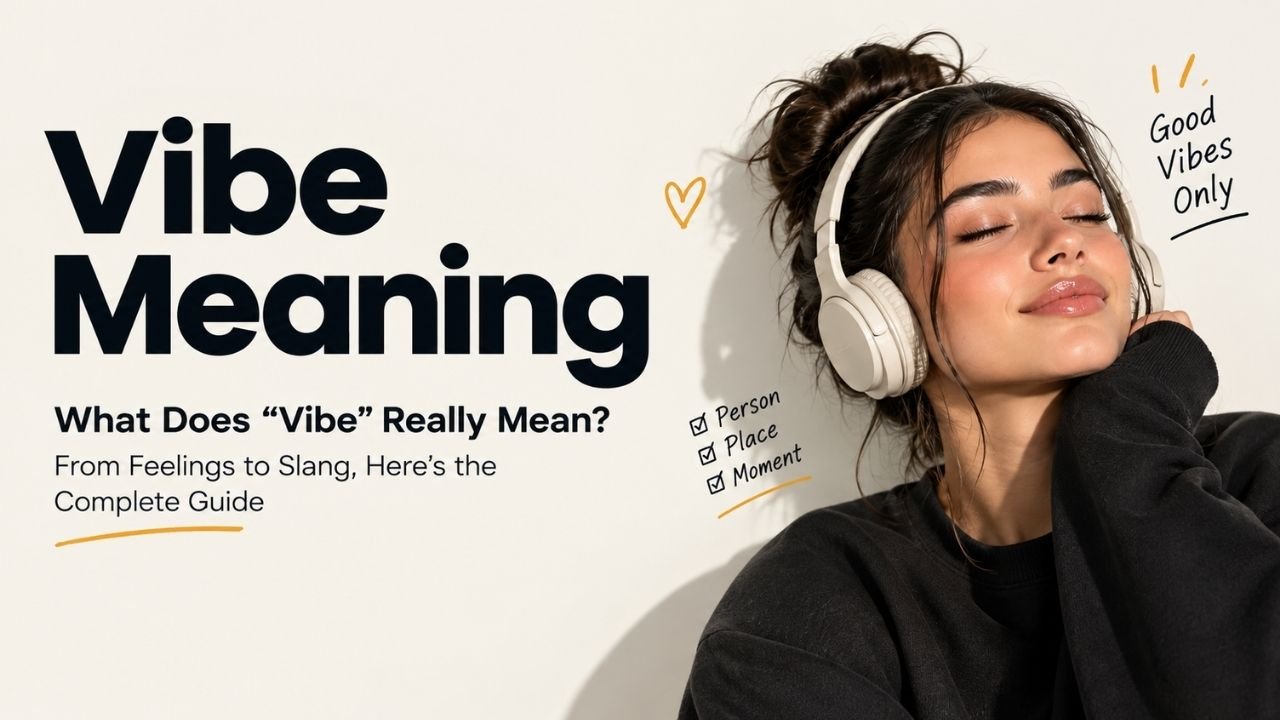
“Vibe” describes the feeling or mood you sense from a person, a place, or a moment. It is not something you can measure. It is something you feel almost instantly, often before you can explain why. When someone says a room has “good vibes,” they mean the atmosphere feels warm, easy, or welcoming.
The word started as short slang for “vibration,” but its meaning has grown far beyond that. Today it covers everything from a friend’s personality to the mood of a song, a party, or even a piece of software code. Understanding vibe meaning helps you follow modern conversation, social media captions, and everyday slang used across the United States and beyond.
What Does “Vibe” Mean in Simple Terms?
At its core, a vibe is an emotional signal. It is the general feeling something gives off.
- A person can “have a vibe,” meaning their energy or personality comes across a certain way.
- A place can “have a vibe,” meaning its atmosphere feels a certain way.
- A moment can “be a vibe,” meaning the overall feeling of that moment stands out, good or bad.
💡 Quick definition: Vibe = the feeling or mood you sense from someone or something, usually without needing words to explain it.
See More: Sincerity Meaning
Vibe: Part Of Speech And Grammar
“Vibe” works in English as both a noun and a verb.
| Form | Example | Meaning |
| Noun | “This café has a cozy vibe.” | Refers to the feeling or atmosphere. |
| Verb | “We really vibe with each other.” | Means to connect or feel in sync with someone. |
| Plural noun | “I’m getting good vibes from this place.” | Common informal plural form. |
As a verb, “vibe” is usually intransitive, meaning it does not take a direct object in the traditional sense. You “vibe with” someone or something, rather than “vibe” something directly.
Correct: “I vibe with slow music.” Also correct: “We’re just vibing tonight,” meaning relaxing and enjoying the moment.
Pronunciation
“Vibe” rhymes with “tribe” and “bribe.”
- Simple pronunciation: vyb
- IPA: /vaɪb/
- One syllable, with a long “i” sound
There is no difference in pronunciation between American and British English for this word.
Where Does “Vibe” Come From?
“Vibe” is short for “vibration.” The shortened slang form became popular in casual American English starting in the mid-20th century, especially through phrases like “good vibrations,” which described a positive feeling someone gave off.
By the 1960s, “vibes” was common slang for the emotional energy of a person, place, or situation. Over time, English speakers dropped the “s” in casual speech to form the singular “vibe,” and both “vibe” and “vibes” are now used interchangeably depending on context.
The word has stayed close to its original idea: an unspoken signal of feeling, almost like something you can sense in the air.
See More: Nebbish Meaning
Vibe Meaning In Different Contexts
The core idea of “vibe” stays the same everywhere, but the flavor changes depending on how it is used.
Good Vibe Meaning
“Good vibes” means a positive, welcoming, or uplifting feeling. People use this phrase to describe:
- A friendly conversation
- A relaxed hangout
- A place that feels safe and comfortable
- Encouraging energy sent toward someone, as in “sending good vibes your way”
A Vibe / Such a Vibe Meaning
When someone says “such a vibe” or calls something “a vibe,” they mean it perfectly captures a certain mood or feeling. This phrase usually expresses approval or enjoyment.
Example: “This playlist is such a vibe.” This means the playlist fits a specific relaxed or enjoyable mood very well.
It’s a Vibe Meaning
“It’s a vibe” is a casual way of saying something feels right, enjoyable, or worth doing, even if it is hard to explain exactly why. It can describe an event, an outfit, a song, or an overall experience.
Example: “The concert was low-key, but honestly, it’s a vibe.”
A Whole Vibe Meaning
Adding “whole” emphasizes the feeling even more. “A whole vibe” suggests something goes beyond a simple mood and becomes a complete experience or identity.
Example: “Her apartment isn’t just decorated, it’s a whole vibe.”
She’s a Vibe Meaning
When someone says “she’s a vibe” (or “he’s a vibe”), they are complimenting a person’s personality or presence. It usually means the person feels fun, confident, calm, or naturally likable to be around.
Caught a Vibe / Catch a Vibe Meaning
“Catch a vibe” means to start feeling relaxed, connected, or in the mood for something, often music or a social setting.
- “I caught a vibe as soon as the music started.”
- “Let’s catch a vibe at the beach this weekend.”
This phrase can also describe romantic or social chemistry, as in feeling a comfortable connection with someone.
I Like Your Vibe Meaning
This is a friendly compliment. It means someone enjoys another person’s energy, attitude, or overall presence, even without knowing them well yet.
We Vibe / We Vibe Meaning
“We vibe” means two people naturally connect or get along well, often without needing much explanation. It suggests shared energy or similar personality.
Current Vibe / Today’s Vibe Meaning
These phrases are commonly used on social media to describe someone’s mood or mindset in that specific moment.
Example: “Today’s vibe: coffee, quiet mornings, and no plans.”
MCM Vibe Meaning
“MCM” stands for “Man Crush Monday,” a social media trend where people highlight a man they admire, often through a photo. “MCM vibe” simply refers to the confident, attractive, or admirable energy associated with that trend.
Bohemian Vibe Meaning
A “bohemian vibe” describes a relaxed, artistic, and unconventional atmosphere. It often relates to fashion, home décor, or lifestyle choices that favor free-spirited or nature-inspired aesthetics over strict, formal styles.
“Bitch Don’t Kill My Vibe” Meaning
This phrase became widely known through a song title by Kendrick Lamar. In general use, “don’t kill my vibe” means “don’t ruin my good mood” or “don’t bring negative energy into this moment.” People often use it casually and humorously when someone interrupts a relaxed or happy atmosphere.
Vibe Meaning in Vibe Coding
“Vibe coding” is a newer, informal term used mainly by developers. It describes writing code quickly and intuitively, often relying on instinct, experimentation, or AI coding assistants, rather than strict upfront planning. Here, “vibe” keeps its core meaning of an informal, feeling-based approach, applied to a technical task instead of a social one.
Vibe Meaning in South Asian Languages
Because “vibe” is a modern slang word, many languages do not have one exact traditional word for it. Instead, speakers often borrow the English word “vibe” directly in casual conversation, especially among younger speakers.
| Language | Common Approach |
| Urdu | Often used as borrowed English “vibe,” sometimes explained using words related to mood or feeling, such as kaifiyat or mahol |
| Hindi | Frequently borrowed as “vibe,” sometimes linked to words like mahaul (atmosphere) or feel |
| Farsi | Usually kept as the English loanword “vibe” in casual speech, since no single traditional word matches it exactly |
| Bengali, Marathi, Tamil, Kannada, Telugu, Malayalam | Commonly borrowed directly as “vibe” in youth slang, often alongside local words for mood, atmosphere, or feeling |
Because “vibe” is informal slang, there is no single official dictionary translation in these languages. Speakers usually blend the English word into their own sentence structure rather than replacing it entirely.
Synonyms and Related Words
| Word | Meaning | Difference from “Vibe” |
| Mood | An emotional state | Mood usually describes one person’s internal feeling; vibe often describes an outward, shared atmosphere |
| Energy | A person’s noticeable enthusiasm or attitude | Energy focuses on intensity; vibe focuses on overall feeling |
| Atmosphere | The overall feeling of a place | Very close in meaning, but “atmosphere” sounds more formal |
| Aura | A distinct feeling surrounding a person | Aura often feels more mystical or spiritual than “vibe” |
Common Mistakes with “Vibe”
❌ Incorrect: “He vibed the room.”
✅ Correct: “He vibes with everyone in the room.”
The verb form usually needs “with” when connecting to a person or group.
❌ Incorrect: Treating “vibe” as a strictly formal term in professional writing.
✅ Correct: Reserve “vibe” for casual, conversational, or creative writing, since it is informal slang.
See More : Ootd Meaning In Text
Frequently Asked Questions
What does “vibe” mean in slang?
In slang, “vibe” means the feeling or energy given off by a person, place, or situation, usually sensed instantly rather than explained.
Is “vibe” a noun or a verb?
“Vibe” can be both. As a noun, it means a feeling or atmosphere. As a verb, it means to connect or feel comfortable with someone.
How do you pronounce “vibe”?
“Vibe” is pronounced like “tribe,” with one syllable: /vaɪb/.
What does “good vibe” mean?
“Good vibe” means a positive, comfortable, or uplifting feeling coming from a person, place, or situation.
What is the difference between “vibe” and “mood”?
“Mood” usually refers to one person’s internal emotional state, while “vibe” often describes a shared or outward feeling that others can sense too.
What does “catch a vibe” mean?
It means starting to feel relaxed, connected, or in tune with a moment, a song, or another person.
What does “it’s a vibe” mean?
It means something feels right or enjoyable overall, even if the reason is hard to put into exact words.
Is “vibe” formal English?
No. “Vibe” is informal slang. It fits casual conversation, social media, and creative writing, but not formal or academic writing.
What does “vibe coding” mean?
“Vibe coding” refers to writing code in an intuitive, exploratory way, often with the help of AI tools, rather than following a strict formal plan from the start.
Does “vibe” have an official meaning in other languages?
Not usually. Many languages borrow the English word “vibe” directly in casual speech, since it does not have one exact traditional translation.
Final Thoughts
At its heart, “vibe” is about feeling, not facts. It captures something people sense instantly, whether it comes from a person’s personality, a song’s mood, a room’s atmosphere, or even the process of writing code. That flexibility is exactly why the word has spread across so many parts of everyday language, from casual texting to social media captions to modern slang phrases.
Whether you hear “good vibes,” “such a vibe,” or “she’s a vibe,” the underlying idea stays the same: an instinctive read on the feeling something gives off. Once you understand vibe meaning at its core, every version of the phrase becomes easy to follow, no matter where or how it shows up in conversation.

Hassan Ibrahim is the author behind Mean Fixer, with 4 years of experience researching and writing about names, words, slang, meanings, and everyday language. Their goal is to make confusing words and meanings simple, clear, and easy to understand through accurate, useful, and reader-friendly explanations.
2 Comments