

Sincerity meaning, in simple terms, is the quality of being honest and genuine in what you say and feel. It describes a person who means what they say, without pretending, exaggerating, or hiding their true feelings. When someone acts with sincerity, their words and their actual thoughts line up. There is no gap between what they show and what they truly believe.
This word matters because people notice the difference between a real apology and a fake one, or a genuine compliment and an empty one. Sincerity meaning shows up in everyday conversation, in formal letters, in religious teaching, and even in song lyrics and movies. Understanding it clearly helps you use the word correctly and recognize it in real life.
What Does Sincerity Mean?
At its core, sincerity means freedom from pretense, deceit, or hypocrisy. It is the state of being truthful and open about your feelings, beliefs, and intentions.
A sincere person:
- Says what they actually think
- Does not fake emotions for effect
- Keeps their words and actions consistent
- Speaks honestly, even when it is uncomfortable
Sincerity is not the same as being blunt or rude. A sincere comment can still be kind. The key idea is honesty of intention, not harshness of delivery.
Quick Definition Box
| Term | Simple Meaning |
| Sincerity | The quality of being honest, genuine, and free from pretense |
| Sincere | The adjective form, describing a person, feeling, or statement that is genuine |
| Sincerely | The adverb form, often used to close letters or describe how something is said |
| Insincerity | The opposite: false or pretended honesty |
Sincerity Meaning: Grammar And Part Of Speech
Sincerity is a noun. It is an abstract noun, which means it names a quality or idea rather than a physical object.
- Singular form: sincerity
- Plural form: sincerity does not normally take a plural form, because it names an abstract quality, not a countable thing
Related word forms include:
- Sincere (adjective): “She gave a sincere apology.”
- Sincerely (adverb): “He sincerely regretted the mistake.”
- Insincerity (noun): “The audience could sense the insincerity in his speech.”
- Insincere (adjective): “That was an insincere compliment.”
See More: What Does Huzz Mean?
How Sincerity Works In A Sentence
Sincerity usually appears with prepositions like “with,” “in,” or “out of.” It also frequently follows possessive words like “my,” “your,” or “our” in formal writing.
Examples:
- “I say this with complete sincerity.”
- “There was real sincerity in her voice.”
- “He apologized out of sincerity, not obligation.”
How to Pronounce Sincerity
Sincerity is pronounced sin-SEHR-ih-tee, with the stress on the second syllable.
- American English: /sɪnˈsɛrɪti/
- British English: /sɪnˈsɛrɪti/ (very similar, with slightly different vowel quality)
The adjective form, sincere, is pronounced sin-SEER, also with stress on the second syllable.
A common mistake is placing stress on the first syllable. The correct stress always falls on the second part of the word: sin-SEHR-ity, not SIN-ser-ity.
Origin And Etymology Of Sincerity
Sincerity comes from the Latin word sincerus, meaning clean, pure, or sound. Many language historians trace sincerus back to a root meaning “of one growth,” suggesting something whole and unmixed, rather than blended or adulterated.
The word entered English through French, as sincérité, before settling into its current form. Over time, its meaning shifted from describing physical purity, such as unmixed wine or unblemished materials, to describing purity of character and honesty of feeling.
This history explains why sincerity still carries a sense of wholeness today. A sincere person is someone whose inner feelings and outer words are not mixed with pretense.
What Is Sincerity Meaning In Different Contexts?
The word does not change meaning dramatically across contexts, but the emphasis shifts depending on the situation.
Sincerity In Relationships
In a relationship, sincerity meaning centers on emotional honesty. It means expressing real feelings instead of performing affection or hiding disappointment. Partners who communicate with sincerity build trust because they are not managing an image; they are sharing what they actually feel.
Emotional Sincerity Meaning
Emotional sincerity refers specifically to genuine feeling behind an expression, rather than the words alone. Someone can say “I’m sorry” without emotional sincerity if the words are not backed by real regret. Emotional sincerity is what makes an apology, a thank-you, or a compliment feel real instead of scripted.
Sincerity Of Purpose Meaning
Sincerity of purpose describes a genuine, wholehearted commitment to a goal or intention, rather than a half-effort or a hidden agenda. A student who studies with sincerity of purpose is not just going through the motions; they genuinely want to learn.
Sincerity In Business And Formal Writing
In professional writing, sincerity often appears in phrases that soften a request or reinforce a claim, such as “I sincerely hope” or “with all sincerity.” It signals that the writer is not simply following a script but genuinely means what they are saying.
Common Phrases Using Sincerity
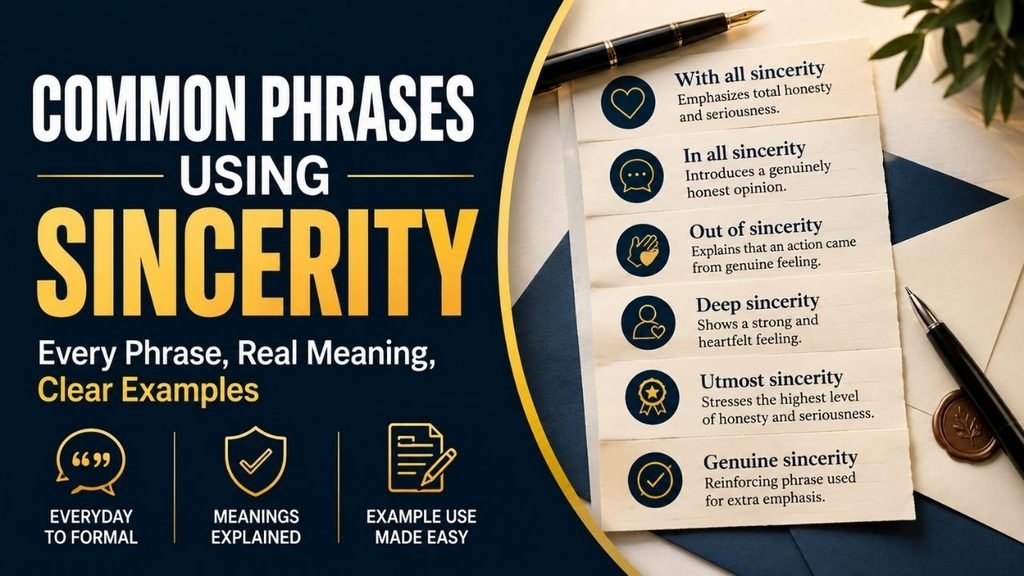
Several fixed phrases use the word sincerity. Each carries a slightly different emphasis, though they all point back to the same core idea of genuine honesty.
| Phrase | Meaning | Typical Use |
| With all sincerity | Emphasizes total honesty and seriousness | Formal statements, apologies, promises |
| In all sincerity | Introduces a genuinely honest opinion | Conversations, opinions, admissions |
| Out of sincerity | Explains that an action came from genuine feeling, not obligation | Explaining motives |
| In sincerity | A more literary or slightly older way to say “sincerely” or “honestly” | Formal or older writing |
| Deep sincerity / Deepest sincerity | Adds emotional weight, showing the feeling is strong and heartfelt | Condolences, formal thanks, apologies |
| Utmost sincerity | Stresses the highest possible level of honesty and seriousness | Formal letters, official statements |
| Genuine sincerity | A reinforcing phrase used for emphasis, even though sincerity already implies genuineness | Everyday speech, informal writing |
With All Sincerity Meaning
“With all sincerity” means “I am saying this completely honestly, with no hidden motive.” It is often used before a serious statement, apology, or promise, to reassure the listener that the words are not exaggerated or insincere.
Example: “With all sincerity, I wish you the best in your new role.”
My Sincerity, Your Sincerity And In Sincerity Meaning
“My sincerity” refers to the speaker’s own genuine honesty, often used when someone wants to underline that their feelings are real. “Your sincerity” refers to someone else’s honesty, often used as a compliment, such as “I appreciate your sincerity.”
“In sincerity” functions similarly to “sincerely” or “honestly,” and often introduces a direct, heartfelt statement. It appears more often in formal or slightly older English than in everyday casual speech.
Deep Sincerity And Deepest Sincerity Meaning
“Deep sincerity” and “deepest sincerity” both intensify the emotional weight of a statement. “Deepest sincerity” is the strongest version, often used in formal condolences or serious apologies, such as “Please accept my deepest sincerity for your loss.” In everyday use, “deepest sympathy” is more common in that specific context, but “deepest sincerity” still appears in formal writing to stress complete honesty.
Lack Of Sincerity Meaning
A lack of sincerity means the absence of genuine feeling behind words or actions. It describes behavior that looks polite or caring on the surface but is not backed by real emotion or intention.
Signs of a lack of sincerity include:
- Compliments that feel scripted or automatic
- Apologies without any real change in behavior
- Promises that are quickly forgotten
- Tone that does not match the words being said
The opposite of sincerity is insincerity, and both words describe this same gap between appearance and truth.
New Sincerity Meaning
New Sincerity is a cultural and literary movement, closely related to what critics call post-postmodernism. It describes art, fiction, music, and film that moves away from the heavy irony and detachment common in postmodern culture, and instead embraces open, heartfelt expression.
The term gained wide attention through American writer David Foster Wallace, particularly through his 1993 essay “E Unibus Pluram,” where he argued that fiction had become saturated with irony and detachment. Wallace suggested that a new generation of writers might reject constant ironic distance and instead treat real human emotions directly, even at the risk of looking sentimental or old-fashioned.
Writers such as Jonathan Franzen, Dave Eggers, and Michael Chabon are often associated with this shift. The New Sincerity movement does not reject irony completely; instead, it tries to balance self-awareness with genuine emotional honesty, rather than using irony as a permanent shield against vulnerability.
In simple terms, New Sincerity meaning is: choosing to be emotionally honest and direct in art and communication, instead of hiding behind constant sarcasm or detachment.
Sincerity In Pop Culture
The word sincerity shows up often in movies, music, and even animated series, usually to highlight the difference between real feeling and performance.
Grinch Christmas Sincerity Meaning
In Dr. Seuss’s “How the Grinch Stole Christmas,” the story’s emotional turning point centers on sincerity. The Grinch expects Christmas to collapse once presents and decorations disappear, but instead, he hears the Whos singing anyway. That moment forces him to realize that the holiday’s meaning was never tied to material things.
This realization reflects the idea of sincerity because it shows a genuine, unforced change of heart, rather than a performance for others. The Whos’ joy is not staged for the Grinch’s benefit; it is real, which is exactly what breaks through his cynicism. When people mention “Grinch Christmas sincerity meaning,” they are usually pointing to this theme: genuine feeling and connection matter more than appearances, gifts, or decorations.
Sincerity Is Scary by The 1975: Meaning
“Sincerity Is Scary” is a song by the English band The 1975, released in 2018 from their album “A Brief Inquiry Into Online Relationships.” Lead singer Matty Healy has explained that the song pushes back against a modern habit of hiding behind irony and sarcasm instead of showing real emotion.
The song argues that being sincere feels riskier than being ironic, because sincerity leaves a person exposed and vulnerable, while irony offers a safe distance from real feeling. The title itself captures this tension: genuine honesty can feel frightening in a culture that often treats emotional openness as embarrassing or uncool.
See More: Conducive Environment Meaning
Sailorr Sincerity Song Meaning
“Sincerity” is a 2025 song by the artist Sailorr. The track explores the tension between wanting real emotional transparency from a partner and settling for surface-level gestures instead. Sailorr uses imagery built around diamonds and jewelry to represent personal value, clarity, and self-worth, contrasting genuine connection with performative affection.
The recurring idea in the song is that true sincerity is rare and valuable, much like a diamond, and the narrator is no longer willing to accept a relationship that only performs closeness without real emotional honesty behind it.
Crest Of Sincerity In Digimon
In the anime series “Digimon Adventure,” each of the main characters carries a “Crest,” a symbol representing a core personal trait needed for their digital partner to evolve to a higher level. The Crest of Sincerity belongs to the character Mimi Tachikawa, and its symbol is a stylized teardrop.
Mimi’s Crest activates when she acts on genuine, heartfelt feelings rather than self-interest, reflecting the same core idea found in the everyday meaning of sincerity: honest, unforced emotion instead of performance. Interestingly, some official translations have used “sincerity” and “purity” somewhat interchangeably for this particular crest, which is why fans sometimes see both terms used across different versions of the show.
Sincerity Meaning In Different Languages
Because sincerity is a widely used word across many cultures and languages, people often search for how it translates. The table below gives commonly used translations, though exact usage can vary slightly by region, dialect, and context.
| Language | Common Word for Sincerity | Notes |
| Arabic | Ikhlas (إخلاص) | Often carries a strong sense of pure, wholehearted devotion, especially in religious contexts |
| Farsi (Persian) | Sedaghat (صداقت) | Commonly used for honesty and sincerity in everyday speech |
| Hindi | Nishtha (निष्ठा) or Imandari (ईमानदारी) | Nishtha leans toward devotion and loyalty; Imandari leans toward honesty |
| Urdu | Ikhlas (اخلاص) or Khuloos (خلوص) | Similar roots and meaning to the Arabic term |
| Bengali | Antorikota (আন্তরিকতা) | Refers to heartfelt, genuine feeling |
| Tamil | Nermai (நேர்மை) | Also commonly used for honesty and integrity |
| Telugu | Nijayithi (నిజాయితీ) | Covers both honesty and sincerity in common usage |
| Malayalam | Athmarthatha (ആത്മാർത്ഥത) | Emphasizes heartfelt, wholehearted genuineness |
| Kannada | Pramanikate (ಪ್ರಾಮಾಣಿಕತೆ) | Also used broadly for honesty and integrity |
| Marathi | Pramanikpana (प्रामाणिकपणा) | Similar in scope to the Kannada and Hindi terms |
Note: Many of these languages do not have one single word that maps perfectly onto the English word “sincerity.” Words for honesty, loyalty, and devotion often overlap with sincerity, so the closest translation can shift depending on whether the context is religious, personal, or everyday conversation.
Sincerity In Religion
Sincerity Meaning In Islam
In Islamic teaching, the concept closely tied to sincerity is Ikhlas, which refers to purity of intention, especially devotion and worship directed sincerely toward God alone, without seeking praise or reward from other people. This concept is central to Islamic spirituality, where the sincerity of one’s intention is considered as important as the action itself.
Sincerity Meaning In The Bible
Older English Bible translations, including the King James Version, use the word “sincere” and “sincerity” in several places to describe honest, unmixed faith and conduct. For example, sincerity is associated with truthful living and consistency between belief and behavior, rather than outward religious performance without real inner conviction. Many modern translations replace “sincerity” with words like “genuine,” “pure,” or “wholehearted” to keep the meaning clear for contemporary readers.
Sincerity Vs. Similar Words
Sincerity overlaps with several related words, but each has a slightly different focus.
| Word | Meaning | Key Difference from Sincerity |
| Honesty | Telling the truth, not lying | Honesty focuses on truthful statements; sincerity focuses on genuine feeling behind them |
| Authenticity | Being true to one’s real self | Authenticity is broader, covering identity and character, not just individual statements |
| Genuineness | Being real and not fake | Very close to sincerity, often used interchangeably |
| Candor | Openness and directness in speech | Candor emphasizes bluntness; sincerity emphasizes truthfulness of feeling, not necessarily bluntness |
| Earnestness | Serious, heartfelt effort or intention | Earnestness focuses on effort and seriousness; sincerity focuses on honesty of feeling |
Examples Of Sincerity In Sentences
- “Her sincerity was obvious the moment she started speaking.”
- “He thanked the team with genuine sincerity, not just polite words.”
- “The letter ended with, ‘Sincerely, John.'”
- “There was no sincerity in his apology; he clearly did not mean it.”
- “She spoke with such sincerity that everyone in the room believed her.”
Common Mistakes with Sincerity
❌ Incorrect: “I am sincerity about this decision.”
✅ Correct: “I am sincere about this decision.”
Explanation: Sincerity is a noun, not an adjective. Use “sincere” to describe a person or feeling.
❌ Incorrect: “She spoke sincerity.”
✅ Correct: “She spoke with sincerity” or “She spoke sincerely.”
Explanation: Sincerity needs a preposition like “with” when used after a verb, or you can switch to the adverb form, “sincerely.”
❌ Incorrect: Pronouncing it as SIN-ser-ity.
✅ Correct: sin-SEHR-ity, with stress on the second syllable.
See More: Aforementioned Meaning
Frequently Asked Questions
What does sincerity mean in simple words?
Sincerity means being honest and genuine, saying what you truly feel instead of pretending or exaggerating.
Is sincerity a noun or an adjective?
Sincerity is a noun. The adjective form is “sincere,” and the adverb form is “sincerely.”
What is the difference between sincerity and honesty?
Honesty focuses on telling the truth and not lying. Sincerity focuses on the genuine feeling behind words, so a statement can be technically honest but still lack emotional sincerity.
What does “with all sincerity” mean?
“With all sincerity” means the speaker is being completely honest and serious, with no hidden motive or exaggeration.
What is a lack of sincerity?
A lack of sincerity means someone’s words or actions seem honest on the surface but are not backed by real feeling or intention.
What does New Sincerity mean in literature?
New Sincerity is a literary and cultural movement that moves away from heavy postmodern irony and instead embraces direct, heartfelt emotional expression, closely associated with writer David Foster Wallace.
How do you pronounce sincerity?
Sincerity is pronounced sin-SEHR-ih-tee, with stress on the second syllable.
What is the origin of the word sincerity?
Sincerity comes from the Latin word sincerus, meaning clean or pure, and entered English through French before settling into its current spelling and meaning.
What does sincerity mean in a relationship?
In a relationship, sincerity means expressing real feelings honestly, rather than performing emotions or hiding true thoughts from a partner.
What does the Crest of Sincerity mean in Digimon?
In Digimon Adventure, the Crest of Sincerity belongs to Mimi Tachikawa and represents genuine, heartfelt feeling and action, rather than self-interest or pretense.
Final Thoughts
Sincerity meaning always comes back to one central idea: honesty that matches real feeling. Whether it appears in a formal letter, a religious teaching, a song lyric, or a simple daily conversation, sincerity describes the moment when someone’s words and true intentions line up completely. It is the opposite of performance, pretense, and empty politeness.
Understanding this word helps you use it correctly in writing and speech, and it also helps you recognize real sincerity when you experience it from others. Whether you are writing “with all sincerity” in a formal message, exploring “new sincerity” in literature, or simply trying to express genuine thanks, the heart of the word stays the same: say what you truly mean, and mean what you truly say.

Hassan Ibrahim is the author behind Mean Fixer, with 4 years of experience researching and writing about names, words, slang, meanings, and everyday language. Their goal is to make confusing words and meanings simple, clear, and easy to understand through accurate, useful, and reader-friendly explanations.

7 Comments