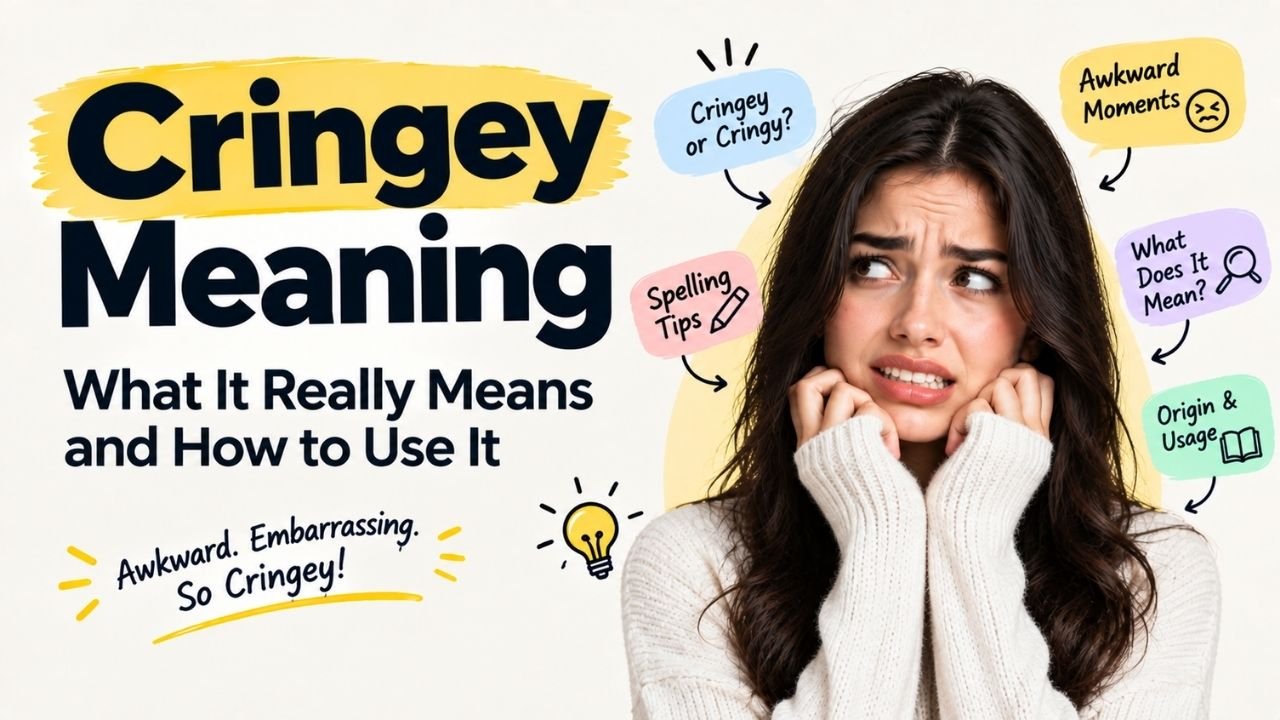
Cringey means something is so awkward, embarrassing, or forced that it makes other people feel uncomfortable just watching or hearing it. It describes behavior, content, or moments that trigger secondhand embarrassment rather than the embarrassment itself. You will see it written as cringey or cringy, and both spellings are accepted.
The word has moved from casual internet slang into everyday conversation, social media captions, and even mainstream news writing. Understanding cringey meaning helps you use it correctly, know when it fits a sentence, and avoid mixing it up with related words like cringe, cringeworthy, or embarrassing. This guide breaks the word down in simple English, with grammar, pronunciation, origin, and real examples.
What Does Cringey Mean?
At its core, cringey is an informal adjective that describes something so awkward or badly judged that it makes onlookers uncomfortable.
Merriam-Webster defines it simply as tending to cause one to cringe, as out of embarrassment or discomfort, and treats it as a close match for cringeworthy. Dictionary.com adds a second sense: seeking favor through servile behavior or flattery, as in cringey interviews with celebrities. merriam-webster
In everyday use, though, the first meaning dominates. People call something cringey when it feels try-hard, out of touch, or painfully awkward to witness.
| Meaning | Simple Explanation | Example |
| Secondhand embarrassment | Something so awkward it makes onlookers uncomfortable | “That wedding speech was so cringey.” |
| Servile or flattering behavior | Trying too hard to please or impress someone | “His cringey attempt to flatter the boss backfired.” |
Quick definition box
💡 Cringey = awkward, embarrassing, or forced enough to make someone else feel uncomfortable watching it.
See More: Sincerity Meaning
Cringey or Cringy: Which Spelling Is Correct?
Both spellings are correct, and dictionaries list them as variants of each other. Merriam-Webster lists cringey as the main entry, with cringe-y and cringy as less common variants. Dictionary.com lists the word as cringey, or crin·gy, treating them as interchangeable informal forms. merriam-websterdictionary
One language resource notes a practical difference in how each form is used day to day: cringey shows up more often online, while cringy simply follows the more standard English pattern of dropping a silent e before adding a suffix (like “sizeable” becoming “sizable” for some writers, or “cringe” becoming “cringy”).
Here is a simple way to remember it:
- Cringey — keeps the “e” from cringe, then adds “-y.” More common in casual writing and social media.
- Cringy — drops the “e” before adding “-y,” following a common English spelling pattern.
Neither spelling is wrong. Pick one and stay consistent within the same piece of writing.
Cringe or Cringey: What’s the Difference?
This is one of the most searched confusions around the word, and the difference is really about part of speech.
| Word | Part of Speech | Function | Example |
| Cringe | Verb or noun | Describes the reaction itself, or the act of physically shrinking back | “I cringe every time I hear that song.” |
| Cringey | Adjective | Describes the thing, person, or moment that causes the reaction | “That song is so cringey.” |
As a verb, cringe traditionally means to shrink back, bend, or crouch, especially in fear, pain, or servility, or to feel very embarrassed or awkward and react with discomfort. Cringey takes that reaction and turns it into a descriptive word for whatever caused it. dictionary
There is a newer wrinkle here too. In current slang, especially online, people also use the plain word “cringe” as an adjective by itself, skipping the “-y” entirely, as in “that outfit is so cringe.” Dictionary.com now records this slang adjective use of cringe directly, defining it as causing embarrassment or resulting in awkward discomfort, essentially a synonym for cringeworthy or cringey. dictionary
So in casual modern usage, you will genuinely hear all three used to mean nearly the same thing:
- “That’s so cringe.”
- “That’s so cringey.”
- “That’s so cringy.”
They are not identical in formality, but readers understand them the same way.
Cringey Grammar and Part of Speech
Cringey functions as an adjective. It describes a noun or follows a linking verb.
| Form | Type | Example |
| Cringey | Positive (base form) | “That was cringey.” |
| Cringier | Comparative | “This video is cringier than the last one.” |
| Cringiest | Superlative | “That’s the cringiest thing I’ve seen all year.” |
A few grammar notes worth knowing:
- Cringey usually sits before a noun (“a cringey moment”) or after a linking verb like be, look, sound, or feel (“that looked cringey”).
- It is informal, so it fits casual writing, social media, and conversation more naturally than formal essays or professional reports.
- The comparative and superlative forms follow the standard rule for short adjectives ending in a consonant plus “y”: change the “y” to “i” and add “-er” or “-est.”
How to Pronounce Cringey
Cringey is pronounced krin-jee, with two syllables and the stress on the first one.
- IPA: /ˈkrɪn.dʒi/
- Simple phonetic spelling: KRIN-jee
- Rhymes with: “stingy,” “dingy”
The “g” in cringey is soft, making a “j” sound, the same way the “g” behaves in “orange” or “gem.” This matches the pronunciation of its root word, cringe, which is also pronounced with a soft “g” (krinj).
Origin of Cringey
Cringey comes directly from the verb cringe plus the adjective-forming suffix “-y,” the same pattern used in words like “itchy” from “itch” or “sleepy” from “sleep.”
Dictionary.com dates the first recorded use of cringey to between 1965 and 1970. However, its rise as a widely recognized slang term came much later. One slang dictionary traces documented use of cringey back to at least 1986, noting it appeared on early internet forums and Usenet groups in the 1990s, then spread through early Twitter, television commentary, and online publications in the following decades. dictionarydictionary
The root word cringe has a much older history. It comes from Middle English crengen or crenchen, first recorded between 1175 and 1225, originally describing a physical shrinking or bending motion, often out of fear or submission. Its roots trace further back to Old English cringan, meaning to shrink or bend the body, often while kneeling. dictionaryweblio
Over centuries, the meaning shifted from a purely physical action (bending your body in fear) to an emotional reaction (feeling embarrassed), and eventually to the adjective form we use today for anything that triggers that feeling in someone else.
Word history at a glance
| Period | Form | Meaning |
| Old English | cringan | To shrink or bend the body, often while kneeling |
| Middle English (1175 to 1225) | crengen, crenchen | To bend or crouch, especially from fear |
| Modern English | cringe (verb) | To feel embarrassed or physically flinch |
| 1965 onward | cringey (adjective) | Describes something that causes embarrassment in others |
| 1986 onward | cringey (slang) | Widely used online to describe awkward or try-hard content |
Cringey in a Sentence
Seeing the word in context makes the meaning click faster than any definition alone. Here are a few natural examples:
- “The cringey slogan on the bus made everyone look away in secondhand embarrassment.”
- “I deleted the post before anyone from work could see how cringey it was.”
- “Watching old home videos of myself is honestly pretty cringey.”
- “His cringey attempt at a compliment made the whole room go quiet.”
- “That advertisement tried so hard to sound young that it came across as cringey instead.”
Notice that cringey almost always describes something external, a video, a post, a comment, a moment, rather than the person’s own internal feeling. You would not usually say “I feel cringey” to mean “I feel embarrassed.” Instead, you would say “I feel embarrassed” or “that made me cringe.”
So Cringey Meaning
“So cringey” simply intensifies the word, the same way “so funny” or “so awkward” work. It means something is extremely or unusually cringey.
“So cringey” is common in spoken English and social media captions, often reacting to a video, post, or moment in real time: “That TikTok was so cringey, I had to skip it.”
It’s Cringey Meaning
“It’s cringey” is a short, direct statement used to describe something as awkward or embarrassing right now, in the moment. People use this phrase to react quickly to a video, comment, ad, or situation without needing a longer explanation.
- “Is that dance trend good?” “No, it’s cringey.”
- “Why did you skip his story?” “Because it’s cringey.”
Cringey Meaning in Slang and Internet Culture
Online, cringey (and its shorter cousin, “cringe”) describes content that feels try-hard, out of touch, overly earnest, or embarrassingly unaware of how it comes across. This includes:
- Adults attempting trendy dances or slang in a way that feels forced
- Overly dramatic or exaggerated social media posts
- Jokes or comments that fall flat in an obviously awkward way
- Old photos, captions, or messages that feel embarrassing in hindsight
- Advertising or marketing that tries too hard to sound relatable to a younger audience
Cringey content is commonly shared and reacted to on social media, where people specifically post about things or behavior they find embarrassing, awkward, or uncomfortably try-hard, including reactions to their own old posts. There is even a well-known internet phrase for looking back at your own old content and feeling embarrassed by it, often shortened simply to admitting “I’m cringey” about a past version of yourself. dictionary
Note: The internet slang sense is informal and best suited to casual writing, texting, and conversation. It generally does not fit formal reports, academic writing, or professional communication.
Cringey Meaning in Urdu, Hindi, and Other Languages
Because cringey began as English-language internet slang, it does not have one single, universally agreed-upon word in Hindi, Urdu, Tamil, or other languages. Most bilingual dictionaries define the base verb cringe rather than the newer slang adjective cringey, and their entries focus on the older sense of shrinking back or acting in a submissive, flattering way, not the modern “so embarrassing to watch” meaning.
For example, one Hindi dictionary translates cringe as चापलूसी (flattery or fawning), reflecting the older sense of cringing to please someone rather than the newer sense of secondhand embarrassment. That is a real, useful translation for the traditional verb, but it does not fully capture how someone online means it when they say a video is “so cringey.” multibhashi
Because of this gap, here is what generally happens across South Asian languages and beyond:
- Many young, bilingual speakers simply borrow the English word directly, saying “cringe” or “cringey” inside a Hindi, Urdu, Tamil, or other native-language sentence, the same way English speakers borrow words from other languages.
- When people do translate it, they usually reach for the closest native word for “embarrassing” or “awkward” rather than a single perfect equivalent, since the exact secondhand, internet-culture flavor of cringey is a fairly recent English slang development.
- Formal dictionaries in these languages are more likely to define the older, traditional verb cringe (to shrink back in fear, or to act in a servile way) than the newer internet-slang adjective cringey.
If you are trying to explain cringey to someone in another language, the safest, most accurate approach is to describe the feeling: something so awkward or forced that it makes onlookers embarrassed for the person involved, rather than to search for one exact translated word.
See More: Endocrinology Meaning
Cringey has several near synonyms, but they are not perfectly interchangeable. Each carries a slightly different shade of meaning.
| Word | Meaning | How It Differs From Cringey |
| Embarrassing | Causing shame or discomfort | Broader and more neutral; can describe any situation that causes shame, not just secondhand embarrassment |
| Awkward | Socially uncomfortable | Milder; can describe simple discomfort without strong secondhand shame |
| Cringeworthy | Deserving of a cringe reaction | Closest in meaning to cringey, but slightly less slangy and often more deliberate in tone |
| Mortifying | Extremely embarrassing | Much stronger; suggests intense, often lasting embarrassment |
| Try hard | Trying too obviously to impress | Focuses specifically on forced effort, a common cause of cringey moments |
Cringey Antonyms
| Word | Meaning | Why It Contrasts With Cringey |
| Cool | Socially confident or impressive | Suggests ease and good judgment instead of forced awkwardness |
| Smooth | Naturally confident in behavior | Implies effortless social skill rather than visible trying |
| Charming | Pleasant and appealing | Creates comfort rather than secondhand discomfort |
Common Mistakes With Cringey
Even fluent English speakers sometimes misuse cringey. Here are the most frequent mix-ups, with corrections.
Mistake 1: Using cringey to describe your own feelings
❌ Incorrect: “I felt cringey after tripping on stage.”
✅ Correct: “I felt embarrassed after tripping on stage.”
Cringey usually describes the thing, person, or content that causes secondhand embarrassment, not the internal feeling of being embarrassed yourself.
Mistake 2: Applying cringey to any unpleasant situation
❌ Incorrect: “The math test was cringey.”
✅ Correct: “The joke I made during the test was cringey.”
A difficult or unpleasant experience (like a hard test) is not automatically cringey. The word fits behavior, style, or content that feels socially awkward or forced, not general unpleasantness.
Mistake 3: Treating cringey as formal vocabulary
❌ Incorrect (in a professional report): “The presentation was cringey.”
✅ Correct (in a professional report): “The presentation felt awkward and poorly judged for the audience.”
Because cringey is informal slang, it fits casual writing and speech far better than business, academic, or formal contexts.
Cringey vs Cringeworthy
These two words are extremely close in meaning, and many people use them as complete synonyms.
| Feature | Cringey | Cringeworthy |
| Formality | More casual, internet-influenced | Slightly more traditional and neutral in tone |
| Common context | Social media, texting, everyday speech | News writing, reviews, general commentary |
| Grammar | cringey, cringier, cringiest | cringeworthy (does not typically take comparative forms) |
In practice, you can usually swap one for the other without changing the meaning of your sentence.
See More: Rando Meaning
Frequently Asked Questions
What does cringey mean?
Cringey means something is so awkward, forced, or embarrassing that it makes other people uncomfortable watching or hearing it, causing secondhand embarrassment.
Is it cringy or cringey?
Both spellings are correct and widely used. Cringey is the more common spelling online, while cringy follows a more standard English spelling pattern.
Is cringey a real word?
Yes. It appears in major dictionaries, including Merriam-Webster and Dictionary.com, as an informal adjective related to the verb cringe.
What is the difference between cringe and cringey?
Cringe is usually a verb or noun describing the reaction itself, such as “I cringe” or “that gave me a cringe.” Cringey is an adjective that describes the thing causing that reaction, such as “that video is cringey.”
How do you pronounce cringey?
Cringey is pronounced krin-jee, with two syllables and stress on the first syllable. The “g” makes a soft “j” sound.
What does so cringey mean?
“So cringey” simply means extremely or very cringey, used to emphasize how awkward or embarrassing something is.
What is the origin of cringey?
Cringey comes from the older verb cringe, which traces back to Old and Middle English words meaning to shrink or bend the body in fear. The adjective form cringey developed later, with recorded use from the late 1960s and wider slang popularity from the mid-1980s onward through internet culture.
Is cringey formal English?
No. Cringey is informal and works well in casual conversation, texting, and social media, but it generally does not fit formal or professional writing.
Can cringey describe a person?
Yes, though it more often describes behavior, content, or a specific moment rather than a person’s entire character. For example, “his comment was cringey” is more natural than a blanket label on someone’s whole personality.
Does cringey have one exact translation in Hindi or Urdu?
Not really. Because cringey is relatively recent English slang, many bilingual speakers simply use the English word directly, while formal dictionaries in these languages tend to define the older, related verb cringe rather than the newer slang adjective.
Conclusion
Cringey describes something so awkward, forced, or badly judged that it makes other people feel embarrassed on someone else’s behalf. It grew out of the older verb cringe, shifting from a word about physically shrinking in fear to a modern adjective that labels embarrassing behavior, content, or moments. Both cringey and cringy are correct spellings, the word functions as an adjective with comparative and superlative forms, and it fits casual speech and social media far more naturally than formal writing.
Whether you are deciding between cringe and cringey, trying to pronounce the word correctly, or wondering how to explain it in another language, the core idea stays simple: cringey is about secondhand embarrassment, not your own personal discomfort. Keep that distinction in mind, and you will use the word accurately in everyday conversation, writing, and online.

Hassan Ibrahim is the author behind Mean Fixer, with 4 years of experience researching and writing about names, words, slang, meanings, and everyday language. Their goal is to make confusing words and meanings simple, clear, and easy to understand through accurate, useful, and reader-friendly explanations.