
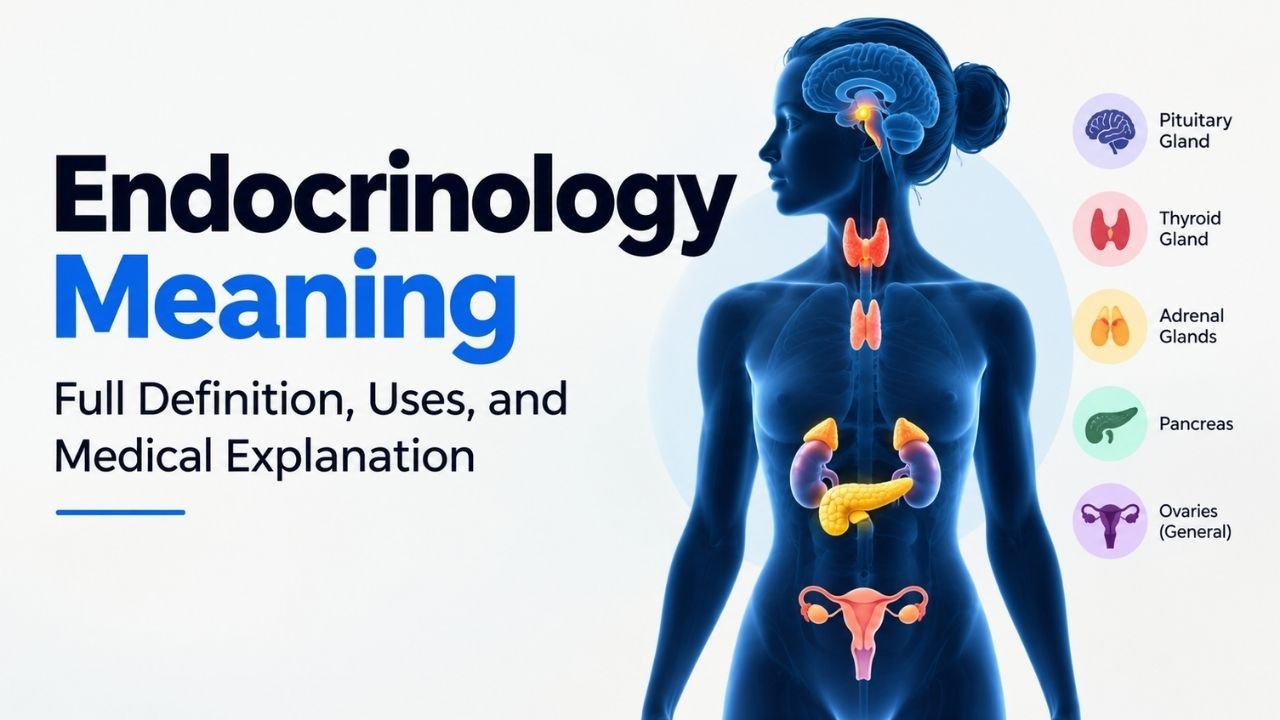
Endocrinology meaning, in the simplest terms, is the branch of medicine and science that studies hormones and the glands that produce them. It looks at how these glands work, what happens when they stop working properly, and how doctors treat the disorders that result. If you have ever heard a doctor mention your thyroid, your pancreas, or your hormone levels, you were hearing about endocrinology in action.
This word shows up often in medical settings, health articles, and hospital directories, so it is easy to see it and still feel unsure what it really covers. Knowing the endocrinology meaning helps you understand referrals, lab reports, and specialist appointments with more confidence. It also helps you follow health news, since conditions like diabetes and thyroid disease are among the most common reasons people are referred to this field.
What Does Endocrinology Mean?
Endocrinology is a noun. It refers to the medical and scientific study of the endocrine system, which is the network of glands that release hormones directly into the bloodstream. According to Merriam-Webster, endocrinology is a branch of medicine concerned with the structure, function, and disorders of the endocrine glands. Cambridge Dictionary defines it in a similar way, describing it as the area of science and medicine that is concerned with the endocrine glands and hormones.
In plain English, endocrinology is the study of hormones and the glands that make them. The Society for Endocrinology puts it simply: endocrinology is the study of hormones, and these chemical messengers control our temperature, sleep, mood, stress, growth and more.
Quick definition box
- Word: Endocrinology
- Part of speech: Noun
- Simple meaning: The study of hormones, hormone glands, and hormone related diseases
- Field: Medicine and biology
- Related professional: Endocrinologist
See More: What Does SMH Mean In Text?
Endocrinology Meaning In Medical Terminology
In medical terminology, endocrinology is classified as a subspecialty. According to the American Association of Clinical Endocrinology, endocrinology is a branch of medicine that deals with the endocrine system, which controls the hormones in your body. In the United States, it typically sits under internal medicine. As WebMD explains, endocrinology is a subspecialty of internal medicine, and doctors first get a certification in internal medicine and then get a separate one in endocrinology if they want to be board certified as an endocrinologist.
This matters for understanding referrals. If your primary care doctor sends you to an endocrinologist, it usually means your symptoms point to a hormone or gland related cause that needs more specialized testing than a general checkup can provide.
The endocrine system itself includes several glands. The American Association of Clinical Endocrinology lists the hypothalamus, pineal body, pituitary, thyroid, parathyroids, adrenals, pancreas, testes and ovaries as part of this system. Each gland produces specific hormones, and there are up to 40 different hormones circulating in your blood at any time.
How Endocrinology Actually Works
To understand the endocrinology meaning fully, it helps to understand what a hormone actually does. A hormone is a chemical messenger. It is made in one part of the body and travels through the blood to affect another part of the body. This is how the Society for Endocrinology describes it: a hormone is a chemical messenger that travels from one cell to another and hormones are secreted by endocrine glands, such as the pituitary, thyroid or adrenal glands.
Not every gland in the body counts as an endocrine gland. The Society for Endocrinology notes that sweat glands or lymph glands are not endocrine glands, because they do not release hormones into the bloodstream in the same way. This distinction is part of why endocrinology is treated as its own specialized field rather than folded into general anatomy.
Here is a simple way to picture the process:
- A gland senses that the body needs a change, such as more energy or a shift in temperature.
- The gland releases a hormone into the blood.
- The hormone travels to a target organ or tissue.
- The target organ responds, and the body adjusts.
Endocrinology Doctor Meaning
The endocrinology doctor meaning refers to the medical specialist trained in this field, known as an endocrinologist. Cleveland Clinic describes an endocrinologist as a healthcare provider who’s an expert in endocrinology, and someone who can diagnose endocrine conditions, develop treatment plans and prescribe medication.
Becoming an endocrinologist takes many years of training. WebMD outlines the path clearly: after completing four years of college, endocrinologists go through medical school, then spend about six additional years of training specializing in endocrinology.
What an endocrinologist typically treats
| Condition Area | Example Conditions |
| Blood sugar disorders | Type 1 diabetes, type 2 diabetes |
| Thyroid disorders | Hypothyroidism, hyperthyroidism |
| Bone health | Osteoporosis |
| Growth issues | Growth hormone deficiency |
| Reproductive hormones | Infertility, menstrual disorders |
| Adrenal glands | Adrenal insufficiency, adrenal tumors |
The American Association of Clinical Endocrinology confirms this range, noting that endocrinologists diagnose and treat a wide range of conditions affecting the endocrine system, including diabetes mellitus, thyroid disorders, osteoporosis, growth hormone deficiency, infertility, cholesterol problems, hypertension (high blood pressure), obesity and more.
Diabetes And Endocrinology Meaning
Diabetes and endocrinology meaning are closely linked because diabetes is one of the most common hormone disorders that endocrinologists treat. Diabetes happens when the body cannot properly produce or use insulin, which is a hormone made by the pancreas. Since insulin is a hormone and the pancreas is an endocrine gland, diabetes falls squarely within the scope of endocrinology.
This connection is so strong that many hospital rankings and departments list diabetes and endocrinology together as a single specialty area. For example, Merriam-Webster’s own usage examples reference hospital rankings in diabetes and endocrinology as a combined category.
Diabetic Endocrinology Meaning
Diabetic endocrinology meaning refers to the part of endocrinology that focuses specifically on diabetes care. This includes:
- Diagnosing type 1 and type 2 diabetes
- Managing insulin therapy
- Monitoring blood sugar patterns
- Preventing complications linked to long term high blood sugar
- Adjusting treatment as a patient’s needs change
A patient with diabetes may see an endocrinologist regularly, especially if blood sugar is hard to control with primary care management alone.
Endocrinology Meaning Thyroid
The thyroid is one of the most frequently discussed glands in endocrinology, so the phrase endocrinology meaning thyroid often comes up in searches. The thyroid is a small, butterfly shaped gland in the neck. It produces hormones that control metabolism, energy use, and body temperature.
Common thyroid conditions treated by endocrinologists include:
- Hypothyroidism, where the thyroid does not make enough hormone
- Hyperthyroidism, where the thyroid makes too much hormone
- Thyroid nodules
- Thyroid cancer, in coordination with oncology specialists
Cleveland Clinic groups thyroid disease alongside diabetes as one of the leading reasons people see an endocrinologist, describing an endocrinologist as an expert in conditions related to your hormones, like diabetes and thyroid disease.
Pediatric Endocrinology Meaning
Pediatric endocrinology meaning refers to the branch of endocrinology that focuses on children and teenagers. This subspecialty deals with hormone related growth and development issues that are unique to younger patients. It is sometimes also searched as paediatric endocrinology meaning, using the British spelling.
Pediatric endocrinologists commonly manage:
- Growth disorders and short stature
- Early or delayed puberty
- Type 1 diabetes in children
- Thyroid conditions in children
- Congenital hormone disorders present from birth
Because a child’s body is still developing, hormone imbalances at this stage can affect growth, bone development, and long term health in ways that differ from adult cases. This is why pediatric endocrinology exists as its own dedicated specialty rather than being handled only by general pediatricians.
Reproductive Endocrinology Meaning
Reproductive endocrinology meaning refers to the branch of endocrinology focused on hormones related to fertility and the reproductive system. Dictionary.com’s own usage examples describe reproductive endocrinology and infertility specialists as professionals who provide evidence based care for conditions affecting fertility.
Reproductive endocrinologists typically work with:
- Infertility in both men and women
- Polycystic ovary syndrome, often shortened to PCOS
- Menstrual cycle irregularities
- Hormone therapy related to fertility treatment
- Conditions affecting testosterone or estrogen levels
This subspecialty often overlaps with obstetrics and gynecology, since many reproductive endocrinologists work closely with fertility clinics.
Endocrinology Meaning in English
When people search for endocrinology meaning in English, they are usually looking for a plain language definition rather than a technical medical one. In everyday English, endocrinology simply means the study of hormones and the glands that make them, along with the diseases that happen when something goes wrong with that system.
A simple way to explain it to a friend or family member:
Endocrinology is the part of medicine that looks after your hormones, the chemical signals your body uses to control things like energy, growth, mood, and metabolism.
See More: Clean Girl Aesthetic Meaning
Endocrinology Meaning In Various Languages
Endocrinology is a technical medical term, so in many languages it appears either as a direct transliteration of the English word, or as a descriptive phrase built from local words for hormones, glands, or internal secretion. Because medical terminology is often standardized internationally, doctors in many countries use the English or Latin based term even while speaking their native language.
Below is a general overview based on how the term is commonly explained in bilingual dictionaries.
| Language Context | How Endocrinology Is Commonly Expressed |
| Endocrinology meaning in Hindi | Often translated descriptively, referring to the branch of medicine dealing with internal secretion glands and hormones, though the English term is also widely used in clinical speech |
| Endocrinology meaning in Urdu and examples | Frequently explained as the study of ductless glands and their secretions, with the English term commonly used by doctors and patients in conversation |
| Endocrinology meaning in Marathi | Generally explained descriptively as the branch of medical science dealing with hormone producing glands |
| Endocrinology meaning in Bangla and endocrinology meaning in Bengali | Usually described as the study of hormones and hormone glands, with the English term frequently used in hospital settings |
| Endocrinology meaning in Nepali | Commonly explained as the study of glands that release hormones into the blood |
| Endocrinology meaning in Tamil | Typically described as the branch of medicine related to hormone glands, alongside use of the English medical term |
| Endocrinology meaning in Kannada | Generally explained through a descriptive phrase referring to hormone and gland related medicine |
| Endocrinology meaning in Sinhala | Usually described as the study of the endocrine glands and hormones |
| Endocrinology meaning in Spanish | Spanish uses the closely related cognate term, endocrinología, which follows the same Greek based roots as the English word |
Important note: Because exact translations can vary between regional dialects and individual dictionaries, if you need an official medical translation for a document or prescription, it is best to confirm the term with a licensed translator or a local medical professional.
Part of Speech And Word Forms
Endocrinology belongs to a small family of related words, all built from the same root.
| Word Form | Part of Speech | Meaning |
| Endocrinology | Noun | The study of hormones and endocrine glands |
| Endocrine | Adjective | Relating to glands that secrete hormones directly into the blood |
| Endocrinologist | Noun | A doctor who specializes in endocrinology |
| Endocrinological | Adjective | Relating to endocrinology as a field |
Example sentences
- Her endocrinology appointment focused on thyroid levels.
- The endocrine system regulates metabolism and growth.
- He has practiced as an endocrinologist for over ten years.
- The clinic published new endocrinological research on insulin resistance.
Endocrinology does not typically have a plural form in everyday use, since it refers to a field of study rather than a countable object, similar to words like biology or cardiology.
How to Pronounce Endocrinology
Endocrinology is pronounced as: en-doh-krih-NOL-uh-jee
The main stress falls on the syllable “nol.” Breaking it down:
- En, as in “end”
- Doh, as in “dough”
- Krih, a short sound like “krih” in “critter”
- NOL, the stressed syllable, rhyming with “doll”
- Uh, a short neutral sound
- Jee, as in “jeep” without the p
This pronunciation is generally the same in American English and British English, though speakers may vary slightly in vowel length depending on regional accent.
Origin of Endocrinology
The origin of endocrinology traces back to Greek word roots combined in a relatively modern medical term. According to Merriam-Webster, the word was probably borrowed from Italian endocrinologia, from endocrine + -o- + -logy.
The name is generally credited to a specific person and moment in medical history. Merriam-Webster notes that, according to some sources coined by the Italian physician Nicola Pende (1880 to 1970) in 1909, and that Pende used the word in the title of his treatise Endocrinologia: patologia e clinica degli organi a secrezione interna, published in Milan and Bologna in 1916. The dictionary lists the first known use of the English word as occurring circa 1913.
Breaking the word into its parts helps explain the meaning directly:
- Endo comes from Greek, meaning within or inside
- Crine relates to the Greek word for secretion or to separate, referring to how hormones are released
- Logy comes from Greek, meaning the study of
Put together, endocrinology literally means the study of internal secretion, which lines up closely with its modern medical meaning as the study of hormones released inside the body.
Endocrinology Department and Appointment Meaning
Hospitals and clinics commonly list endocrinology as its own department. The endocrinology department meaning refers to the specific unit within a hospital or clinic where hormone related conditions are diagnosed and treated. This department usually works closely with internal medicine, gynecology, and sometimes oncology.
If you are wondering what an endocrinology appointment involves, here is a general outline of what commonly happens, based on how endocrinology practices describe patient visits:
- Review of symptoms and medical history, including any prior lab work or referrals
- Physical examination, which may include checking the neck for thyroid changes
- Blood tests, often used to measure hormone levels
- Discussion of results, either during the same visit or at a follow up appointment
- Treatment planning, which may include medication, lifestyle changes, or further testing
Appointments can vary widely depending on whether the visit is a first consultation or a routine follow up for an existing condition like diabetes or thyroid disease.
Endocrinology Tests
Endocrinology tests are used to measure hormone levels and check how well certain glands are functioning. Common categories include:
- Blood tests to measure hormones such as thyroid stimulating hormone, insulin, or cortisol
- Imaging tests, such as ultrasounds of the thyroid or pancreas
- Stimulation or suppression tests, which measure how a gland responds to a triggering substance
- Bone density scans, often used when osteoporosis is a concern
The exact tests ordered depend entirely on the symptoms and the specific gland being evaluated.
Endocrinology Diseases
Endocrinology diseases cover a wide range of conditions, since so many different glands and hormones are involved. The table below summarizes some of the most commonly discussed categories.
| Disease Category | Example Conditions | Related Gland or Hormone |
| Blood sugar disorders | Type 1 diabetes, type 2 diabetes | Pancreas, insulin |
| Thyroid disorders | Hypothyroidism, hyperthyroidism | Thyroid gland |
| Bone disorders | Osteoporosis | Calcium regulating hormones |
| Adrenal disorders | Adrenal insufficiency | Adrenal glands, cortisol |
| Reproductive disorders | PCOS, infertility | Ovaries, testes |
| Growth disorders | Growth hormone deficiency | Pituitary gland |
This is not a complete list, since endocrinology touches nearly every part of the body through the hormones it studies.
Endocrinology Treatment
Endocrinology treatment approaches depend heavily on the specific condition, but they generally fall into a few broad categories:
- Medication, such as insulin, thyroid hormone replacement, or hormone blockers
- Lifestyle adjustments, including diet and exercise changes for conditions like diabetes
- Monitoring, through regular blood tests to track hormone levels over time
- Surgery, in some cases, such as removing a thyroid nodule or an adrenal tumor
- Long term management plans, since many endocrine conditions are chronic rather than short term
Endocrine specialists are described as using a range of treatments, from medication to lifestyle changes to help patients manage hormone related conditions over time.
Contextual Meanings of Endocrinology
While the core definition of endocrinology stays consistent, the word appears in slightly different contexts depending on who is using it.
In a hospital directory: Endocrinology usually refers to a specific department, often paired with diabetes care.
In a medical journal: Endocrinology may refer to ongoing research into hormone mechanisms, as seen in academic sources that describe it as a field where ongoing research helps us better understand the mechanisms of hormone actions, as well as new diagnostic tools and therapeutic interventions.
In everyday conversation: Endocrinology is usually shorthand for “hormone medicine,” used when explaining why someone is seeing a specialist.
In academic or scientific writing: Endocrinology can appear alongside other disciplines, such as psychology or epidemiology, when researchers study how hormones interact with behavior or stress.
Similar and Related Words
Endocrinology is often confused with a few related medical terms. The table below clarifies the differences.
| Term | Meaning | Key Difference |
| Endocrinology | The study of hormones and hormone glands | Focuses on internal secretion glands |
| Metabolism | The chemical processes that convert food into energy | A process, not a medical field, though closely regulated by hormones |
| Internal medicine | A broad field covering adult diseases affecting internal organs | Endocrinology is a subspecialty within it |
| Gynecology | The field focused on the female reproductive system | Overlaps with reproductive endocrinology but is broader in scope |
| Dermatology | The study of skin conditions | Unrelated field, though some skin symptoms can be hormone related |
Understanding these distinctions helps explain why a patient might be referred to more than one specialist for symptoms that seem connected.
Common Mistakes With Endocrinology
Because endocrinology is a long, technical word, a few mistakes come up often.
✅ Correct: Endocrinology is the study of hormones.
❌ Incorrect: Endocrinology is the study of glands only, without mentioning hormones.
✅ Correct: An endocrinologist treats hormone disorders.
❌ Incorrect: An endocrinologist treats all internal diseases.
✅ Correct: The plural or general reference stays as “endocrinology” when discussing the field.
❌ Incorrect: Referring to “endocrinologies” when meaning multiple hormone disorders. The correct term for that would be “endocrine disorders,” not multiple “endocrinologies.”
✅ Correct: Pediatric endocrinology focuses on children.
❌ Incorrect: Assuming pediatric endocrinology is the same as general pediatrics. It is a distinct specialty focused specifically on hormone related growth and development issues.
See More: Ootd Meaning In Text
Frequently Asked Questions
What does endocrinology mean in simple words?
Endocrinology means the study of hormones and the glands that produce them, along with the diseases that happen when hormone levels go wrong.
What is endocrinology in medical terminology?
In medical terminology, endocrinology is a subspecialty of internal medicine focused on diagnosing and treating disorders of the endocrine glands, such as the thyroid, pancreas, and adrenal glands.
Is endocrinology the same as diabetes care?
Not exactly. Diabetes care is one major part of endocrinology, since diabetes is a hormone disorder involving insulin, but endocrinology also covers thyroid disease, bone health, growth disorders, and reproductive hormone issues.
What is pediatric endocrinology?
Pediatric endocrinology is the branch of endocrinology that focuses on hormone related growth and development issues in children and teenagers, including growth disorders, early or delayed puberty, and diabetes in children.
What is reproductive endocrinology?
Reproductive endocrinology is the branch of endocrinology focused on hormones connected to fertility, menstrual health, and reproductive function in both men and women.
How do you pronounce endocrinology?
Endocrinology is pronounced en-doh-krih-NOL-uh-jee, with the main stress on the syllable “nol.”
What is the difference between endocrinology and an endocrinologist?
Endocrinology is the field of study itself, while an endocrinologist is the medical doctor who practices in that field.
Where does the word endocrinology come from?
The word comes from Greek roots meaning within, secretion, and study. Merriam-Webster records its first known English use as circa 1913, with the term likely coined earlier by Italian physician Nicola Pende.
What happens during an endocrinology appointment?
A typical endocrinology appointment includes a review of symptoms, a physical exam, blood tests to check hormone levels, and a discussion of treatment options based on the results.
Is endocrinology only about diabetes and thyroid problems?
No. While diabetes and thyroid disease are common reasons for referral, endocrinology also covers bone health, growth disorders, adrenal gland conditions, and reproductive hormone issues.
Conclusion
Endocrinology meaning comes down to one central idea: it is the study of hormones and the glands that produce them, along with the medical care given when that system does not work as it should. This single field connects conditions as different as diabetes, thyroid disease, growth disorders, and infertility, because all of them trace back to hormones and the glands behind them. Whether you encountered the word through a hospital department, a doctor’s referral, or a search for its meaning in another language, the core idea stays the same across every context.
Knowing this definition makes it easier to understand medical referrals, lab results, and health conversations involving hormones. If you or someone you know is being referred to an endocrinologist, it simply means a specialist is going to take a closer look at how the body’s hormone system is working, using the training and tools built specifically for that purpose.

Hassan Ibrahim is the author behind Mean Fixer, with 4 years of experience researching and writing about names, words, slang, meanings, and everyday language. Their goal is to make confusing words and meanings simple, clear, and easy to understand through accurate, useful, and reader-friendly explanations.



3 Comments