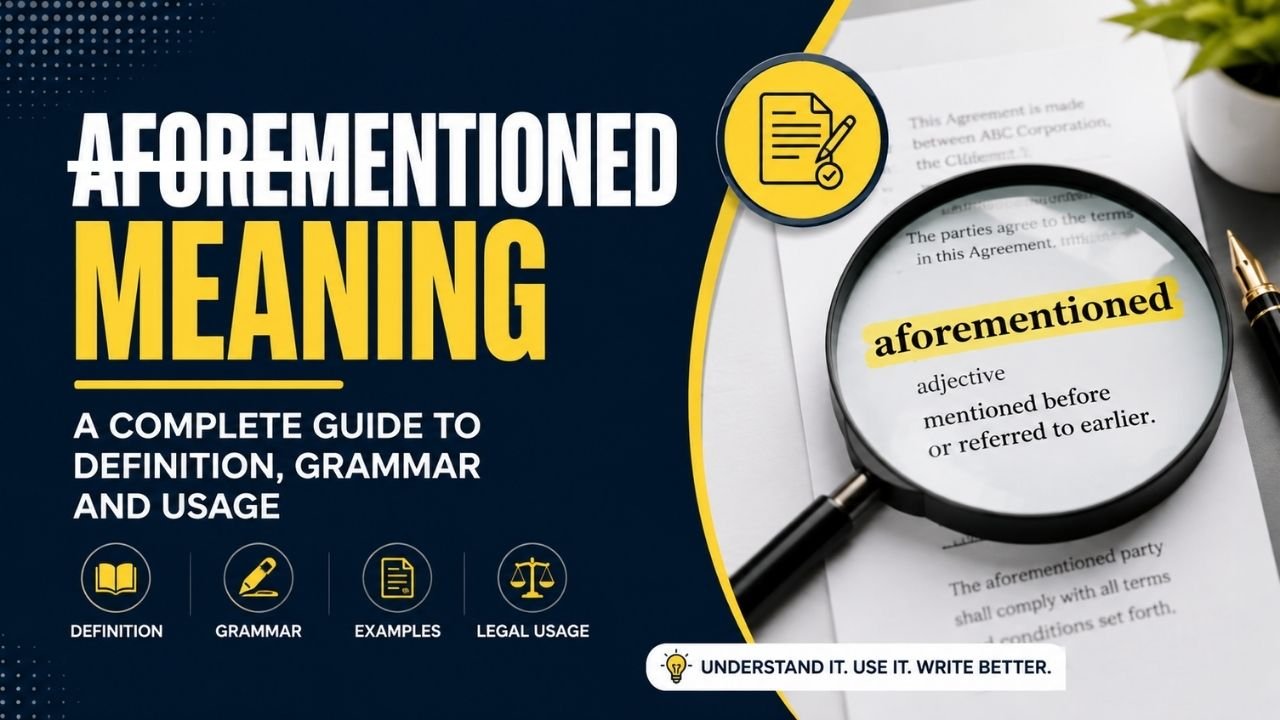
If you have ever read a contract, a legal notice, or a formal report, you have probably seen the word “aforementioned.” The aforementioned meaning is simple once you break it down. It refers to something that was mentioned earlier in the same piece of writing or conversation. Writers use it to point back to a person, item, or idea without repeating the full name again.
This word shows up most often in formal writing. You will find it in legal documents, business letters, official reports, and academic papers. Understanding the aforementioned meaning helps you read these documents with confidence. It also helps you use the word correctly if you ever need to write something formal yourself.
What Does Aforementioned Mean?
Aforementioned is an adjective. It means “mentioned before” or “referred to earlier.” Writers use it to point back to something already named in the same text.
Simple definition: Already mentioned or named earlier in the same document, speech, or conversation.
For example: If a contract first names “John Smith” and later says “the aforementioned party agrees to the terms,” it simply means John Smith agrees to the terms. The word saves the writer from repeating the full name every time.
Here is a quick breakdown of the word:
| Feature | Detail |
| Part of speech | Adjective |
| Pronunciation | uh-FOR-men-shund |
| Common use | Legal, formal, and business writing |
| Function | Points back to something already stated |
| Register | Formal, not used in casual speech |
See More: What Does Huzz Mean?
Aforementioned Meaning Definition
According to standard English dictionaries, “aforementioned” is defined as something that was named or mentioned previously in the same speech, letter, article, or document. It is almost always used as an adjective before a noun, such as “the aforementioned document” or “the aforementioned individual.”
The key idea behind the aforementioned meaning is repetition avoidance. Instead of writing a person’s full name, a company’s full title, or a long description again and again, a writer uses “aforementioned” to refer back to it clearly and briefly.
Aforementioned Meaning In English: A Closer Look
In everyday English, “aforementioned” works like a pointer. It tells the reader, “Look back. I already told you about this.”
Think of it as similar to saying “the one I just mentioned” or “the one named above.” The difference is that “aforementioned” packs that whole idea into a single formal word.
Here are three ways the aforementioned meaning plays out in English sentences:
- Pointing to a person: “Mr. Adams signed the form. The aforementioned individual will receive a copy.”
- Pointing to an item: “The company shipped two laptops. The aforementioned laptops arrived on Monday.”
- Pointing to an idea: “We discussed three options. The aforementioned options are listed below for reference.”
In each case, the word “aforementioned” saves space and avoids repeating information the reader already has.
Aforementioned Meaning And Examples
Examples make grammar and meaning much easier to understand. Below are a few natural examples that show how the word works in real writing.
Example 1: “The tenant, Sarah Lee, must pay rent by the first of the month. The aforementioned tenant is also responsible for utility bills.”
Here, “the aforementioned tenant” simply means Sarah Lee, the person already named.
Example 2: “Our team reviewed the budget report last week. As stated in the aforementioned report, expenses rose by ten percent.”
Here, “the aforementioned report” points back to the budget report mentioned earlier.
Example 3: “The company signed a supply agreement with two vendors in March. The aforementioned agreement remains valid until December.”
These examples show a clear pattern. The word “aforementioned” always follows something that was already named, and it always comes before a noun.
The Aforementioned Meaning In A Sentence
To use “aforementioned” correctly, place it directly before the noun it describes. It usually follows “the,” as in “the aforementioned contract” or “the aforementioned employee.”
A useful way to think about sentence placement:
- Name the person, item, or idea first.
- Add more information or continue the discussion.
- Use “the aforementioned [noun]” to refer back to it without repeating the full name.
For example: “The manager approved the budget on Tuesday. The aforementioned budget covers all department expenses for the quarter.”
Aforementioned Meaning In Law
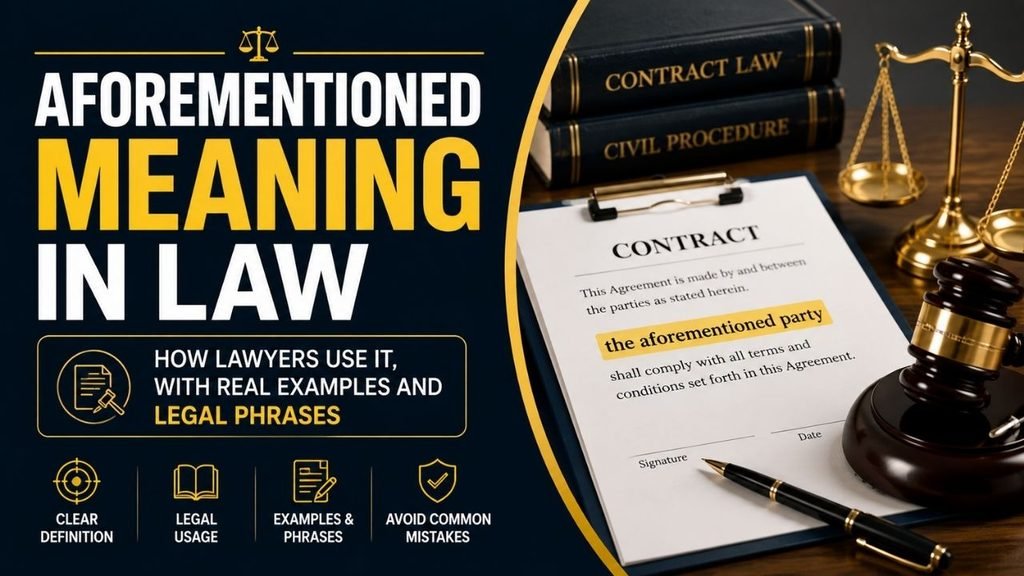
The aforementioned meaning is especially common in legal writing. Lawyers and legal drafters use it to refer back to people, parties, dates, or documents named earlier in a contract, agreement, or court filing.
In legal documents, precision matters. If a contract names “ABC Corporation” in the first paragraph, later sections might refer to “the aforementioned corporation” instead of repeating the full company name every time. This keeps the document consistent and avoids confusion about which company is being discussed.
Common legal phrases that use this word include:
- “The aforementioned party shall comply with all terms.”
- “Pursuant to the aforementioned agreement…”
- “The aforementioned date shall be considered the effective date.”
Aforementioned documents meaning: In legal and business writing, “the aforementioned documents” refers to specific files, contracts, or records that were named or listed earlier in the same text.
Aforementioned date meaning: This phrase points back to a specific date already stated in the document, such as a signing date, deadline, or effective date.
Aforementioned period meaning: This refers to a time frame or duration that was already described earlier, such as a lease term, payment period, or notice period.
See More: What Does Chopped Mean In Slang?
Notwithstanding The Aforementioned Meaning
This phrase combines two formal words: “notwithstanding” and “aforementioned.” Together, they mean “despite what was said before” or “even though the previous point was mentioned.”
For example: “Notwithstanding the aforementioned terms, the landlord may terminate the lease early if rent is unpaid for sixty days.”
This sentence means: even though the earlier terms were stated, this new rule still applies. Writers use this phrase to introduce an exception or a condition that overrides an earlier statement.
In Light Of The Aforementioned Meaning
This phrase means “considering what was mentioned earlier” or “based on the information already given.” It introduces a conclusion or decision that follows from a previous statement.
Example: “In light of the aforementioned delays, the project deadline has been extended by two weeks.”
This phrase is common in business emails, reports, and official announcements when a decision is being explained.
Above Aforementioned Meaning
Some people write “above aforementioned,” but this phrase is technically redundant. Since “aforementioned” already means “mentioned above” or “mentioned before,” adding the word “above” repeats the same idea twice.
⚠️ Common mistake: Using “above aforementioned” together.
✅ Better choice: Use either “aforementioned” or “above mentioned,” not both together.
Careful writers avoid combining these words because clear, formal writing values precision over repetition.
All the Aforementioned Meaning
“All the aforementioned” refers back to everything already mentioned, not just one single item. It is used when a writer wants to summarize or refer to a full list of points, items, or people discussed earlier.
Example: “All the aforementioned conditions must be met before the contract becomes valid.”
This phrase is useful when a document lists several rules, items, or names, and the writer wants to refer to the entire group at once.
Aforementioned Meaning In Different Languages
Many readers search for the aforementioned meaning in their own language because they encounter the word in translated documents, legal papers, or English learning materials. Below are commonly used equivalents. Exact wording can vary slightly depending on formal or regional usage, so these should be treated as general guidance rather than a single fixed translation.
| Language | Common Equivalent |
| Hindi | उपरोक्त or पूर्वोक्त |
| Urdu | مذکورہ بالا |
| Bengali | পূর্বোক্ত |
| Tamil | மேற்கூறிய |
| Telugu | పైన పేర్కొన్న |
| Marathi | पूर्वोक्त |
| Gujarati | ઉપરોક્ત |
| Punjabi | ਉਪਰੋਕਤ |
| Malayalam | മുൻപറഞ്ഞ |
| Kannada | ಮೇಲೆ ತಿಳಿಸಿದ |
| Malay | tersebut di atas |
| Tagalog | nabanggit na |
| Chinese (Mandarin) | 上述 (shàng shù) |
💡 Tip: In most of these languages, the equivalent phrase carries the same core idea as English: something already named or referred to earlier in the same text.
Grammar Of Aforementioned
“Aforementioned” is a compound word formed from three parts: “afore” (meaning before), “mention,” and the suffix “-ed.” It functions as an adjective and always appears before a noun.
Part of Speech
Aforementioned is an adjective. It describes a noun by showing that the noun was already mentioned earlier.
- Correct: “The aforementioned witness confirmed the statement.”
- Incorrect: “He aforementioned the witness.” (This misuses it as a verb, which is not standard usage.)
Sentence Structure
The typical pattern looks like this:
The + aforementioned + noun
Examples:
- The aforementioned employee
- The aforementioned agreement
- The aforementioned address
Sometimes “said” is used in a similar legal role, as in “said document,” but “aforementioned” is more common in modern formal English.
Singular And Plural Use
“Aforementioned” does not change form for singular or plural nouns. The noun itself changes, not the adjective.
- The aforementioned company (singular)
- The aforementioned companies (plural)
How To Pronounce Aforementioned
Pronunciation: uh-for-MEN-shund
Breaking it into syllables:
- uh (short, unstressed)
- for (rhymes with “for”)
- MEN (main stress)
- shund (soft “sh” sound, rhymes with “stunned”)
In IPA, it is written as /əˌfɔːrˈmɛnʃənd/. American and British pronunciations are very close, with only a slight difference in the vowel sound of the first syllable.
Origin Of Aforementioned
The word “aforementioned” comes from combining “afore,” an older English word meaning “before,” with “mentioned.” “Afore” was common in earlier English and is related to “before,” though it is rarely used alone in modern English today.
Over time, English speakers combined “afore” with “mentioned” to create a single formal adjective. This gave writers, especially in law and business, a compact way to refer back to something already stated. The word has remained closely tied to formal and legal writing throughout its history, and it is rarely used in casual conversation.
Synonyms For Aforementioned
Several words share a similar meaning with “aforementioned,” though small differences in tone and formality exist.
| Word | Meaning | Typical Use |
| Above mentioned | Mentioned earlier in the text | Formal writing, slightly less legal |
| Previously mentioned | Mentioned before now | General formal and semi-formal writing |
| Said | Already named or discussed | Legal writing, older style |
| Aforesaid | Already said or stated | Legal writing, very formal |
| Foregoing | Mentioned just before, especially at the end of a section | Legal and academic writing |
Aforementioned opposite: The closest opposite ideas are words like “following,” “subsequent,” or “the aforementioned’s counterpart in later text,” since these all point forward instead of backward. There is no single perfect antonym, but “following” and “subsequent” work well when a writer wants to point ahead instead of behind.
Aforementioned Vs Above Mentioned
These two phrases mean almost the same thing, but there are small differences.
- Aforementioned is a single, formal word often used in legal and official writing.
- Above mentioned is two words and feels slightly less formal, though it is still used in professional writing.
Both point back to something already named in the text. Choosing between them often comes down to house style or personal preference in formal writing.
Common Mistakes With Aforementioned
Even experienced writers sometimes misuse this word. Here are frequent mistakes and how to fix them.
❌ Incorrect: “The aforementioned above document was signed.”
✅ Correct: “The aforementioned document was signed.”
Why: “Aforementioned” already means “mentioned above,” so adding “above” repeats the same idea.
❌ Incorrect: “She aforementioned the meeting during lunch.”
✅ Correct: “She mentioned the meeting during lunch.”
Why: “Aforementioned” is not used as a verb. Use “mentioned” instead when describing an action.
❌ Incorrect: “The aforementioned person, who I have not named yet, will attend.”
✅ Correct: Name the person first, then refer to them as “the aforementioned person” later.
Why: The word only works correctly when it points back to something already named earlier in the text.
When Should You Use Aforementioned?
“Aforementioned” fits best in formal writing where precision matters. It is common in:
- Legal contracts and agreements
- Court documents and filings
- Business letters and formal reports
- Academic papers referring back to earlier points
- Government and official documents
It is rarely used in casual conversation, text messages, or everyday speech. Using it in a casual chat with a friend would sound stiff and unnatural. In those settings, simpler phrases like “the one I mentioned” or “like I said before” work much better.
See More: Conducive Environment Meaning
Aforementioned Meaning: Quick Reference
For readers who want a fast summary, here is the core idea in one place.
- Meaning: Already mentioned or named earlier in the same text.
- Part of speech: Adjective.
- Common context: Legal, business, and formal writing.
- Pronunciation: uh-for-MEN-shund.
- Similar words: Above mentioned, previously mentioned, aforesaid, said.
- Avoid: Using it as a verb or pairing it with “above” for redundancy.
Frequently Asked Questions
What does aforementioned mean?
It means something that was already mentioned or named earlier in the same document, speech, or conversation.
Is aforementioned a noun or an adjective?
It is an adjective. It always describes a noun, such as “the aforementioned contract.”
How do you use aforementioned in a sentence?
Name the person, item, or idea first. Later in the text, refer back to it using “the aforementioned” followed by the noun, such as “the aforementioned employee.”
How do you pronounce aforementioned?
It is pronounced uh-for-MEN-shund, with the main stress on the second syllable, “men.”
What is the difference between aforementioned and above mentioned?
Both mean the same thing. “Aforementioned” is a single formal word, often used in legal writing. “Above mentioned” is two words and feels slightly less formal, though still professional.
Is it correct to say “above aforementioned”?
No. This phrase repeats the same meaning twice because “aforementioned” already means “mentioned above.” Use one term, not both together.
Can aforementioned be used as a verb?
No. It only works as an adjective. Use “mentioned” if you need a verb form, as in “she mentioned it earlier.”
What is a synonym for aforementioned?
Common synonyms include “above mentioned,” “previously mentioned,” “aforesaid,” and “said,” though each carries a slightly different level of formality.
Where is aforementioned commonly used?
It appears most often in legal contracts, court documents, business letters, official reports, and academic writing.
Does aforementioned change for plural nouns?
No. The word itself stays the same. Only the noun that follows it changes, such as “the aforementioned company” versus “the aforementioned companies.”
Conclusion
The aforementioned meaning comes down to one simple idea: pointing back to something already named earlier in a document or conversation. Writers use it to avoid repeating full names, titles, or descriptions, which keeps formal writing clear and efficient. Whether you see it in a legal contract, a business report, or an academic paper, the word always serves the same purpose: reminding the reader of something mentioned before.
Now that you understand how the word works, you can read formal documents with more confidence and use it correctly in your own writing. Remember to place it directly before a noun, avoid pairing it with “above,” and save it for formal contexts rather than casual conversation. With this understanding, the aforementioned meaning should never feel confusing again.

Hassan Ibrahim is the author behind Mean Fixer, with 4 years of experience researching and writing about names, words, slang, meanings, and everyday language. Their goal is to make confusing words and meanings simple, clear, and easy to understand through accurate, useful, and reader-friendly explanations.