
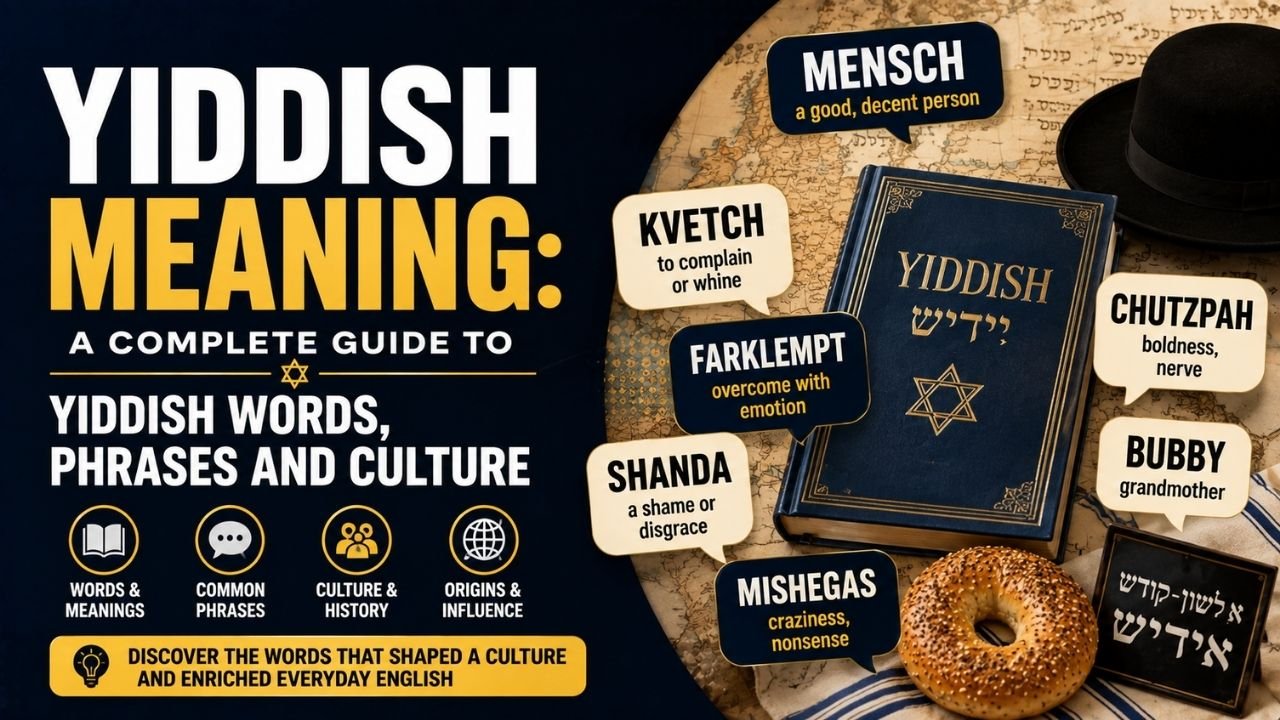
Yiddish meaning refers to the sense and origin behind words that come from Yiddish, a language born over a thousand years ago among Jewish communities in Central and Eastern Europe. Many Yiddish words now live comfortably inside everyday English, especially in the United States, even though most English speakers never studied the language itself.
This guide explains what Yiddish is, how it differs from Hebrew, and what dozens of common Yiddish words actually mean. You will find clear definitions, pronunciation help, real examples, and honest notes when a word’s origin is uncertain. The goal is simple: help you understand these words the way a fluent speaker would explain them to a curious friend.
What Is Yiddish?
Yiddish is a language that developed roughly a thousand years ago in Central Europe among Ashkenazi Jewish communities. It grew from a base of Middle High German, then absorbed vocabulary and grammar patterns from Hebrew, Aramaic, and later Slavic languages such as Polish, Russian, and Ukrainian.
Yiddish is written using the Hebrew alphabet, but the language itself is not Hebrew. It is a separate, independent language with its own grammar, sounds, and vocabulary. For centuries, Yiddish was the everyday spoken language of Jewish life across Poland, Lithuania, Ukraine, Germany, and Russia, used in homes, markets, schools, and literature.
Before World War II, an estimated 10 to 13 million people spoke Yiddish worldwide. The Holocaust devastated Yiddish speaking communities in Europe, and the number of native speakers dropped sharply. Today, Yiddish is still spoken as a first language in many Hasidic and Haredi Jewish communities, particularly in New York, and it is studied and preserved in academic programs, cultural institutions, and Jewish communities around the world.
Yiddish Meaning In Simple Terms
When someone searches for Yiddish meaning, they are usually asking one of two things.
- What does this specific Yiddish word mean?
- What is the general meaning and background of the Yiddish language itself?
Both questions matter. Individual Yiddish words carry emotional texture that is hard to translate directly into English. A single Yiddish word can capture a feeling, a type of person, or a social situation that would otherwise take a full sentence to explain. That expressive quality is a major reason so many Yiddish words survived and spread into everyday American English.
See More: FMB Meaning
Yiddish Vs Hebrew: What Is The Difference?
People often confuse Yiddish and Hebrew because both use the Hebrew alphabet and both are closely tied to Jewish history and religious life. They are not the same language.
| Feature | Yiddish | Hebrew |
| Language family | Germanic, with Hebrew, Aramaic, and Slavic influence | Semitic |
| Historical role | Everyday spoken language of Ashkenazi Jews | Traditionally the language of Jewish prayer and scripture; revived as a modern spoken language in Israel |
| Alphabet | Hebrew alphabet | Hebrew alphabet |
| Grammar | Closer to German sentence structure | Semitic grammar, distinct verb and root system |
| Modern status | Spoken mainly in some Hasidic communities and preserved culturally | Official language of Israel, spoken by millions daily |
Hebrew is the ancient liturgical language of Judaism and, since the late nineteenth and early twentieth centuries, has also been revived as the modern national language of Israel. Yiddish developed later, as the vernacular language Ashkenazi Jews used at home and in daily life, distinct from the Hebrew used in the synagogue.
Note on religion: Yiddish itself is not a religion. It is a language closely associated with Ashkenazi Jewish culture and, in many communities, with religious Jewish life, but speaking Yiddish does not indicate a particular religious practice on its own.
Yiddish Words And Phrases: Meanings, Pronunciation And Usage
Below are the most searched Yiddish words, each explained in plain English. Pronunciations are given in a simple, readable form rather than strict phonetic notation, since that is how most English speakers actually learn to say these words.
Mensch
Meaning: A mensch is a person of real integrity and decency, someone honest, kind, and reliable.
Pronunciation: “mensh” (rhymes with “bench”)
Part of speech: Noun
Mensch comes from the German word for “person” or “human being,” but in Yiddish it grew a much warmer, more specific meaning. Calling someone a mensch is high praise. It does not just mean a good person in a general sense. It means someone who does the right thing even when nobody is watching, who keeps their word, and who treats others fairly.
Example: “He drove two hours to help me move without being asked twice. That guy is a real mensch.”
Nu
Meaning: A flexible expression meaning roughly “so?”, “well?”, or “what’s up?” depending on tone and context.
Pronunciation: “noo”
Part of speech: Interjection
Nu is one of the most versatile words in Yiddish. It can express impatience, curiosity, encouragement, or mild challenge, almost entirely based on tone of voice. There is no single English word that captures it, which is part of why it survived so strongly in Yiddish influenced English.
Example: “Nu, are you going to tell me what happened or not?”
Shonda And Shanda
Meaning: A shame, disgrace, or embarrassment, often one that reflects badly on a wider group.
Pronunciation: “SHON-duh”
Part of speech: Noun
Shonda and shanda are two common spellings of the same Yiddish word. It describes something scandalous or shameful, particularly behavior that brings embarrassment not just to the person involved but to their family or community.
Example: “Leaving without saying goodbye at his own sister’s wedding? What a shonda.”
A related, well known phrase is “a shanda far di goyim,” meaning a shame in front of non Jews, historically used to describe behavior that Jewish communities worried would reflect poorly on Jews in the eyes of outsiders.
Putz
Meaning: An insult meaning a foolish or contemptible person; the word also has a vulgar anatomical meaning.
Pronunciation: “puts”
Part of speech: Noun
Putz is a mild to moderate insult in casual English use, similar in weight to calling someone a jerk or a fool. It is worth knowing that in Yiddish itself, the word’s original and more vulgar meaning refers to male anatomy, so it carries a coarser edge than its casual English usage might suggest. In everyday American speech, it is usually used more lightly, but it is still not considered polite.
Example: “Stop being a putz and just apologize to her.”
Schmuck
Meaning: An insult for a foolish, obnoxious, or contemptible person.
Pronunciation: “shmuk”
Part of speech: Noun
Schmuck works very similarly to putz. It began as a vulgar Yiddish term for male anatomy and became, in English, a common insult for someone acting foolishly or badly. Because of its origin, some speakers consider it a word to avoid in formal or mixed company, even though it is widely used casually.
Example: “He borrowed my car and returned it with an empty tank. What a schmuck.”
Schnorrer
Meaning: A beggar, moocher, or someone who habitually asks others for favors, money, or free things without offering anything back.
Pronunciation: “SHNOR-er”
Part of speech: Noun
A schnorrer is not just someone who is occasionally short on cash. The word implies a pattern, someone who makes a habit of freeloading, often with a bit of nerve or charm about it.
Example: “He never brings anything to the party but always fills his plate twice. Total schnorrer.”
Farklempt
Meaning: Overcome with emotion, often to the point of being unable to speak; choked up.
Pronunciation: “fer-KLEMPT”
Part of speech: Adjective
Farklempt describes that specific feeling of being so emotionally full, whether from sadness, joy, or nostalgia, that words temporarily fail you. It became widely known in the United States partly through comedy sketches, but its actual use describes a very real and common human experience.
Example: “She got farklempt during the toast at her daughter’s wedding.”
Yenta
Meaning: A gossip, or someone who talks too much about other people’s business; can also mean a busybody matchmaker.
Pronunciation: “YEN-tuh”
Part of speech: Noun
Yenta was originally a common Yiddish first name. Over time it became a general term for a gossipy, meddling person, largely because of the character Yente in the musical “Fiddler on the Roof,” a matchmaker who is deeply involved in everyone’s personal affairs.
Example: “Don’t tell Aunt Ruth. She’s a yenta, and the whole family will know by dinner.”
Landsman
Meaning: A fellow countryman, specifically someone from the same town, region, or country of origin, often used to describe a fellow Jewish immigrant from the same part of Europe.
Pronunciation: “LANDS-mun”
Part of speech: Noun
Landsman carries a sense of shared roots and mutual recognition. Among immigrant communities, meeting a landsman meant meeting someone who understood your background without needing an explanation.
Example: “When my grandfather arrived in New York, a landsman from his hometown helped him find work.”
Goniff
Meaning: A thief, crook, or dishonest person.
Pronunciation: “GON-if”
Part of speech: Noun
Goniff (sometimes spelled ganef or ganev) is used both literally, for an actual thief, and more loosely, for someone who is simply dishonest, sneaky, or takes more than their fair share.
Example: “That contractor overcharged us by a mile. He’s a real goniff.”
Bubby (Bubbe)
Meaning: Grandmother; a warm, affectionate term for a grandmother.
Pronunciation: “BUB-ee”
Part of speech: Noun
Bubby, also spelled bubbe, is the Yiddish word for grandmother, used the way “grandma” or “nana” is used in English. It is an affectionate, everyday term rather than a formal one.
Example: “We’re going to Bubby’s house for Friday night dinner.”
Kvetch
Meaning: To complain, especially in a persistent or whiny way; also used as a noun for a person who complains a lot.
Pronunciation: “kvetch” (rhymes with “fetch”)
Part of speech: Verb and noun
Kvetch can describe the act of complaining (“Stop kvetching about the weather”) or the person doing it (“He’s such a kvetch”). It carries a slightly humorous, exasperated tone rather than a harsh one.
Example: “Every family dinner, someone kvetches about the traffic getting there.”
Mishpucha
Meaning: Family, in the broad sense, including extended relatives and sometimes close friends treated like family.
Pronunciation: “mish-POO-khuh”
Part of speech: Noun
Mishpucha refers to the whole family network, not just parents and siblings. It is often used warmly to include in laws, cousins, and close family friends.
Example: “The whole mishpucha showed up for the baby naming.”
Schmutz
Meaning: Dirt, grime, or a small smudge, usually on skin, clothing, or a surface.
Pronunciation: “shmuts”
Part of speech: Noun
Schmutz is a light, everyday word, most often used for something small and easily wiped away, like a stray bit of food on someone’s face.
Example: “You’ve got a bit of schmutz on your chin from the sauce.”
Mishegas
Meaning: Craziness, nonsense, or chaotic, irrational behavior or situations.
Pronunciation: “mish-uh-GAHS”
Part of speech: Noun
Mishegas describes the kind of chaotic nonsense that makes you shake your head, whether it is family drama, office politics, or an overly complicated situation.
Example: “I don’t have time for this scheduling mishegas today.”
Punim
Meaning: Face, often used affectionately, especially toward children.
Pronunciation: “PUN-im”
Part of speech: Noun
Punim is most commonly heard in the phrase “sheyne punim,” meaning pretty face, said fondly to a baby or young child.
Example: “Look at that sweet little punim!”
Nebbish
Meaning: A timid, awkward, or ineffectual person; someone easily overlooked or pitied.
Pronunciation: “NEB-ish”
Part of speech: Noun and adjective
A nebbish is not exactly disliked, just unremarkable and a little hapless, the kind of person who fades into the background and never quite gets their way.
Example: “He’s a nice enough guy, but honestly a bit of a nebbish at meetings.”
Nachas
Meaning: A deep sense of pride and joy, especially the pride parents or grandparents feel from a child’s achievements.
Pronunciation: “NAHKH-us”
Part of speech: Noun
Nachas describes a specific kind of warm, glowing pride, the feeling a parent gets watching their child succeed or do something good.
Example: “Watching him graduate gave his parents so much nachas.”
Shpilkes
Meaning: A restless, nervous energy; the feeling of being unable to sit still.
Pronunciation: “SHPIL-kess”
Part of speech: Noun
Shpilkes literally traces back to a word for pins or needles, capturing that antsy, on edge feeling, like sitting on pins and needles.
Example: “The kids have shpilkes waiting for the movie to start.”
See More: Sincerity Meaning
Narishkeit
Meaning: Foolishness, silliness, or nonsense.
Pronunciation: “NAR-ish-kite”
Part of speech: Noun
Narishkeit describes behavior or talk that is silly or pointless, often used with mild affection rather than sharp criticism.
Example: “Enough narishkeit, let’s get back to work.”
Yiddishkeit
Meaning: Jewishness as a lived, cultural experience, including tradition, community, food, humor, and values, not strictly religious observance.
Pronunciation: “YID-ish-kite”
Part of speech: Noun
Yiddishkeit refers to the full cultural feeling and identity connected to Jewish, particularly Ashkenazi, life and tradition. It is broader than religion alone and includes community, humor, food, and shared history.
Yiddish Meaning Of Goy: Etymology And Usage
The word goy comes originally from Hebrew, not Yiddish, though Yiddish adopted and popularized it widely. In Hebrew, goy simply meant “nation” or “people,” and it was historically used in the Hebrew Bible to refer to nations in general, including Israel itself in some passages.
Over time, in Yiddish and later in English, goy came to mean specifically a non Jewish person. The plural form is goyim. The word is generally neutral or descriptive in everyday use, though tone and context can shift it toward a more pointed or, less commonly, dismissive meaning. Most commonly today, it is used simply to describe someone who is not Jewish, without negative intent.
Words People Search Under “Yiddish Meaning” That Need A Careful Answer
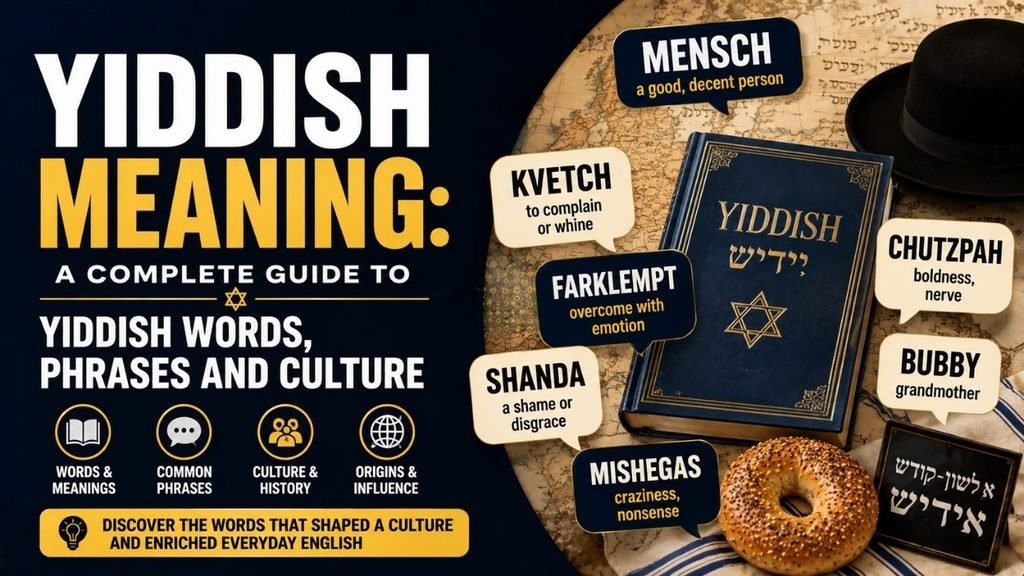
Not every word people search alongside Yiddish is actually Yiddish. Being accurate matters more than giving an answer for every possible search.
Satchmo: Satchmo is not a Yiddish word. It is the well known nickname of jazz musician Louis Armstrong, generally believed to come from “satchel mouth,” a playful reference to his wide smile and mouth shape. It has no established Yiddish origin or meaning.
Famished: Famished is an English word, not a Yiddish one. It means extremely hungry, and it comes from the Latin root “fames,” meaning hunger, through Old French. It is unrelated to Yiddish vocabulary, though hunger and food are, unsurprisingly, common themes in Yiddish influenced humor and family life.
Being upfront about words like these matters. A trustworthy answer says clearly when a word does not belong to the language being discussed, rather than forcing a connection that does not exist.
Yiddish Words In Everyday English
Many Yiddish words have become so common in American English that people use them without realizing their origin. This happened largely because of Jewish immigration to the United States in the late nineteenth and early twentieth centuries, especially in cities like New York, where Yiddish influenced local speech, entertainment, and later, national media and comedy.
Common examples include mensch, schlep, klutz, chutzpah, bagel, kibitz, spiel, and glitch, alongside the words explained in detail above. This borrowing is one reason Yiddish, despite having far fewer native speakers today than a century ago, still shapes the sound and texture of casual American English.
Yiddish Meaning In Slang
In slang usage, Yiddish words often function as compact emotional shortcuts. English sometimes needs a full sentence to describe what a single Yiddish word captures instantly, such as the specific pride of nachas, the restless energy of shpilkes, or the choked up feeling of farklempt.
This is a major reason Yiddish slang spread so widely, even among speakers with no Jewish or Yiddish speaking background. The words fill real gaps in everyday emotional vocabulary.
Common Mistakes With Yiddish Words
❌ Incorrect: Treating Yiddish and Hebrew as the same language.
✅ Correct: Yiddish is a distinct Germanic influenced language; Hebrew is a separate Semitic language.
❌ Incorrect: Assuming every Jewish culture related word is Yiddish.
✅ Correct: Some words, like goy, actually originate from Hebrew, even though Yiddish popularized their everyday use.
❌ Incorrect: Using putz or schmuck casually without knowing their vulgar origin.
✅ Correct: Both words started as coarse anatomical terms; even in casual English use, they are still considered impolite.
❌ Incorrect: Confusing schnorrer (a moocher) with schmutz (dirt) because the words sound similar.
✅ Correct: These are unrelated words with completely different meanings.
Similar And Confusing Yiddish Words
| Word | Meaning | How It Differs |
| Kvetch | To complain | Focuses on whining, not necessarily dishonesty |
| Kvell | To beam with pride | Similar warmth to nachas, but describes the visible reaction of pride itself |
| Schmutz | Dirt or a smudge | Refers to a physical mess, not a person or behavior |
| Mishegas | Craziness or chaos | Describes a situation, not a single messy object |
| Nebbish | A timid, overlooked person | Mild and slightly pitying, unlike sharper insults such as putz |
| Putz or schmuck | A foolish, contemptible person | Sharper insult with a vulgar origin, unlike the gentler nebbish |
Yiddish Meaning In Different Languages
People searching in different languages, including Hindi, Urdu, Tamil, and Arabic, are usually looking for a straightforward translation and explanation of what Yiddish means as a language, rather than a translation of individual slang words.
In simple terms, across any language, Yiddish means: a historical Jewish language from Central and Eastern Europe, related to German, written in Hebrew script, and still spoken today mainly among some Orthodox and Hasidic Jewish communities.
The cultural words explained throughout this guide, such as mensch, kvetch, and chutzpah, generally do not have single word equivalents in other languages, which is part of why they are so often borrowed directly rather than translated.
See More: EVB Meaning In Text
Frequently Asked Questions
What does Yiddish mean as a language?
Yiddish is a historical Jewish language that developed from Middle High German, combined with Hebrew, Aramaic, and Slavic influences, traditionally spoken by Ashkenazi Jews across Central and Eastern Europe.
Is Yiddish the same as Hebrew?
No. Yiddish and Hebrew are separate languages. Yiddish is Germanic in structure, while Hebrew is Semitic. Both are written in the Hebrew alphabet, but they developed differently and serve different historical roles.
What does mensch mean in Yiddish?
A mensch is a person of genuine integrity, someone honest, decent, and reliable, considered a real compliment when used to describe someone.
What does shonda or shanda mean?
Shonda and shanda both mean a shame or disgrace, often something embarrassing enough to reflect on a wider family or community.
Is putz a bad word?
Putz began as a vulgar Yiddish term and is still considered impolite, even though it is commonly used in casual English as a mild insult meaning a foolish person.
What does nu mean in Yiddish?
Nu is a flexible expression roughly meaning “so?” or “well?” and its exact meaning shifts based on tone and context.
What does kvetch mean?
Kvetch means to complain, often in a persistent or whiny way, and can also describe a person who complains frequently.
Is goy a Yiddish word or a Hebrew word?
Goy originates from Hebrew, where it originally meant nation or people, but it became widely used through Yiddish to mean a non Jewish person.
Is Satchmo a Yiddish word?
No. Satchmo is a nickname for jazz musician Louis Armstrong, generally believed to come from “satchel mouth,” and it has no connection to Yiddish.
What does mishpucha mean?
Mishpucha means family, including extended relatives, and is often used to describe a close knit or broad family network.
How do you pronounce farklempt?
Farklempt is pronounced “fer-KLEMPT,” with the emphasis on the second syllable, and it means overcome with emotion.
Final Thoughts
Yiddish is far more than a list of borrowed slang terms. It is a full language with its own grammar, history, and identity, shaped by centuries of Jewish life across Central and Eastern Europe and carried forward today by speakers, writers, and cultural communities who keep it alive. Understanding the real Yiddish meaning behind words like mensch, kvetch, farklempt, and mishpucha means understanding a small piece of that larger story.
Whether you came here to settle a debate about what schmuck really means, to understand the difference between Yiddish and Hebrew, or simply to expand your vocabulary, the words explained in this guide are meant to be used with both accuracy and respect. Yiddish words carry emotional precision that English often lacks, and that is exactly why so many of them found a permanent home in everyday American speech.

Hassan Ibrahim is the author behind Mean Fixer, with 4 years of experience researching and writing about names, words, slang, meanings, and everyday language. Their goal is to make confusing words and meanings simple, clear, and easy to understand through accurate, useful, and reader-friendly explanations.
One Comment