
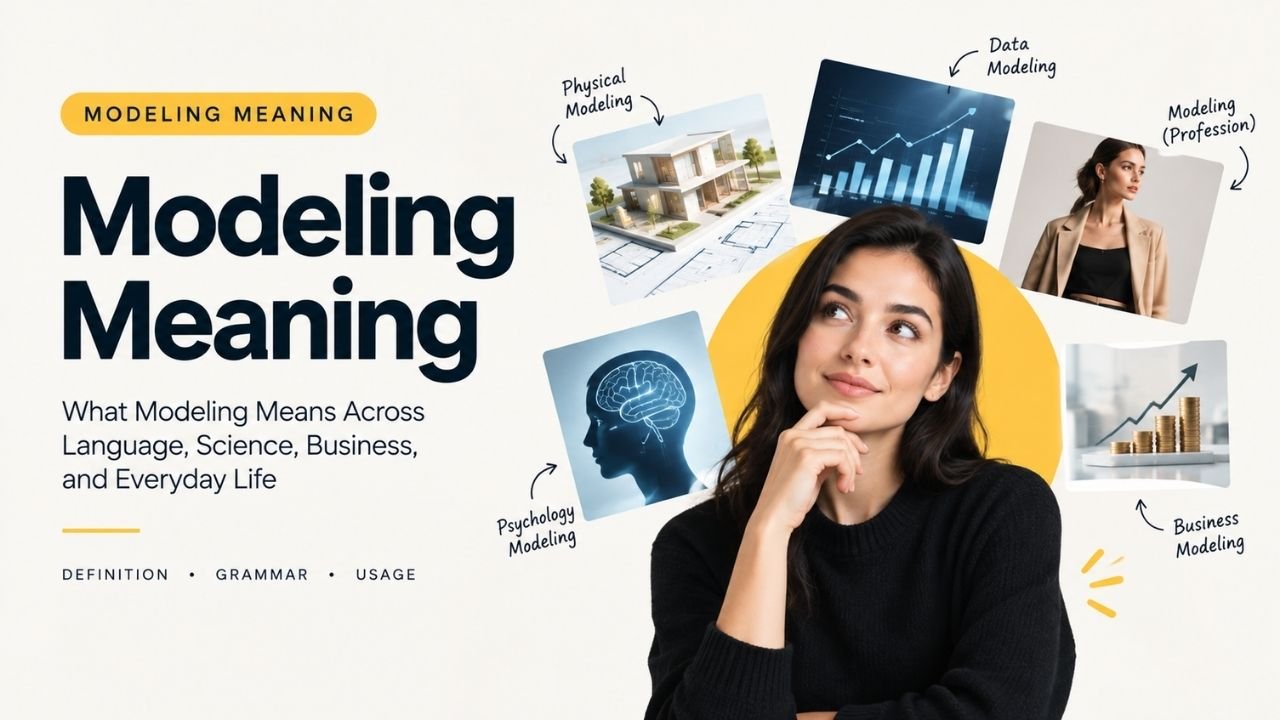
Modeling meaning is simple at its core: modeling means building a version of something so it can be understood, tested, or shown to others. That “something” can be a physical object, a set of numbers, a behavior, or even a person’s appearance. The word stretches across many fields, and each field bends the meaning slightly to fit its own needs.
This flexibility is exactly why so many people search for the phrase. A student researching data science, a parent hearing about role modeling from a teacher, and someone curious about a modeling career are all typing the same word into a search bar. This guide walks through every major sense of modeling, in plain English, with clear examples and no unnecessary jargon.
What Does Modeling Mean?
At its simplest, modeling means creating a representation of something. That representation stands in for the real thing so people can study it, test it, or learn from it without dealing with the full complexity of the original.
There are three broad categories worth knowing before diving into specific fields.
- Physical modeling: building a small, scaled, or simplified version of a real object, such as a clay figure, a 3D printed part, or an architectural model.
- Abstract modeling: using numbers, equations, or diagrams to represent something that is not physical, such as financial modeling or statistical modeling.
- Behavioral modeling: demonstrating or copying behavior, such as role modeling in parenting or modeling meaning in psychology.
A separate, everyday sense also exists: modeling as a job, where a person wears clothing or poses for photos, video, or artwork. This sense feels unrelated to the others at first glance, but it shares the same root idea. A model, in fashion, is literally a person who represents how clothing or a product looks on a human body.
Modeling Meaning and Grammar
Modeling is the present participle and gerund form of the verb “to model.” Understanding its grammar helps with correct usage in writing and speech.
| Form | Word | Function |
| Base verb | model | I model new software features before building them. |
| Gerund | modeling | Modeling helps engineers predict how a bridge will behave. |
| Present participle | modeling | She is modeling the data in a spreadsheet. |
| Noun | model | The model showed strong results. |
| Past tense | modeled | He modeled the building last year. |
As a gerund, modeling acts like a noun. In “Modeling is important in engineering,” modeling is the subject of the sentence. As a present participle, it works with a helping verb, as in “They are modeling customer behavior.”
Modeling can also function as a noun on its own, referring to the profession, as in “She started modeling at nineteen,” or referring to the activity itself, as in “Modeling takes patience and attention to detail.”
See More: EVB Meaning In Text
Modeling vs Modelling: Which Spelling Is Correct?
Both spellings are correct, but they belong to different varieties of English.
- Modeling is the standard American English spelling, used throughout the United States and Canada.
- Modelling (with two Ls) is the standard British English spelling, used in the UK, Australia, India, and most Commonwealth countries.
The double-L pattern follows a common British English rule: when a word ends in a single vowel plus a single consonant, British English often doubles the final consonant before adding a suffix like -ing. American English usually does not double it unless the stress falls on that final syllable. Both forms are pronounced the same way and mean exactly the same thing. The choice comes down to which English variety the writer is using, not correctness.
How to Pronounce Modeling
Modeling is pronounced MOD-uh-ling in American English, with the stress on the first syllable.
- IPA (American): /ˈmɒd.əl.ɪŋ/
- IPA (British): /ˈmɒd.əl.ɪŋ/ (modelling, same sound pattern)
The word has three syllables: mod, uh, and ling. The “uh” sound is soft and quick, almost blending into the syllables around it in fast speech. There is no meaningful difference in pronunciation between American and British English here, even though the spelling differs.
Origin and Etymology of Modeling
The word model comes from the Old French word “modelle,” which itself came from the Italian “modello.” Both trace back to the Latin word “modulus,” meaning a small measure or standard. Modulus is related to “modus,” the Latin word for measure or manner.
Originally, a model referred to a small representation of a planned structure, often used by architects and sculptors to plan buildings or artworks before creating the full-size version. Over the following centuries, the meaning expanded from physical objects into abstract representations, and eventually into the modern verb “to model,” meaning to create such a representation. The -ing suffix simply turns that verb into its gerund or participle form, giving us modeling.
The fashion sense of the word developed later, sometime in the 19th century, when the term “model” began referring to a person who displayed clothing designs, much like a small model displays a design in miniature.
Modeling Meaning in Different Contexts: Quick Overview
Because modeling shows up in so many industries, a quick comparison table helps before going deeper into each one.
| Context | What Modeling Means There |
| Data modeling | Organizing and structuring data so systems can store and use it |
| Financial modeling | Building spreadsheets that forecast a company’s finances |
| BIM modeling | Creating a digital 3D representation of a building |
| 3D modeling | Building a three-dimensional digital object using software |
| CAD modeling | Designing precise technical drawings and objects digitally |
| Statistical modeling | Using math to describe relationships in data |
| Predictive modeling | Using data to forecast future outcomes |
| Psychology | Learning behavior by observing and copying others |
| Fashion and commercial work | Posing or wearing products for photos, video, or shows |
| Health | Simulating disease spread, treatment outcomes, or body systems |
Each of these deserves its own closer look, since the details matter for anyone researching a specific field.
Data Modeling Meaning
Data modeling means organizing information into a clear structure so a computer system can store, connect, and retrieve it efficiently. It is one of the first steps in building any database or software system.
A data model defines what kinds of information exist, such as customers, orders, or products, and how those pieces of information relate to each other. For example, a data model for an online store would define that one customer can place many orders, and each order contains one or more products.
There are typically three levels of data modeling:
- Conceptual data modeling: a high-level view of what data exists and how it relates, without technical detail.
- Logical data modeling: adds structure, such as fields and data types, without tying it to a specific database system.
- Physical data modeling: the final, technical version that a database actually uses, including tables, columns, and indexes.
Good data modeling prevents confusion, duplicate information, and errors later in a project. It is considered a foundational skill in database design, software engineering, and data analytics.
Financial Modeling Meaning
Financial modeling means building a structured spreadsheet or tool that represents a company’s past, present, and expected future financial performance. Analysts, investors, and business owners use financial models to make decisions.
A typical financial model includes projected revenue, expenses, profit, and cash flow, often stretching several years into the future. These models rely on assumptions, such as expected sales growth or cost changes, which the person building the model must research and justify.
Common uses of financial modeling include:
- Deciding whether to invest in a company or startup.
- Planning a company budget for the coming year.
- Valuing a business before a sale or merger.
- Testing how changes, like a price increase, would affect profit.
Financial modeling is widely taught in finance, accounting, and business programs, and it remains a core skill for careers in investment banking, corporate finance, and equity research.
See More: Sincerity Meaning
BIM Modeling Meaning
BIM modeling stands for Building Information Modeling. It means creating a detailed, intelligent 3D digital representation of a building before or during construction.
Unlike a simple 3D shape, a BIM model contains information about every part of the building, including materials, dimensions, costs, and how different systems, such as plumbing and electrical wiring, fit together. Architects, engineers, and construction teams share this same model, which reduces mistakes and miscommunication.
BIM modeling is widely used because it allows teams to:
- Spot design conflicts before construction begins, such as a pipe running through a support beam.
- Estimate material costs more accurately.
- Plan construction schedules using the same shared model.
- Maintain the building’s information even after construction, for future repairs or renovations.
Many governments and large construction firms now require BIM modeling on major projects because it reduces costly errors and improves collaboration between teams.
3D Modeling Meaning
3D modeling means creating a three-dimensional digital object using specialized computer software. The result is called a 3D model, and it can represent almost anything: a character in a video game, a piece of furniture, a mechanical part, or a building.
3D modeling works by placing and connecting points, called vertices, in a virtual three-dimensional space. These points form edges and surfaces, building up a shape the way a sculptor builds a shape from clay, except entirely inside a computer.
3D modeling is used across many industries:
- Entertainment: characters, environments, and props for films, animation, and video games.
- Product design: prototypes of products before they are manufactured.
- Architecture: visualizing buildings before construction.
- 3D printing: creating the digital file that a 3D printer later builds into a physical object.
Popular 3D modeling software includes Blender, Autodesk Maya, and Autodesk 3ds Max, each suited to slightly different industries and workflows.
CAD Modeling Meaning
CAD modeling stands for Computer Aided Design modeling. It means using specialized software to create precise, technical, and often engineering-focused digital designs.
CAD modeling differs slightly from general 3D modeling because it emphasizes accuracy, measurements, and manufacturability rather than visual appearance alone. Engineers use CAD modeling to design parts that must fit together exactly, such as machine components, electronics housings, or vehicle parts.
Common features of CAD modeling include:
- Exact measurements down to fractions of a millimeter.
- The ability to test how parts move or fit together.
- Direct compatibility with manufacturing equipment, including 3D printers and CNC machines.
Popular CAD software includes AutoCAD, SolidWorks, and Fusion 360. CAD modeling is essential in mechanical engineering, product design, and manufacturing.
Parametric Modeling Meaning
Parametric modeling means designing a digital model using adjustable values, called parameters, so that changing one value automatically updates the entire design.
For example, if a designer builds a parametric model of a table using parameters for height, width, and leg thickness, changing the height value will automatically resize the entire table, including all connected parts, without redrawing anything manually.
This approach saves enormous time during the design process, especially when a design goes through many rounds of changes. Parametric modeling is common in:
- Architecture, where building dimensions often change during planning.
- Mechanical engineering, where part sizes are frequently adjusted.
- Product design, where multiple size variants of the same product are needed.
Parametric modeling tools include software such as SolidWorks, Revit, and Grasshopper, a parametric design tool often used alongside Rhino 3D.
Statistical Modeling Meaning
Statistical modeling means using mathematical equations and probability to describe relationships between variables in a dataset. It helps researchers and analysts understand patterns and make informed estimates about data.
A statistical model might describe how advertising spending relates to sales, or how a patient’s age relates to recovery time after surgery. These models rely on data collected from the real world, along with assumptions about how that data behaves.
Common types of statistical models include:
- Linear regression: describes a straight-line relationship between two variables.
- Logistic regression: predicts categories, such as yes or no outcomes.
- Time series models: analyze data that changes over time, such as stock prices.
Statistical modeling forms the backbone of fields such as economics, medicine, social science research, and quality control in manufacturing.
Predictive Modeling Meaning
Predictive modeling means using historical data and statistical or machine learning techniques to forecast future outcomes. It builds directly on statistical modeling but focuses specifically on prediction rather than just description.
A predictive model might estimate whether a customer will cancel a subscription, whether a loan applicant is likely to repay a loan, or how much rainfall an area will receive next month. The model learns patterns from past data and applies those patterns to new, unseen situations.
Predictive modeling is widely used in:
- Marketing, to predict which customers are likely to make a purchase.
- Healthcare, to identify patients at risk of certain conditions.
- Finance, to assess credit risk.
- Weather forecasting, to predict upcoming conditions.
Common tools for predictive modeling include Python, R, and specialized machine learning platforms, though the underlying statistical principles remain the same regardless of the software used.
Computational Modeling Meaning
Computational modeling means using computer simulations, based on mathematical equations, to study systems that are too complex, expensive, or dangerous to test directly in the real world.
Instead of building a physical experiment, researchers build a computer program that mimics how a system behaves. Scientists can then change variables and observe results instantly, without needing new physical materials or lab time for every test.
Computational modeling appears in many scientific fields:
- Climate science: simulating how greenhouse gases affect global temperatures over decades.
- Physics: modeling particle behavior at scales too small to observe directly.
- Biology: simulating how proteins fold or how diseases spread through a population.
- Engineering: testing how structures respond to stress before building them.
Computational modeling has become essential in modern research because it allows scientists to test countless scenarios quickly and safely.
CFD Modeling Meaning
CFD modeling stands for Computational Fluid Dynamics modeling. It means using computer simulations to study how liquids and gases move and behave.
CFD modeling breaks a fluid, such as air or water, into millions of small sections and calculates how each section moves, based on physics equations, as it interacts with objects and forces around it.
CFD modeling is widely used in:
- Aerospace engineering: testing how air flows around an aircraft wing.
- Automotive design: improving a car’s aerodynamics to reduce fuel use.
- HVAC design: predicting how air circulates inside a building.
- Weather prediction: modeling how air masses move in the atmosphere.
Because building physical wind tunnels and prototypes is expensive, CFD modeling allows engineers to test many design variations digitally before committing to physical testing.
Process Modeling Meaning
Process modeling means creating a visual or structured representation of how a business process works, step by step. It shows what happens, in what order, and who or what is responsible for each step.
A process model might map out how a customer order moves from the moment it is placed to the moment it ships, including every department and system involved along the way.
Process modeling commonly uses diagrams such as:
- Flowcharts: simple step-by-step diagrams.
- BPMN diagrams: Business Process Model and Notation, a standardized diagramming system.
- Swimlane diagrams: diagrams that show which team or role handles each step.
Businesses use process modeling to identify bottlenecks, remove unnecessary steps, and train new employees on how a workflow actually functions.
Attribution Modeling Meaning
Attribution modeling means determining which marketing touchpoints, such as ads, emails, or social media posts, deserve credit for leading a customer to make a purchase.
A customer might see a social media ad, later click a search ad, and finally buy a product after receiving an email. Attribution modeling decides how much credit each of those interactions gets for the final sale.
Common attribution models include:
- First-touch attribution: gives all credit to the first interaction a customer had with the brand.
- Last-touch attribution: gives all credit to the final interaction before purchase.
- Linear attribution: spreads credit evenly across every touchpoint.
- Multi-touch attribution: uses data and algorithms to weigh each touchpoint based on its actual influence.
Marketing teams rely on attribution modeling to decide where to spend advertising budgets, since it reveals which channels genuinely drive sales rather than simply appearing before a purchase by coincidence.
Fused Deposition Modeling Meaning
Fused deposition modeling, often shortened to FDM, is a type of 3D printing technology. It means building a physical object by melting plastic filament and depositing it layer by layer until the full shape forms.
The 3D printer heats a thin plastic filament until it softens, then pushes it through a nozzle that moves precisely according to a digital 3D model. Each layer bonds to the one below it, gradually building up a solid object from the bottom up.
Fused deposition modeling is one of the most common and affordable 3D printing methods, widely used for:
- Rapid prototyping of new product designs.
- Educational and hobbyist 3D printing.
- Manufacturing custom parts and tools.
FDM printers are popular partly because the technology is simple, reliable, and works with a wide range of affordable plastic materials.
Modeling Meaning in Psychology
In psychology, modeling means learning a new behavior by observing someone else perform it, then copying that behavior. This concept comes primarily from Albert Bandura’s Social Learning Theory, developed in the 1960s and 1970s.
Bandura’s famous Bobo doll experiments demonstrated that children who watched an adult behave aggressively toward a doll were more likely to imitate that aggression afterward, even without being told to do so. This showed that people, especially children, learn a great deal simply by watching others, not only through direct instruction or reward.
Psychological modeling includes several key elements:
- Attention: the observer must notice and pay attention to the behavior.
- Retention: the observer must remember what they saw.
- Reproduction: the observer must be physically or mentally able to copy the behavior.
- Motivation: the observer must have a reason to imitate the behavior.
Modeling explains a wide range of human learning, from children copying their parents’ speech patterns to adults picking up habits from coworkers or mentors. It remains one of the most influential ideas in developmental and behavioral psychology.
Role Modeling Meaning
Role modeling means demonstrating behavior, values, or skills that others, often children or newer members of a group, are encouraged to observe and imitate. A role model is the person whose behavior serves this purpose.
Role modeling appears constantly in everyday life:
- Parents role model how to handle stress, speak to others, and solve problems.
- Teachers role model curiosity, patience, and fairness.
- Managers role model work ethic, communication style, and professionalism.
- Coaches role model discipline, resilience, and teamwork.
Effective role modeling usually works best when it is consistent. A person who says one thing but behaves differently tends to teach the behavior they actually display, not the one they describe, since observers naturally pay closer attention to actions than words.
Modeling Meaning in Health
In healthcare and public health, modeling means using data and mathematical simulations to understand diseases, predict outbreaks, or evaluate treatments before applying them to real patients.
Health modeling includes several important applications:
- Epidemiological modeling: predicting how a disease will spread through a population, which became widely discussed during the COVID-19 pandemic.
- Disease progression modeling: estimating how an illness will develop over time in an individual patient.
- Treatment outcome modeling: predicting how well a patient might respond to a specific treatment or medication.
- Anatomical modeling: creating 3D representations of organs or body structures, often used in surgical planning or medical education.
Health modeling helps doctors, researchers, and policymakers make informed decisions without needing to test every possible scenario directly on real patients, which would often be unsafe or unethical.
Fashion, Commercial, Editorial, and Fit Modeling Meaning
Outside of science and technology, modeling also refers to a well-known profession involving fashion, advertising, and photography. Several distinct categories exist within this profession, and each has a different meaning and purpose.
| Type of Modeling | What It Means |
| Fashion modeling | Wearing designer clothing on runways or in high-fashion photo shoots |
| Commercial modeling | Appearing in advertisements for everyday products and brands |
| Editorial modeling | Appearing in fashion magazine spreads, often artistic rather than commercial |
| Fit modeling | Trying on clothing during production so designers can check sizing and fit |
Fashion modeling focuses on high-end designer clothing, often shown on runways during fashion weeks or in glossy fashion campaigns. It typically requires specific height and body proportions favored by designers.
Commercial modeling covers a much broader range of people and looks, since it represents everyday products such as food, technology, or household items. Commercial modeling values relatability and approachability over the strict physical standards of high fashion.
Editorial modeling appears in magazine features and artistic photo shoots. It often prioritizes striking or unusual looks over conventional beauty standards, since the goal is artistic storytelling rather than direct product promotion.
Fit modeling serves a practical, behind-the-scenes purpose. Fit models try on unfinished clothing samples during the design process so a brand can check how a garment fits a specific body size before mass production begins. Fit models are not usually photographed at all; their body measurements are the actual product being used.
Clay Modeling Meaning
Clay modeling means shaping soft, moldable clay by hand into a three-dimensional figure, object, or sculpture. It is one of the oldest and most direct forms of physical modeling, long used in art, education, and craftsmanship.
Clay modeling typically involves techniques such as pinching, coiling, rolling, and carving to shape the material before it hardens or is fired in a kiln. It is widely taught in schools because it helps develop fine motor skills, spatial thinking, and creativity, especially in young children.
Clay modeling also plays a professional role in industries such as:
- Sculpture and fine art.
- Automotive design, where clay models are still used to shape and refine vehicle body designs by hand.
- Special effects and character design for film and animation.
Modeling Meaning in Teaching
In education, modeling means demonstrating a skill, process, or way of thinking so students can observe it before attempting it themselves. Teachers use modeling as an instructional strategy, closely related to the psychological concept discussed earlier.
For example, a teacher might model how to solve a math problem step by step out loud, allowing students to hear the thought process, not just see the final answer. This approach is sometimes called a “think-aloud” and is considered one of the most effective teaching techniques for building new skills.
Modeling in teaching typically follows three stages:
- I do: the teacher demonstrates the skill alone.
- We do: the teacher and students practice together.
- You do: students practice the skill independently.
This gradual release approach helps students build confidence before attempting a task entirely on their own.
Modeling Meaning in Other Languages
Because modeling is searched in many regions, it helps to briefly note how the word is generally understood across different languages, even though direct translation often depends on context.
- Modeling meaning in Hindi: generally understood as “मॉडलिंग,” most often referring to the fashion or 3D design professions, borrowed directly from English.
- Modeling meaning in Tamil: commonly written as “மாடலிங்,” used the same way, especially for fashion or technical modeling contexts.
- Modeling meaning in Urdu: written as “ماڈلنگ,” again typically referring to fashion modeling or a representation in technical fields.
- Modeling meaning in Bengali: written as “মডেলিং,” used similarly across fashion and technical senses.
- Modeling meaning in Marathi: written as “मॉडेलिंग,” following the same pattern.
- Modeling meaning in Kannada: written as “ಮಾಡೆಲಿಂಗ್,” used in fashion and design contexts.
- Modeling meaning in Telugu: written as “మోడలింగ్,” used the same way.
- Modeling meaning in Malayalam: written as “മോഡലിംഗ്,” following the same borrowed usage.
Across all of these languages, the word modeling is largely borrowed directly from English rather than translated into a completely different native word, since the term describes concepts, such as fashion work or 3D design, that entered these regions primarily through English-language industries.
Synonyms and Related Words
Depending on context, several words relate closely to modeling, though none are perfect substitutes in every situation.
| Word | Meaning | Difference From Modeling |
| Simulating | Recreating a process or system to study its behavior | Often more focused on ongoing behavior over time, rather than a static representation |
| Representing | Standing in for something else | A broader, more general term that lacks modeling’s technical or structured process |
| Prototyping | Building an early, testable version of a product | Usually physical and iterative, aimed at product development specifically |
| Simulacrum | A representation or imitation of something | A more formal or academic term, rarely used in everyday or technical speech |
| Emulating | Imitating behavior, often in computing or personal conduct | Focuses specifically on copying behavior or function, not building a structure |
These words overlap with modeling in certain contexts but are not always interchangeable. Choosing the right word depends heavily on the specific field being discussed.
Common Mistakes With the Word Modeling
A few mix-ups appear frequently, especially among learners of English or people new to a technical field.
Incorrect: She is a model for her portfolio, showing off new clothes for the client’s brand identity design. Correct: She is modeling new clothes for the client, and her portfolio shows examples of her past work.
The word “model” as a noun refers to the person or the representation itself, while “modeling” refers to the ongoing activity. Mixing these up creates confusing sentences.
Incorrect: The engineer modeled data, but forgot to model it correct. Correct: The engineer modeled the data, but forgot to model it correctly.
“Correct” is an adjective, while “correctly” is the adverb needed to describe how an action, like modeling, was performed.
Incorrect: He is modelling in America and prefers that spelling for his resume, since it looks more correct. Correct: Either spelling, modeling or modelling, is correct, but writers should stay consistent within a single document, matching the English variety their audience expects.
See More: Aforementioned Meaning
Frequently Asked Questions About Modeling Meaning
What does modeling mean in simple terms?
Modeling means creating a representation of something, whether physical, mathematical, or behavioral, so it can be studied, tested, or demonstrated.
Is modeling a noun or a verb?
Modeling functions as a gerund or present participle of the verb “model,” and it can also act as a standalone noun referring to an activity or profession.
What is the difference between modeling and modelling?
There is no difference in meaning. Modeling is the American English spelling, while modelling is the British English spelling.
What does modeling mean in data science?
In data science, modeling usually refers to building statistical or machine learning models that find patterns in data and make predictions.
What does modeling mean in psychology?
In psychology, modeling means learning behavior by observing and imitating someone else, a concept central to Bandura’s Social Learning Theory.
What is BIM modeling used for?
BIM modeling is used to create detailed digital representations of buildings, helping architects, engineers, and construction teams collaborate and avoid design errors.
What is the difference between 3D modeling and CAD modeling?
3D modeling generally focuses on visual shape and appearance, often for art or entertainment, while CAD modeling focuses on precise, technical designs meant for engineering and manufacturing.
What does fit modeling mean in fashion?
Fit modeling means trying on unfinished clothing samples so designers can check sizing and fit before a garment goes into full production.
What is attribution modeling in marketing?
Attribution modeling means deciding how much credit each marketing touchpoint, such as an ad or email, deserves for leading to a final sale.
How do you pronounce modeling?
Modeling is pronounced MOD-uh-ling, with stress on the first syllable, and the pronunciation stays the same regardless of American or British spelling.
Conclusion
Modeling meaning ultimately comes down to one core idea: building a representation of something so it becomes easier to understand, test, or demonstrate. Whether that representation is a spreadsheet forecasting a company’s revenue, a digital building in BIM software, a child copying a parent’s behavior, or a person wearing clothes for a photo shoot, the same underlying concept connects every version of the word.
Understanding which type of modeling applies in a given situation makes the term far less confusing. Readers researching data modeling, financial modeling, psychology, health, fashion, or engineering can now recognize exactly which sense of modeling fits their needs, and use the word correctly and confidently in their own writing or conversation.

Hassan Ibrahim is the author behind Mean Fixer, with 4 years of experience researching and writing about names, words, slang, meanings, and everyday language. Their goal is to make confusing words and meanings simple, clear, and easy to understand through accurate, useful, and reader-friendly explanations.