
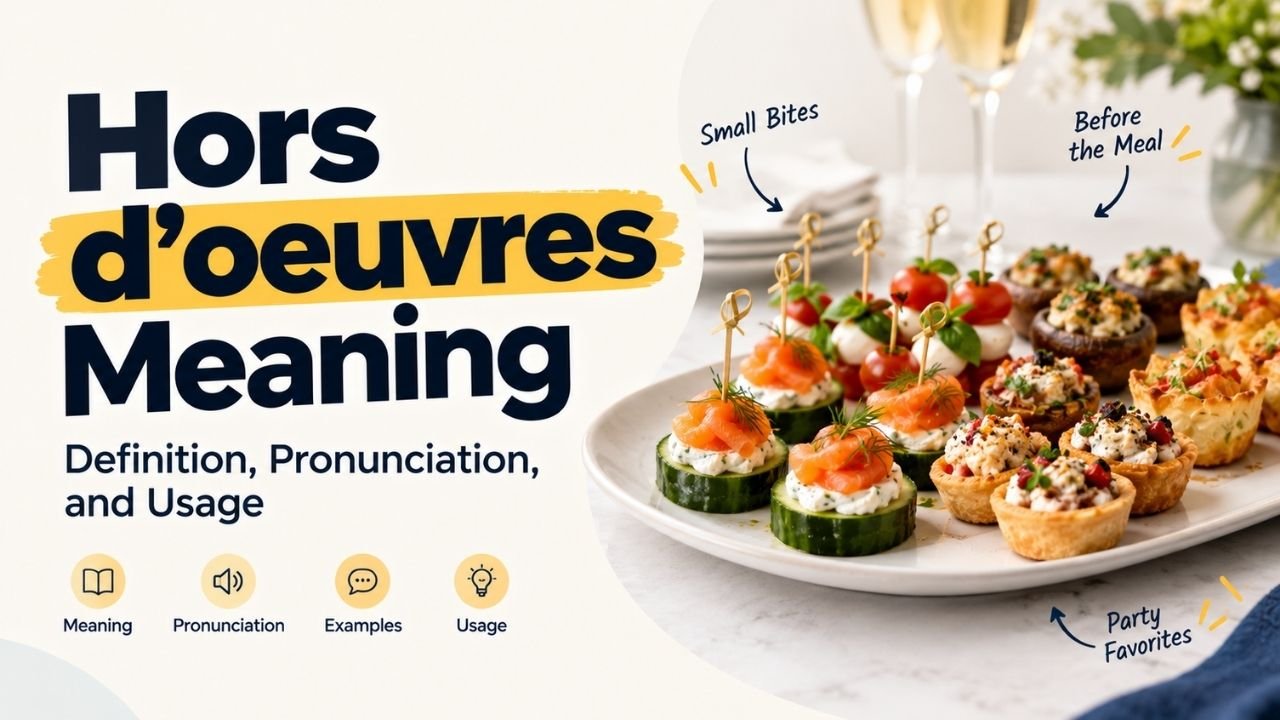
Hors d’oeuvres are small, bite sized foods served before a meal, or on their own at a party. They are often eaten with your fingers while guests stand and talk. Think of mini quiches, stuffed mushrooms, or shrimp on a tray. The word is French, and it is a noun.
The term sounds fancy, but the idea is simple. These are the little bites that come before dinner or fill the time at a reception. This guide explains the meaning, pronunciation, spelling, and common phrases like “passed hors d’oeuvres” and “heavy hors d’oeuvres.”
What Does Hors d’oeuvres Mean?
Hors d’oeuvres means small appetizers served before the main meal or at a gathering. In American English, the word is used for party food in particular. It usually describes food that is easy to pick up and eat in one or two bites.
Here is a quick summary:
| Item | Answer |
| Part of speech | Noun |
| Simple meaning | Small appetizers served before a meal or at a party |
| Language of origin | French |
| Literal meaning | “Outside the work” |
| Singular | hors d’oeuvre |
| Plural | hors d’oeuvres (in English) |
See more: Sincerity Meaning
Hors d’oeuvres Meaning in French
The phrase has three parts. Hors means “outside.” D’ is short for de, which means “of.” Œuvre means “work.”
Put together, it means “outside the work.” In cooking, “the work” is the main meal. So an hors d’oeuvre is food that sits outside the main course.
If you only see “d’oeuvres” in a search, it means “of works.” The word œuvre is also used in English for the complete body of work of an artist or writer. That use is separate from the food term.
In French, the plural does not change. The French write des hors d’œuvre with no added “s.” English speakers usually add the “s,” which is why you see “hors d’oeuvres.”
How to Pronounce Hors d’oeuvres
Many people feel unsure about this word. The good news is that the American pronunciation is easy once you break it into two beats.
- Simple American pronunciation: or DURV
- Plural pronunciation: or DURVZ (the plural is often said the same way, with a soft z at the end)
- IPA (English): /ɔːr ˈdɜːrv/
- IPA (French): /ɔʁ dœvʁ/
The first word, “hors,” sounds like the English word “or.” The “h” is silent. The stress falls on the second part, “durv.”
💡 Tip: Do not say the “s” in “hors.” Say “or,” not “horse.”
Hors d’oeuvres Spelling and the Œ Letter
You will see several spellings online. Only some of them are correct.
| Spelling | Status |
| hors d’oeuvres | Correct and most common in American English |
| hors d’œuvres | Correct, uses the French letter œ |
| hors d’oeuvre | Correct singular form |
| hors d’ oeuvres | Incorrect spacing |
| hors d oeuvres | Missing the apostrophe |
The “œ” is a ligature. It joins the letters “o” and “e” into one character. English writers usually type “oe” because it is easier on a keyboard, and both forms are accepted.
⚠️ Common mistake: Putting a space after the apostrophe. The correct form is “d’oeuvres,” with no space between the apostrophe and the “o.”
Passed Hors d’oeuvres Meaning
Passed hors d’oeuvres are appetizers carried around by servers on trays. The servers walk through the room and offer food to guests. This is common at weddings, cocktail hours, and formal parties.
Guests do not have to leave their conversations or line up at a table. They simply take a bite from the tray and a napkin. This style also keeps the food fresh, since small amounts are brought out at a time.
Here is a sentence that shows the use:
- “The caterer will serve passed hors d’oeuvres during the first hour of the reception.”
Heavy Hors d’oeuvres Meaning
Heavy hors d’oeuvres are larger and more filling appetizers. They are meant to work almost like a light meal. Hosts use them when an event does not include a full sit down dinner.
Light hors d’oeuvres are the small bites you eat before dinner. Heavy ones are more substantial. They may include meatballs, sliders, skewers, or small tacos.
Here is a sentence that shows the use:
- “The invitation said heavy hors d’oeuvres would be served, so we skipped dinner.”
💡 Tip: When an invitation mentions “light hors d’oeuvres,” eat before you go. When it says “heavy hors d’oeuvres,” you can usually count it as dinner.
See More: EVB Meaning In Text
Light vs. Heavy Hors d’oeuvres
| Type | What it means | Typical foods | Best for |
| Light | Small bites before a meal | Cheese cubes, olives, deviled eggs | Dinner parties |
| Passed | Carried around by servers | Mini quiches, stuffed mushrooms | Weddings and formal events |
| Heavy | Filling bites that can replace dinner | Sliders, meatballs, skewers | Receptions and open houses |
Examples of Hors d’oeuvres
Hors d’oeuvres come in many styles. Some are hot and some are cold. Most are small enough to eat in a bite or two.
Cold examples:
- Shrimp cocktail
- Deviled eggs
- Cheese and crackers
- Bruschetta
- Cucumber bites with cream cheese
Hot examples:
- Stuffed mushrooms
- Mini quiches
- Pigs in a blanket
- Chicken skewers
- Crab cakes
Hors d’oeuvres in a Sentence
Examples can help you see how the word works. Here are a few natural ones:
- “Waiters moved through the crowd with trays of hors d’oeuvres.”
- “She made three kinds of hors d’oeuvres for the holiday party.”
- “I filled up on hors d’oeuvres and barely touched dinner.”
Notice that “hors d’oeuvres” can be the subject or the object. It acts like any plural noun in English. A single item is called “an hors d’oeuvre.”
Hors d’oeuvres Grammar: Singular and Plural
English has two ways of treating this word. Both are common.
- Singular: “This hors d’oeuvre is delicious.”
- Plural: “These hors d’oeuvres are delicious.”
Use “an” before the singular form, since “hors” starts with a silent “h.” So you say “an hors d’oeuvre.” The verb should match the number, as with other nouns.
Synonyms and Related Words
Several words overlap with hors d’oeuvres. They are not always exact matches.
| Word | Meaning | How it differs |
| Appetizer | Food served before a meal | Common at a table, and can be larger |
| Starter | The first course | More common in British English |
| Canapé | A small bite on bread, cracker, or pastry | A specific type of hors d’oeuvre |
| Finger food | Food eaten with the hands | Describes how it is eaten, not when |
| Amuse bouche | A tiny free bite from the chef | Served at restaurants, usually one bite |
| Antipasto | Italian first course | Italian in origin, often a platter |
Hors d’oeuvres vs. Appetizer
Many people use these words as if they mean the same thing. Often that works fine. There is a small difference, though.
An appetizer is usually the first course at a restaurant, served at the table. Hors d’oeuvres are more often passed or set out at a gathering, and guests may eat them standing up. So all hors d’oeuvres can be appetizers, but not every appetizer is an hors d’oeuvre.
A Note on “Entrée”
This word can confuse readers. In American English, “entrée” means the main dish. In French and in much of British usage, it means the starter. Keep this in mind when reading menus from different countries.
Origin and Etymology
The word comes from French. It entered English in the early 1700s, according to major dictionaries. Over time, English speakers kept the French spelling and the French feel.
Its literal meaning, “outside the work,” points to the old idea of a meal having a main course as the “work.” Anything outside that main course was an extra. That is how the term came to mean small foods served apart from the main meal.
Hors d’oeuvres Meaning in Other Languages
Many readers search for this word in their own language. There is no single fixed word in most of these languages. People often use the English word “starter” or “appetizer,” or a short phrase that explains the idea.
| Language | Common equivalent | Note |
| Hindi | स्टार्टर | Often borrowed from English |
| Bengali | স্টার্টার | Often borrowed from English |
| Tamil | ஸ்டார்ட்டர் | Often borrowed from English |
| Malayalam | സ്റ്റാർട്ടർ | Often borrowed from English |
These are common everyday choices. For formal writing in any of these languages, a local dictionary or a native speaker is the best check.
Google Translate usually renders the phrase as “appetizers” or “starters.” That is a good match for everyday use.
Does Hors d’oeuvres Have a Slang Meaning?
No. Hors d’oeuvres does not have an established slang meaning. It is a food term, and it has stayed that way. If you see it used playfully, it usually just means “small bites” in a joking tone.
Common Mistakes With Hors d’oeuvres
⚠️ Mistake 1: Saying the “s” in “hors”
❌ Incorrect: “horse DURV”
✅ Correct: “or DURV”
The first word has a silent “h” and a silent “s” in the singular.
⚠️ Mistake 2: Wrong spacing
❌ Incorrect: “hors d’ oeuvres”
✅ Correct: “hors d’oeuvres”
The apostrophe joins “d” to “oeuvres” with no space.
⚠️ Mistake 3: Using “a” instead of “an”
❌ Incorrect: “a hors d’oeuvre”
✅ Correct: “an hors d’oeuvre”
Because the “h” is silent, the word starts with a vowel sound.
⚠️ Mistake 4: Thinking it means a main dish
Hors d’oeuvres are small foods served before or apart from the main meal. Only “heavy” hors d’oeuvres can stand in for dinner.
See More: FMB Meaning
Frequently Asked Questions
What does hors d’oeuvres mean?
It means small appetizers served before a meal or at a party. They are usually bite sized.
What does hors d’oeuvres mean literally?
Literally, it means “outside the work.” In cooking terms, it means outside the main course.
How do you pronounce hors d’oeuvres?
Say “or DURV.” The plural is often said “or DURVZ.”
Is hors d’oeuvres singular or plural?
In English, “hors d’oeuvres” is the usual plural. The singular is “hors d’oeuvre.”
Is hors d’oeuvres a noun or a verb?
It is a noun. It names a type of food.
What are passed hors d’oeuvres?
They are appetizers that servers carry around on trays and offer to guests.
What are heavy hors d’oeuvres?
They are larger, more filling appetizers. They can replace a full dinner at some events.
What is the difference between hors d’oeuvres and appetizers?
They overlap a lot. Appetizers are often a restaurant first course. Hors d’oeuvres are more often small party bites eaten standing up.
Is “hors d’oeuvres” the same as “canapés”?
Not exactly. A canapé is one kind of hors d’oeuvre. It sits on a small base such as bread or a cracker.
Conclusion
Hors d’oeuvres meaning comes down to this: small, bite sized foods served before a meal or at a gathering. The word is French and literally means “outside the work.” You say it “or DURV,” and you can spell it with “oe” or the “œ” letter.
The next time an invitation mentions passed or heavy hors d’oeuvres, you will know what to expect. Passed means servers bring food to you. Heavy means plan to fill up. With the right spelling and pronunciation, you can use the word with confidence.

Hassan Ibrahim is the author behind Mean Fixer, with 4 years of experience researching and writing about names, words, slang, meanings, and everyday language. Their goal is to make confusing words and meanings simple, clear, and easy to understand through accurate, useful, and reader-friendly explanations.


One Comment