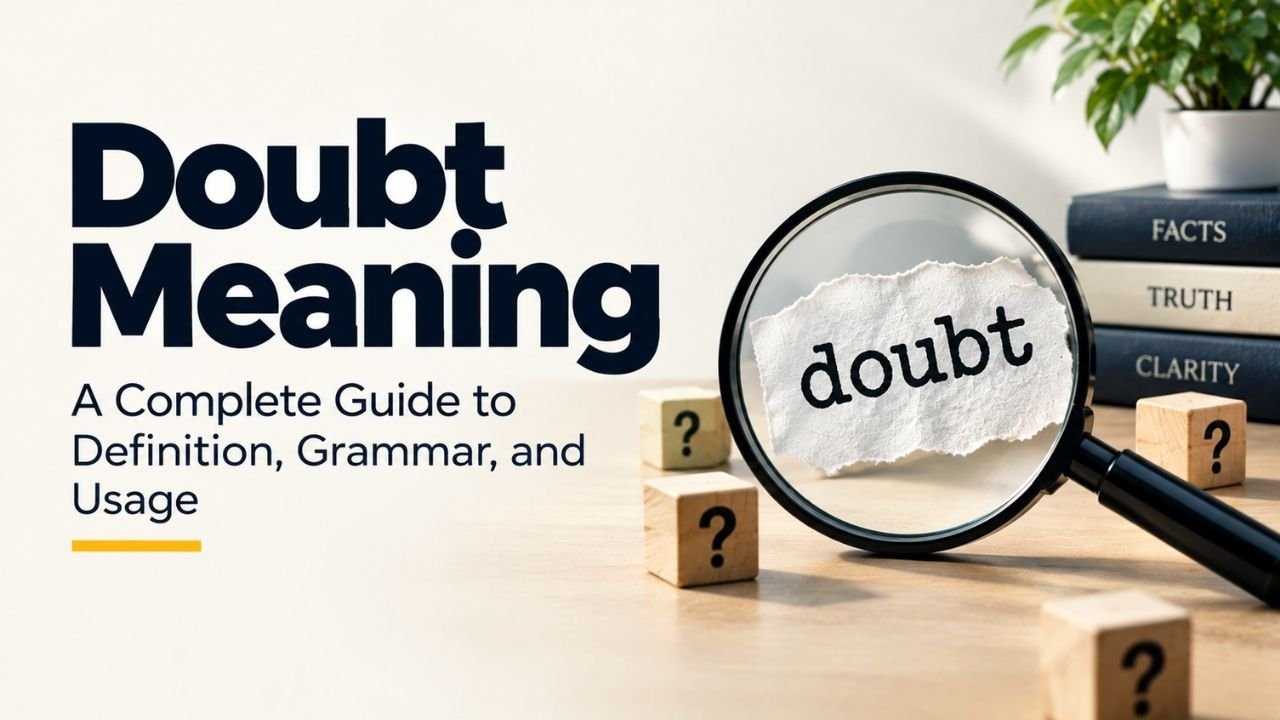
Doubt means a feeling of uncertainty about something. It happens when you are not fully sure if a fact, a person, or a decision is correct or true. People feel doubt when they lack enough proof or confidence to believe something completely.
Understanding doubt meaning helps in everyday conversation, writing, and even legal contexts. The word appears in idioms like benefit of the doubt, phrases like beyond a reasonable doubt, and personal feelings like self doubt. Each version carries a slightly different shade of the same core idea: uncertainty.
What Does Doubt Mean?
At its core, doubt is a noun and a verb that describes uncertainty or lack of belief. When you doubt something, you question whether it is true, correct, or reliable.
Doubt (noun): A feeling of being unsure about the truth, reliability, or outcome of something.
Doubt (verb): To feel uncertain about something, or to lack full trust or belief in it.
Here is a simple table showing both forms:
| Word Form | Part of Speech | Example |
| Doubt | Noun | She had doubt about the plan. |
| Doubt | Verb | I doubt he will come tonight. |
| Doubtful | Adjective | The weather looks doubtful today. |
| Doubtless | Adverb | He is doubtless the best player. |
| Doubter | Noun | Every idea has its doubters. |
See More: Dought Meaning
Doubt Meaning in Simple Terms
If someone says, “I have my doubts,” they mean they are not confident that something is true or will happen the way it is expected to.
Doubt is not the same as denial. Denial means refusing to accept something as true. Doubt simply means you are unsure. You have not decided one way or the other.
💡 Quick Tip: Think of doubt as a pause button on belief. You have not said no. You just have not said yes either.
Part of Speech and Grammar of Doubt
Doubt functions in English grammar in three main ways.
As a noun: Doubt refers to the feeling itself.
Example: There is no doubt in my mind.
As a verb: Doubt describes the action of questioning something.
Example: I doubt that story is true.
As related forms: Doubtful (adjective) and doubtless (adverb) extend the meaning into description and certainty, respectively.
Countable or Uncountable?
Doubt can be both countable and uncountable depending on context.
- Uncountable: “There is doubt about the results.” (general uncertainty)
- Countable: “She raised several doubts about the project.” (specific concerns)
Doubt as a Verb: Sentence Structure
The verb doubt is usually followed by a clause, an object, or the word “that.”
- I doubt that he finished the work.
- She doubts his intentions.
- Do you doubt me?
Doubt can also be followed by “if” or “whether” in more formal or uncertain contexts.
- I doubt if she will attend.
- He doubted whether the plan would succeed.
How to Pronounce Doubt
Doubt is pronounced daʊt, rhyming with “out” or “shout.” The letter “b” is silent.
- American English: /daʊt/
- British English: /daʊt/
The silent “b” often confuses new English learners, since it is written but not spoken. This happens because of the word’s history, which the next section explains.
Origin and Etymology of Doubt
Doubt comes from the Latin word dubitare, meaning “to waver” or “to be uncertain.” This passed into Old French as doute, which English borrowed in the 13th century.
The silent “b” was added later. Scholars in the 14th and 15th centuries reintroduced the “b” to match the original Latin spelling, even though it was never pronounced in English. This is why doubt looks like it should rhyme with “out” but visually resembles words like “debt,” which shares a similar silent-letter history.
Doubt Meaning in English: Everyday Usage
In daily conversation, doubt usually expresses hesitation, disbelief, or lack of confidence.
Common everyday uses include:
- Expressing uncertainty: “I doubt it will rain today.”
- Questioning trust: “I have doubts about his honesty.”
- Softening a statement: “No doubt you’re tired after that trip.”
Common Doubt Expressions
| Expression | Meaning |
| No doubt | Certainly, without question |
| Without a doubt | Definitely, with full confidence |
| Beyond a shadow of a doubt | Completely certain, no uncertainty at all |
| Benefit of the doubt | Choosing to trust someone despite uncertainty |
| Self doubt | Lack of confidence in oneself |
| Reasonable doubt | A legal standard of uncertainty |
Each of these expressions is explored in detail below, since they are among the most searched doubt related phrases.
No Doubt Meaning
No doubt means something is certain or very likely true. It is often used to express confidence or agreement.
Example: “No doubt she will win the award.”
This phrase can also appear as a polite way to agree with someone.
Example: “No doubt, that was a difficult decision.”
Without a Doubt Meaning
Without a doubt means completely certain, with no uncertainty at all. It is a stronger version of “no doubt” and often used for emphasis.
Example: “He is, without a doubt, the hardest working person on the team.”
This phrase works well in both spoken and written English, especially when someone wants to remove any hesitation from a statement.
Beyond a Shadow of a Doubt
This phrase means total certainty, with absolutely no room for questioning. It is often used in serious or formal situations to stress complete confidence.
Example: “The evidence proved, beyond a shadow of a doubt, that he was innocent.”
This expression is slightly more dramatic than “without a doubt” and is often found in legal or emotionally significant contexts.
Benefit of the Doubt Meaning
Benefit of the doubt means choosing to believe someone or something in a positive way, even when there is not full proof. It reflects trust despite uncertainty.
Example: “I don’t have proof he lied, so I’ll give him the benefit of the doubt.”
Give the Benefit of the Doubt Meaning
To give someone the benefit of the doubt means to assume good intentions rather than jumping to a negative conclusion.
Example: “She was late, but I gave her the benefit of the doubt since traffic was bad.”
This phrase is commonly used in relationships, workplaces, and everyday disagreements where full information is not available.
Why This Phrase Uses “Benefit”
The word “benefit” here refers to a favorable judgment. Instead of assuming the worst, you offer the more generous interpretation.
Reasonable Doubt Meaning
Reasonable doubt is a legal term. It describes the level of uncertainty a jury must have before they cannot convict someone of a crime.
In simple terms, if there is a reasonable, sensible reason to question the evidence, the accused should not be found guilty.
Reasonable Doubt Meaning in Law
In the American legal system, “beyond a reasonable doubt” is the standard of proof required in criminal trials. It is a much higher bar than in civil cases, where “preponderance of the evidence” is used instead.
| Legal Standard | Used In | Level of Certainty Required |
| Beyond a reasonable doubt | Criminal cases | Very high, near certainty |
| Preponderance of the evidence | Civil cases | More likely than not |
| Clear and convincing evidence | Some civil cases | Higher than preponderance, lower than reasonable doubt |
Beyond a Reasonable Doubt Meaning
Beyond a reasonable doubt means the evidence is so strong that no reasonable person would question the defendant’s guilt. It does not mean absolute certainty, but it does mean doubt must not be based on reasonable, logical grounds.
Example: “The jury found him guilty beyond a reasonable doubt.”
This standard protects the legal principle that it is better to let a guilty person go free than to wrongly convict an innocent one.
See More: Modeling Meaning
Self Doubt Meaning
Self doubt means a lack of confidence in your own abilities, decisions, or worth. It is an internal feeling rather than doubt about someone or something else.
Example: “Self doubt often stops talented people from trying new things.”
Common Signs of Self Doubt
- Constantly questioning your decisions
- Comparing yourself unfavorably to others
- Avoiding challenges out of fear of failure
- Downplaying your own achievements
Self doubt is a normal human experience, but when it becomes constant, it can affect confidence, performance, and mental well being.
Doubt in the Bible
In religious and biblical contexts, doubt often refers to a lack of faith or hesitation in belief. One of the most well known references is the story of “Doubting Thomas,” a disciple who hesitated to believe in the resurrection without physical proof.
This phrase, doubting Thomas, is now used generally to describe someone who refuses to believe something without solid evidence.
Example: “Don’t be such a doubting Thomas; just trust the process.”
Doubt Meaning in Different Languages and Regions
Because “doubt” is searched widely across different language backgrounds, here is a simple guide to its translated meaning.
| Language | Common Translation | Notes |
| Hindi | संदेह (Sandeh) | Refers to uncertainty or suspicion |
| Urdu | شک (Shak) | Common in daily speech |
| Tamil | சந்தேகம் (Sandheham) | Same root meaning as Hindi |
| Bengali | সন্দেহ (Sandeho) | Used similarly in conversation |
| Marathi | शंका (Shanka) | Common in spoken Marathi |
| Telugu | సందేహం (Sandeham) | Used in formal and informal speech |
| Malayalam | സംശയം (Samshayam) | Everyday usage |
| Kannada | ಸಂದೇಹ (Sandeha) | Common regional usage |
| Arabic | شك (Shak) | Same core meaning of uncertainty |
| Tagalog | Pagdududa | Derived from “duda,” meaning doubt |
These translations are close in meaning but may carry slightly different emotional weight depending on cultural context. In many of these languages, the word for doubt is also connected to suspicion, not just simple uncertainty.
Doubt Meaning for Kids
For younger readers, doubt can be explained simply:
Doubt means you are not sure about something. If your friend says a fact and you are not sure it’s true, you might feel doubt.
Example for kids: “I doubt it will snow today because the sky looks sunny.”
This simple explanation helps children understand the word without complicated grammar terms.
Doubt Meaning in Chat and Texting
In informal chat or texting, doubt is often used the same way as in speech, but sometimes shortened or simplified.
Example: “idk, I doubt it 🤷”
People may also say “doubt it” as a short, casual way of disagreeing or expressing skepticism about something someone said.
Example:
Person A: “He said he’ll finish the project tonight.”
Person B: “Doubt it.”
No Doubt: The Band Reference
Many searches for “no doubt meaning” actually relate to the American rock band No Doubt, known for hits like “Just a Girl.”
I’m Just a Girl, No Doubt Meaning
“Just a Girl” is a song by No Doubt, released in 1995. The lyrics express frustration about being underestimated or restricted because of gender expectations. The phrase “I’m just a girl” is used sarcastically to highlight unfair stereotypes, not to express literal self doubt.
This is a separate, cultural meaning from the grammatical or everyday meaning of doubt discussed earlier in this article. It shows how the same words can carry entirely different meanings depending on context, whether that is grammar, music, or emotion.
For the Avoidance of Doubt Meaning
This is a formal, often legal or business phrase used to clarify a statement and prevent misunderstanding.
Example: “For the avoidance of doubt, this agreement applies only to services listed in Section 2.”
Avoidance of Doubt Meaning
Avoidance of doubt refers to the practice of adding extra clarification in contracts, agreements, or formal writing to eliminate any possible confusion.
This phrase is common in legal documents, business contracts, and official communications where precision matters.
Common Mistakes With Doubt
Many English learners and even native speakers make small errors when using doubt. Here are the most common ones.
Incorrect: I doubt that he will not come.
Correct: I doubt that he will come.
Why: When you use “doubt” in a positive sentence, it already implies uncertainty about something happening. Adding “not” creates confusion about the intended meaning.
Incorrect: I have doubt about it.
Correct: I have doubts about it. / I have some doubt about it.
Why: “Doubts” (plural) is more natural when referring to specific concerns. Singular “doubt” without an article often needs a modifier like “some” or “a lot of.”
Incorrect: No doubts, she is right.
Correct: No doubt, she is right.
Why: “No doubt” is a fixed expression and does not typically take the plural form in this usage.
Doubt vs Suspect vs Question vs Distrust
These words are related but not identical. Understanding the difference helps you choose the right word for the right situation.
| Word | Meaning | Example |
| Doubt | General uncertainty about truth or outcome | I doubt he passed the test. |
| Suspect | Belief that something bad or hidden is true | I suspect she is lying. |
| Question | To formally challenge or ask about something | I question his decision. |
| Distrust | Lack of trust in a person’s character | I distrust his motives. |
Doubt is usually neutral. Suspect often implies something negative. Distrust is stronger and more personal, usually about character rather than facts.
Synonyms and Antonyms of Doubt
Synonyms
- Uncertainty
- Skepticism
- Hesitation
- Suspicion
- Disbelief
Antonyms
- Certainty
- Confidence
- Belief
- Trust
- Assurance
Each synonym carries a slightly different tone. “Skepticism,” for example, often implies a more critical or questioning attitude, while “hesitation” leans more toward indecision than disbelief.
How to Use Doubt in a Sentence
Here are a few natural examples showing different uses of doubt across contexts.
- “I doubt we’ll finish the project by Friday.” (verb, everyday use)
- “There is no doubt about her talent.” (noun, confident statement)
- “He looked at me with doubt in his eyes.” (noun, emotional description)
- “The lawyer argued there was reasonable doubt in the case.” (legal use)
- “She struggled with self doubt before the interview.” (personal, emotional use)
See More: Illustration Meaning
Frequently Asked Questions
What does doubt mean?
Doubt means a feeling of uncertainty about whether something is true, correct, or likely to happen.
Is doubt a noun or a verb?
Doubt can be both. As a noun, it means uncertainty. As a verb, it means to question or not fully believe something.
How do you pronounce doubt?
Doubt is pronounced “daʊt,” similar to “out,” with a silent “b.”
What is the difference between doubt and suspect?
Doubt is neutral uncertainty, while suspect usually implies believing something negative or hidden is true.
What does benefit of the doubt mean?
It means choosing to trust someone or interpret a situation positively, even without full proof.
What is reasonable doubt in law?
Reasonable doubt is the legal standard requiring that evidence be strong enough that no reasonable person would question a defendant’s guilt in a criminal case.
What does self doubt mean?
Self doubt means a lack of confidence in your own abilities, decisions, or worth.
What does no doubt mean?
No doubt means something is certain or highly likely, often used to express agreement or confidence.
Why is there a silent “b” in doubt?
The silent “b” was added during the 14th and 15th centuries to match the word’s Latin origin, dubitare, even though it was never pronounced in English.
What does beyond a shadow of a doubt mean?
It means something is completely certain, with absolutely no possibility of being wrong.
Conclusion
Doubt means uncertainty, whether about a fact, a person, or an outcome. It works as both a noun and a verb, and it appears in many common expressions like no doubt, without a doubt, and benefit of the doubt. In legal settings, reasonable doubt and beyond a reasonable doubt describe a specific, high standard of certainty required before someone can be judged guilty. In personal life, self doubt reflects uncertainty about oneself rather than about external facts.
Knowing how doubt is used, pronounced, and applied across different contexts, from casual conversation to courtroom language, helps you communicate more clearly and confidently. Whether you’re questioning a fact, giving someone the benefit of the doubt, or simply saying you doubt it will rain today, the word carries the same core idea: not being fully sure, yet still trying to make sense of what’s true.

Hassan Ibrahim is the author behind Mean Fixer, with 4 years of experience researching and writing about names, words, slang, meanings, and everyday language. Their goal is to make confusing words and meanings simple, clear, and easy to understand through accurate, useful, and reader-friendly explanations.