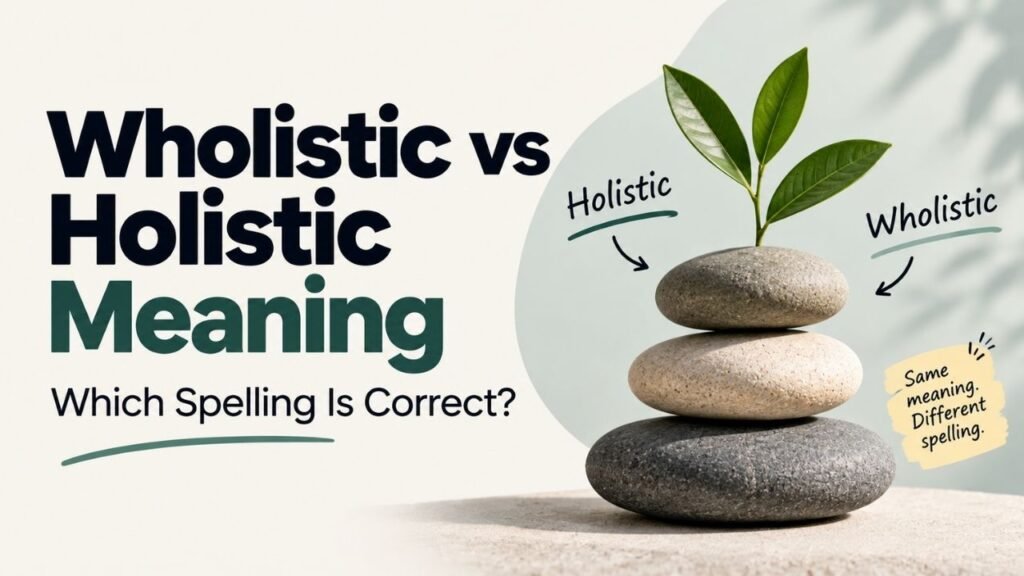
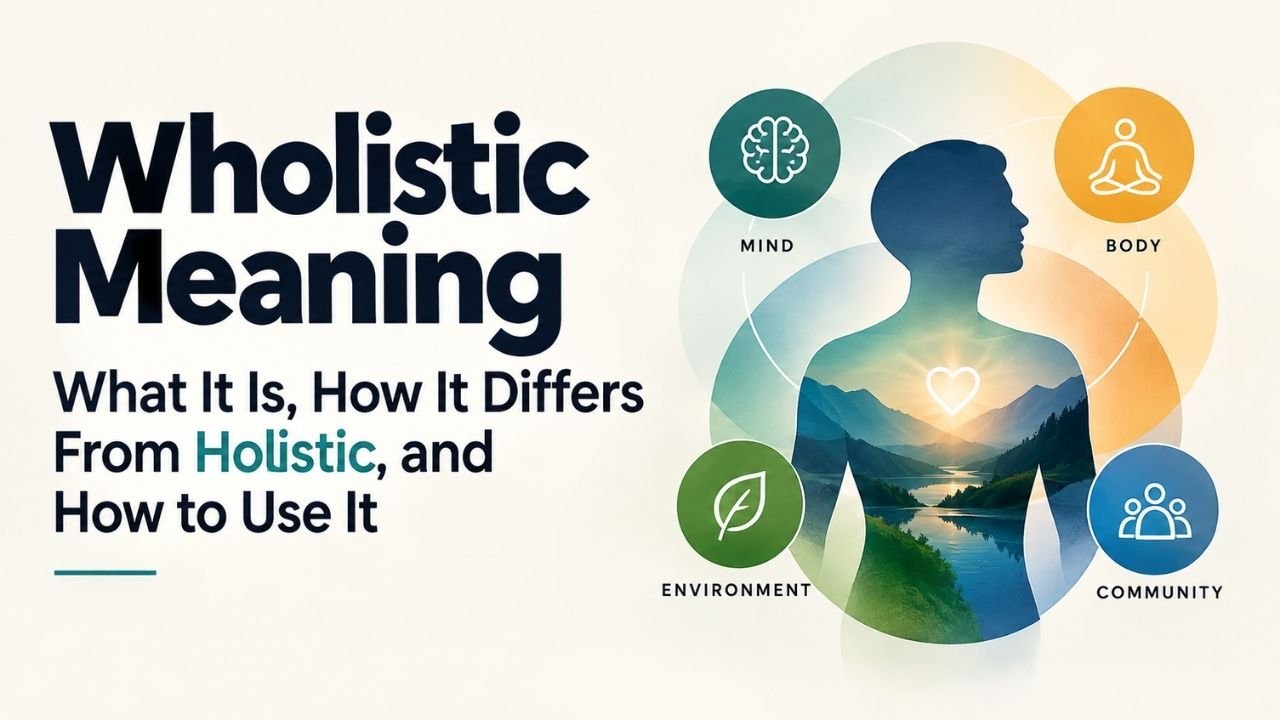
Wholistic means the same thing as holistic: dealing with the whole of something rather than only its separate parts. It is a variant spelling, and dictionaries treat the two words as interchangeable. You will see it most often in health, education, and business writing.
The spelling “wholistic” adds a “w” because people link the word to “whole.” Holistic is still the standard form in American English. This guide covers the meaning, the difference between the two spellings, pronunciation, origin, and examples.
What Does Wholistic Mean?
Wholistic describes an approach that looks at the entire picture. It treats a person, problem, or system as one connected thing instead of a pile of separate pieces.
Quick definition box
- Word: wholistic
- Part of speech: adjective
- Simple meaning: considering the whole, not just parts
- Standard spelling: holistic
- Adverb form: wholistically (or holistically)
- Noun form: wholism (or holism)
Wholistic Meaning in English
In English, wholistic has one core meaning. It describes something that treats all parts of a subject as connected and important. A wholistic view of a patient looks at body, mind, lifestyle, and environment together.
Merriam-Webster lists wholistic as a variant of holistic, so the definitions match. Some writers prefer it because it visibly contains the word “whole.”
Is Wholistic a Word?
Yes, wholistic is a recognized word. Major dictionaries list it as a variant of holistic. It is less common and sometimes flagged by spell checkers, but it is not an error.
💡 Tip: In formal or academic writing, choose holistic. It is the safer, more widely accepted spelling.
Holistic vs Wholistic: What Is the Difference?
There is no difference in meaning. The difference is spelling, frequency, and style.
| Feature | Holistic | Wholistic |
| Meaning | Considering the whole | Considering the whole |
| Status | Standard spelling | Accepted variant |
| Frequency | Much more common | Less common |
| Best for | Formal, academic, professional writing | Informal writing or where a writer prefers the “whole” link |
| Pronunciation | hoh LIS tik | hoh LIS tik |
See More: NVM Meaning
Holistic or Wholistic: Which Should You Use?
Use holistic in most cases. Readers expect it, editors prefer it, and search results favor it. Use wholistic only if your organization or style guide asks for it.
Pick one spelling and stay consistent within a single piece of writing.
Wholistic vs Holistic in Medicine
In medicine and wellness, both words mean care that considers the whole person. That can include physical health, emotional state, lifestyle, and social factors. The word does not tell you whether a treatment is scientifically proven.
⚠️ Important reminder: “Holistic” or “wholistic” on a label is not a quality guarantee. Check the actual treatment and talk to a licensed healthcare provider.
Wholistic vs Holistic in Business
In business, a wholistic or holistic strategy considers how every department, process, and customer touchpoint affects the others. Instead of fixing marketing in isolation, a holistic plan looks at how marketing connects to product, sales, and support.
How to Pronounce Wholistic
Wholistic and holistic are pronounced the same way in American English.
- Simple pronunciation: hoh LIS tik
- IPA: /hoʊˈlɪstɪk/
- Stress: on the second syllable
- Syllables: 3
The “w” is silent in speech. People often wonder whether to say “whole” at the start, but standard pronunciation sounds like “hoh.”
Wholistic Grammar and Word Forms
Wholistic is an adjective. It usually comes before a noun or after a linking verb.
| Form | Word | Example |
| Adjective | wholistic | She takes a wholistic approach to teaching. |
| Adverb | wholistically | The team looked at the problem wholistically. |
| Noun | wholism | Wholism values the connection between parts. |
See More: CFS Meaning on Instagram
Wholistic in a Sentence
Here are a few natural examples:
- The clinic offers wholistic care that includes nutrition and stress management.
- A wholistic view of the project helped the team spot hidden risks.
- The school uses a wholistic approach to student development.
Holistic Meaning and Related Terms
Many readers search for the standard word, so here are the common related phrases.
Holistic Approach Meaning
A holistic approach looks at a whole system and how its parts affect each other. It avoids treating one part alone.
Holistic Health, Wellness, Care, and Healing
| Phrase | Simple Meaning |
| Holistic health | Health seen as body, mind, and lifestyle together |
| Holistic wellness | A balanced approach to overall wellbeing |
| Holistic care | Care that considers the whole person, not only symptoms |
| Holistic healing | Healing that addresses more than the physical problem |
Holistically Meaning
Holistically is the adverb. It means “in a way that considers the whole.” Wholistically is the variant spelling. For example: “We reviewed the budget holistically.”
What About “Wholistic Ego”?
“Wholistic ego” is not an established dictionary term. It may appear in personal growth or psychology writing to describe a balanced sense of self. Because there is no standard definition, check how the author uses it.
Meaning in Other Languages
Many readers look up the meaning in their own language. These are commonly used equivalents for holistic. Wholistic carries the same meaning.
| Language | Common Equivalent | Pronunciation Guide |
| Hindi | समग्र, सर्वांगीण | samagra, sarvāngīṇ |
| Tamil | முழுமையான | muzhumaiyāna |
| Bengali | সামগ্রিক | sāmagrik |
| Urdu | جامع، ہمہ گیر | jāmi, hama gīr |
| Telugu | సమగ్రమైన | samagramaina |
| Marathi | समग्र, सर्वसमावेशक | samagra, sarvasamāveshak |
| Malayalam | സമഗ്രമായ | samagramāya |
| Kannada | ಸಮಗ್ರ | samagra |
Translations can shift with context. In health writing, a translator may choose a different word than in business writing.
Origin of Wholistic
The standard word holistic comes from “holism.” The term holism was coined by Jan Smuts, a South African statesman and thinker, in his 1926 book Holism and Evolution. He built it from the Greek word holos, meaning “whole.”
“Wholistic” appeared later as a respelling. English speakers connected the word with “whole,” which comes from Old English and has a different root from Greek holos. The two words sound similar and share meaning, but they are not historically the same word.
Common Mistakes With Wholistic and Holistic
Mistake 1: Thinking wholistic has a different meaning
❌ Incorrect: “Wholistic is about the whole, but holistic is about spirituality.”
✅ Correct: Both words mean considering the whole. Context, not spelling, adds any spiritual sense.
Mistake 2: Mixing spellings in one document
❌ Incorrect: “Our holistic plan is a wholistic solution.”
✅ Correct: “Our holistic plan is a holistic solution.” Pick one spelling.
Mistake 3: Assuming “holistic” means “scientifically proven”
❌ Incorrect: “This product is holistic, so it must be safe.”
✅ Correct: The word describes an approach, not safety or effectiveness.
Similar Words and Synonyms
| Word | Meaning | How It Differs |
| Comprehensive | Covering all or nearly all aspects | Focuses on completeness, not connection |
| Integrated | Combined into a working whole | Stresses parts working together |
| Complete | Having every part | Does not imply connection |
| Whole person | Considering all aspects of a person | A phrase, mostly used in health and education |
| Total | Covering everything | Broader and less specific |
| Systemic | Relating to a whole system | Often used for problems or structures |
The opposite of holistic is usually reductionist, meaning an approach that explains something by studying its separate parts.
See More: Como Meaning Slang
Frequently Asked Questions
What does wholistic mean?
It means dealing with the whole instead of only parts. It is a variant spelling of holistic.
Is wholistic a real word?
Yes. Major dictionaries list it as a variant of holistic, though holistic is far more common.
What is the difference between holistic and wholistic?
Only the spelling. The meaning and pronunciation are the same.
Should I use holistic or wholistic?
Use holistic unless a style guide or brand asks for wholistic.
How do you pronounce wholistic?
Say “hoh LIS tik.” The “w” is silent.
Is wholistic a noun or an adjective?
It is an adjective. The related noun is wholism, and the adverb is wholistically.
What is the origin of holistic?
It comes from holism, a word coined by Jan Smuts in 1926 from Greek holos, meaning “whole.”
Does wholistic medicine mean alternative medicine?
Not necessarily. The word describes treating the whole person. It does not say whether the treatment is conventional or alternative.
Conclusion
Wholistic is an accepted variant of holistic, and both mean looking at the whole instead of only the parts. The words are pronounced the same, share the same grammar, and appear in the same fields, from medicine to business. The only real difference is that holistic is the standard spelling.
When you write, choose holistic for formal work and stay consistent. If you read wholistic elsewhere, you can treat it as the same word. That is the simplest way to understand wholistic meaning and use it with confidence.

Hassan Ibrahim is the author behind Mean Fixer, with 4 years of experience researching and writing about names, words, slang, meanings, and everyday language. Their goal is to make confusing words and meanings simple, clear, and easy to understand through accurate, useful, and reader-friendly explanations.