
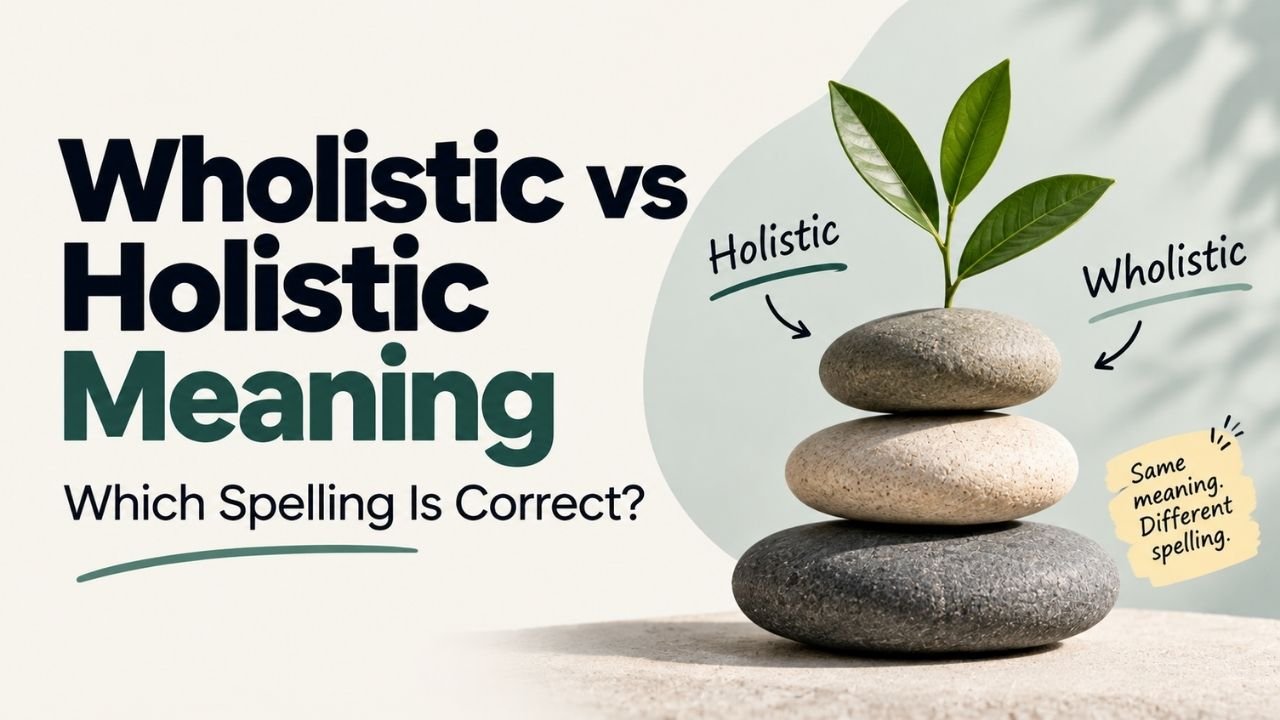
Holistic is the standard spelling. It describes an approach that looks at the whole of something instead of only its separate parts. Wholistic carries the same meaning, but it is a rare variant that many writers and editors treat as a spelling mistake. In the wholistic vs holistic meaning debate, the safe choice is almost always holistic.
The confusion comes from the word “whole,” which makes wholistic look logical. Holistic comes from a Greek root that never had a “w” in it. Knowing that history helps you pick the right form in school writing, business documents, and medical content.
Quick Answer: Is Wholistic a Word?
Yes, wholistic appears in some dictionaries, but only as a less common variant of holistic. It is not wrong in the sense of being meaningless. It is simply not the form most editors, teachers, and publishers expect.
| Feature | Holistic | Wholistic |
| Status | Standard spelling | Rare variant |
| Meaning | Considering the whole | Same meaning |
| Used in formal writing | Yes | Seldom |
| Pronunciation | hoh LIS tik | hoh LIS tik |
| Safe for exams, business, and publishing | Yes | No |
💡 Tip: If you are unsure, write “holistic.” No one will question it.
See More: HN Meaning In Text
What Does Holistic Mean?
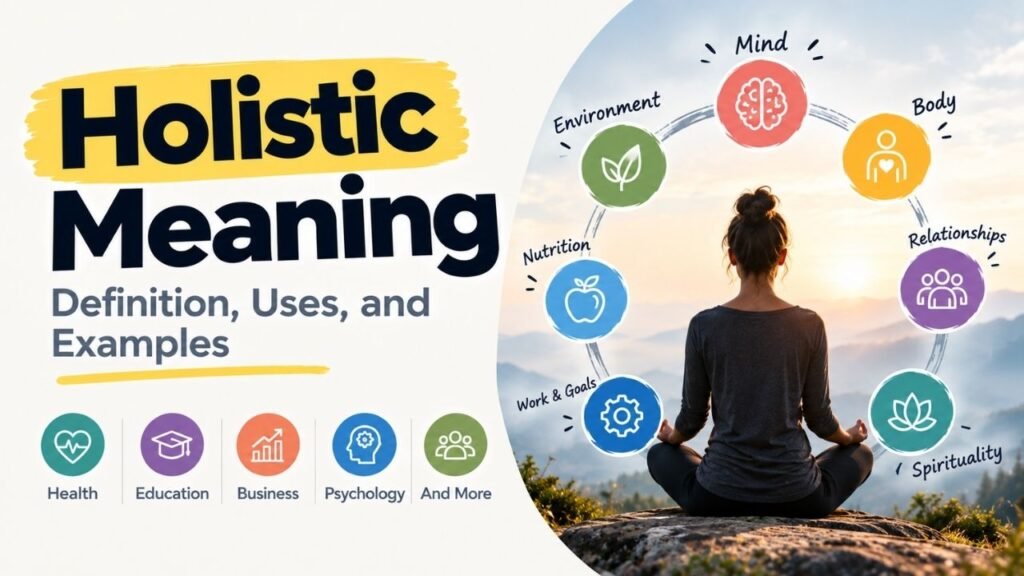
Holistic means dealing with the whole of something, not just one part. It treats a thing as a connected system. The parts matter, but the way they work together matters more.
Part of speech: Holistic is an adjective.
Simple definition: Looking at all parts of something and how they relate.
Examples:
- The school takes a holistic approach to student growth.
- A holistic review looks at grades, essays, and activities together.
The related adverb is holistically, which means “in a way that considers the whole.”
- The team reviewed the project holistically before making changes.
The related noun is holism, the idea that wholes have properties that cannot be explained by looking only at their parts.
What Does Wholistic Mean?
Wholistic means exactly the same thing as holistic. It is a spelling variant, not a different word. Some writers add the “w” because they connect the word to “whole,” which is a reasonable guess.
Some people, especially in alternative health and wellness circles, use wholistic on purpose. They like the link to “whole” and want the word to feel more direct. That choice is a style preference. It does not create a new meaning.
Why Is Holistic Not Spelled Wholistic?
The spelling follows the word’s history, not the word “whole.” Holistic comes from the Greek word holos, which means “whole” or “entire.” Greek holos had no “w” sound.
The English word “whole” has a separate history. It comes from Old English hāl, meaning healthy or complete. Over time, English spelling added a “w” to “whole.” The “w” was never part of the Greek root.
So the two words are related in meaning, but they did not grow from the same spelling. Holistic kept the Greek form.
💡 Tip: Think of “holistic” as a Greek word that English borrowed whole, “w” left out.
Origin of the Word Holistic
The term holism was coined by Jan Smuts, a South African statesman and philosopher. He used it in his 1926 book Holism and Evolution. He wanted a word for the idea that nature tends to form wholes that are more than the sum of their parts.
The adjective holistic grew out of holism. It later spread into medicine, education, psychology, and business. Today most people use it far more loosely than Smuts did. It often just means “comprehensive” or “considering everything.”
Pronunciation of Holistic and Wholistic
Both words are pronounced the same way.
- IPA (American): /hoʊˈlɪstɪk/
- Simple version: hoh LIS tik
- Stress: On the second syllable (LIS).
- Syllables: ho·lis·tic
British speakers use nearly the same sound. The first vowel is a little different, but the stress pattern is identical. Because the spelling variants sound alike, you cannot hear which one someone is using.
Is It “A Holistic” or “An Holistic”?
Use a holistic. In modern American English, the “h” in holistic is pronounced, so the word begins with a consonant sound. A consonant sound takes “a.”
✅ Correct: She wants a holistic view of the problem.
❌ Incorrect: She wants an holistic view of the problem.
“An holistic” appears in some older British writing. That style came from dropping the “h” sound in speech. It now looks dated, and most modern style guides prefer “a holistic.”
Wholistic vs Holistic in the UK
Holistic is also the standard form in British English. There is no regional rule that makes wholistic correct in the UK. British dictionaries and publishers treat holistic as the normal spelling.
The “a holistic” versus “an holistic” question is the only real difference you might notice. As explained above, “a holistic” is the safer choice in both countries.
Wholistic vs Holistic Medicine
Holistic medicine is an approach to care that considers the whole person. That can include body, mind, lifestyle, and environment. It is not one single treatment.
The term is used in many ways. Some doctors use it to describe patient centered care that looks beyond symptoms. Other people use it for alternative therapies. Because the label is broad, it is worth checking what a specific provider actually offers.
⚠️ Note: “Holistic” does not tell you whether a treatment is proven. Ask about the evidence and talk to a licensed healthcare professional about medical decisions.
You may also see “wholistic medicine” or “wholistic health.” These spellings are less common. Most medical schools, journals, and health organizations use holistic.
Wholistic vs Holistic in Education
In education, a holistic approach looks at the whole learner. It considers academic, social, emotional, and physical development, not only test scores.
Common examples:
- Holistic grading: A teacher scores a piece of writing as a whole, not line by line.
- Holistic admissions: A college looks at the full applicant, not only grades and test results.
- Whole child education: A related phrase that stresses student wellbeing as well as learning.
Notice that “whole child” uses the English word “whole.” That phrase is correct as written. It does not mean the spelling “wholistic” is preferred.
Wholistic vs Holistic in Business
In business, a holistic approach looks at the whole organization or system. It avoids fixing one department while ignoring how the others are affected.
Examples:
- A holistic marketing strategy connects advertising, sales, and customer service.
- A holistic risk review considers finance, legal, operations, and reputation together.
Business writing almost never uses wholistic. Using it may look like a typing error to readers.
Holistic Approach Meaning
A holistic approach is a way of solving problems by studying the entire situation. It asks how all the pieces connect before making a decision.
| Approach | What it focuses on | Example |
| Holistic | The whole system | Improving a company by studying every team |
| Reductionist | Separate parts | Studying one machine part alone |
| Piecemeal | Small, disconnected fixes | Repairing one problem at a time |
Neither style is always better. Holistic thinking helps with complex systems. Detailed part by part study helps when you need precise answers.
See More: SM Meaning in Text
Holistic View vs Wholistic View
A holistic view is a broad perspective that takes in the whole picture. A “wholistic view” means the same thing but is far less common.
- Holistic view example: The report gives a holistic view of city traffic.
- Natural alternatives: a complete view, a big picture view, a full view.
Holism and Holistic: What Is the Difference?
Holism is the noun. It names the idea or philosophy. Holistic is the adjective. It describes something that follows that idea.
| Word | Part of speech | Example |
| Holism | Noun | Holism says the whole is more than its parts. |
| Holistic | Adjective | The clinic uses a holistic method. |
| Holistically | Adverb | They studied the problem holistically. |
Holistic Wisdom Meaning
“Holistic wisdom” is not a fixed dictionary term. It is a phrase writers use in different ways. It usually means understanding that sees connections between ideas, people, or systems instead of treating them as separate.
Because the phrase has no single official definition, check the context to see how a writer is using it.
Holistic Synonyms
Holistic has no perfect one word synonym. These words are close, but each has a slightly different shade.
| Word | Meaning | How it differs |
| Comprehensive | Covering everything | Stresses completeness |
| Integrated | Joined into a unified whole | Stresses connection |
| All encompassing | Including all parts | Stresses breadth |
| Whole | Complete | Plain and general |
| Systemic | Relating to a whole system | More technical |
| Big picture | Broad and general | Informal |
Antonyms and Non Holistic Meaning
“Non holistic” describes an approach that focuses on parts instead of the whole. It does not consider how pieces connect.
Useful opposites:
- Reductionist: Explains things by studying their smallest parts.
- Atomistic: Treats things as separate units.
- Piecemeal: Done in small, unconnected steps.
- Fragmented: Broken into disconnected pieces.
Example: A non holistic treatment plan may fix one symptom but ignore the cause.
Holistic Meaning in Urdu
The meaning of holistic in Urdu is based on the idea of completeness and wholeness. Common Urdu translations include:
- ہمہ گیر (hama gir): all embracing, comprehensive
- جامع (jaami): comprehensive, complete
- کلی (kulli): total, relating to the whole
The best choice depends on the sentence. For example, “holistic approach” is often rendered as “جامع نقطہ نظر” or “ہمہ گیر طریقہ.”
Wholistically meaning in Urdu: It can be translated as “مکمل طور پر” or “ہمہ گیر انداز میں,” meaning “in a complete, all round way.”
Common Mistakes
Mistake 1: Using wholistic in formal writing
❌ Incorrect: We need a wholistic business plan.
✅ Correct: We need a holistic business plan.
Why: Holistic is the form editors and readers expect.
Mistake 2: Using “an” before holistic
❌ Incorrect: This is an holistic method.
✅ Correct: This is a holistic method.
Why: The “h” is pronounced, so “a” is correct.
Mistake 3: Treating holistic as proof of quality
❌ Incorrect: It is holistic, so it must be effective.
✅ Correct: It takes a holistic approach, but we should still check the evidence.
Why: Holistic describes a method, not its results.
Mistake 4: Confusing holistic with holy
Holistic is not related to “holy,” although the words look similar. Holistic comes from Greek holos. Holy comes from an Old English word with a different root.
See More: 269 Meaning
Frequently Asked Questions
Is wholistic a word?
Yes, but only as a rare variant of holistic. Most writers should use holistic.
What is the difference between holistic and wholistic?
There is no difference in meaning. Holistic is the standard spelling. Wholistic is a less common variant.
Why is holistic not spelled wholistic?
Holistic comes from the Greek holos, which has no “w.” The “w” in “whole” developed separately in English.
Is it “an holistic” or “a holistic”?
Use “a holistic.” The “h” is pronounced in modern English.
Is holistic a noun or an adjective?
It is an adjective. The noun is holism, and the adverb is holistically.
What does holistic mean in Urdu?
Common Urdu equivalents are ہمہ گیر, جامع, and کلی, depending on context.
What is a holistic approach?
It is a way of looking at the whole situation and how its parts connect, instead of focusing on one piece.
What is the opposite of holistic?
Reductionist, atomistic, piecemeal, or fragmented, depending on the context.
How do you pronounce holistic?
Say “hoh LIS tik,” with stress on the second syllable.
Conclusion
The wholistic vs holistic meaning question has a simple answer. Both words mean looking at the whole instead of separate parts, but holistic is the standard spelling. Wholistic is a rare variant that can look like an error. Holistic comes from the Greek word holos, which is why it has no “w.”
For any school, business, or medical writing, use holistic and write “a holistic” with the pronounced “h.” If you see wholistic, you can read it as the same idea. Your readers will find holistic clearer and more professional.

Hassan Ibrahim is the author behind Mean Fixer, with 4 years of experience researching and writing about names, words, slang, meanings, and everyday language. Their goal is to make confusing words and meanings simple, clear, and easy to understand through accurate, useful, and reader-friendly explanations.


One Comment