
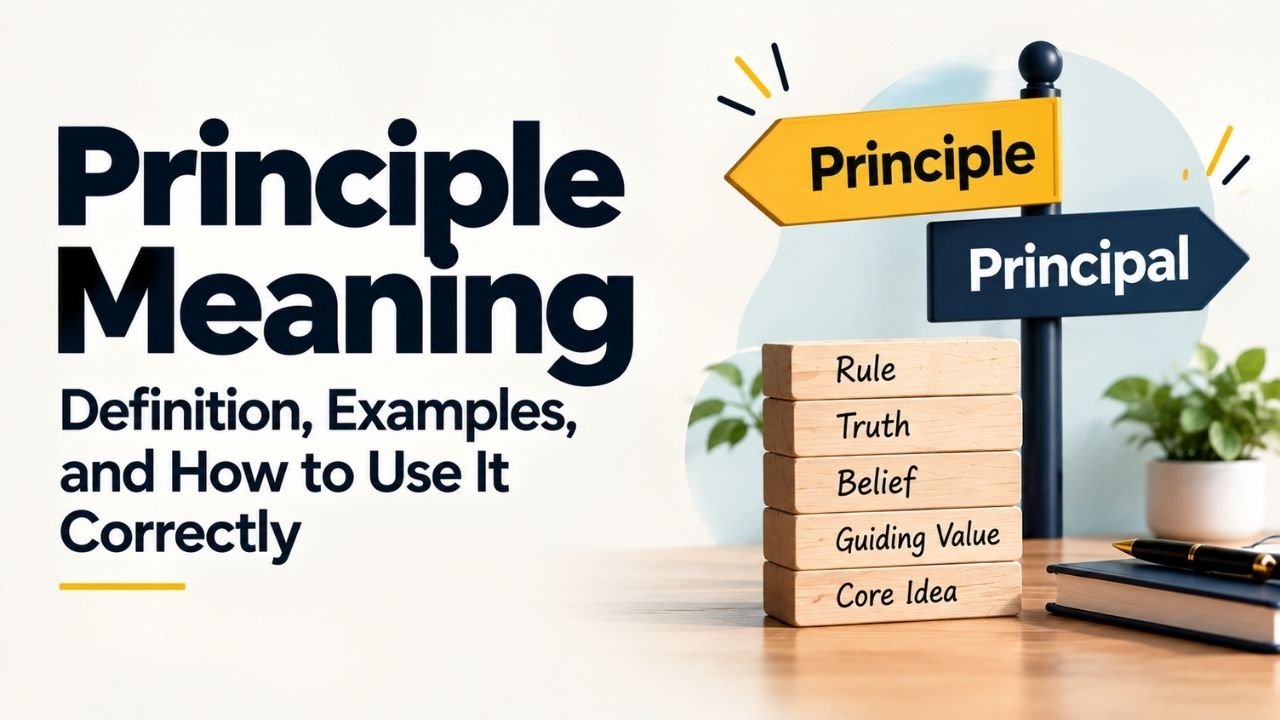
Principle is a noun. It means a basic rule, truth, or belief that guides how something works or how a person behaves. For example, honesty can be a principle you live by, and gravity works on a scientific principle. The word is spelled with “le” at the end, and it is never an adjective.
People often mix it up with “principal,” which sounds exactly the same. The two words have different meanings. This guide explains what principle means, how it differs from principal, and what it means in phrases like “in principle,” “on principle,” and “the Peter principle.” You will also find pronunciation, origin, examples, and translations in several languages.
What Does Principle Mean?
A principle is a fundamental idea that something else is built on. It can be a rule of nature, a moral belief, or a basic method. Here is the quick definition.
Principle (noun): a basic truth, rule, or belief that explains how something works or guides how people act.
The word has three main meanings.
Meaning 1: A basic truth or law of nature
This is a fundamental fact that explains how something works. Archimedes’ principle explains why objects float.
Meaning 2: A moral rule or personal belief
This is a standard of right and wrong that guides your behavior. She never lies, because honesty is one of her principles.
Meaning 3: A basic way something works or is done
This is the core idea behind a system, method, or design. The machine works on the principle of heat turning water into steam.
Principle Meaning at a Glance
| Detail | Answer |
| Part of speech | Noun |
| Plural | Principles |
| Related adjective | Principled |
| Opposite adjective | Unprincipled |
| Simple meaning | A basic rule, truth, or belief |
| Common synonyms | Rule, law, standard, belief, ethic |
See More: Pursue Meaning
Principle vs Principal: What Is the Difference?
This is the most searched question about the word. The two words sound the same, but they work differently.
| Principle | Principal | |
| Part of speech | Noun only | Adjective and noun |
| Meaning | A rule, belief, or basic truth | Main, or the head of a school, or an amount of money |
| Example | It is a matter of principle. | The principal reason is cost. |
Principal as an adjective means main or most important. The principal cause of the delay was weather.
Principal as a noun has two common meanings:
- The head of a school. The principal spoke to the students.
- The original amount of money in a loan or investment, before interest. Your payment covers interest and principal.
💡 Tip: Principal ends in “pal.” Your principal at school is your pal. Principle ends in “le,” just like the word “rule.” A principle is a rule.
Common Mistakes
❌ Incorrect: The school principle announced a new schedule.
✅ Correct: The school principal announced a new schedule.
The head of a school is a person, so you need “principal.”
❌ Incorrect: I paid off the loan principle.
✅ Correct: I paid off the loan principal.
The loan amount is money, so you need “principal.”
❌ Incorrect: He refused on principal.
✅ Correct: He refused on principle.
A belief or rule is a principle.
How to Pronounce Principle
Principle is pronounced PRIN suh pul. It has three syllables, and the stress falls on the first one.
- IPA (American English): /ˈprɪnsəpəl/
- Rhymes with: “municipal” (in its ending sound)
- Sounds exactly like: principal
The pronunciation is the same in American and British English. Because it matches “principal,” you can only tell the two apart in writing or from context.
Principle Meaning in Different Contexts
The core idea stays the same, but the word shows up in many fields.
Principle Meaning in Life
In everyday life, principles are the values you refuse to give up. Honesty, fairness, loyalty, and kindness are common examples. A person with firm values is called a principled person. This means someone who sticks to their moral beliefs even when it is hard.
Principle Meaning in Physics and Science
In science, a principle is a basic law that explains how nature behaves. Famous examples include:
- Archimedes’ principle, which explains buoyancy
- Bernoulli’s principle, which relates fluid speed and pressure
- Heisenberg’s uncertainty principle, from quantum physics
- Pascal’s principle, about pressure in fluids
Principle Meaning in Law
In law, a principle is a general rule that guides how laws are made and applied. Examples include the principle of due process and the principle that a person is innocent until proven guilty. Courts often refer to legal principles when a situation is not covered by a specific law.
Principle Meaning in Finance
Here, be careful. In finance, the word for loan money is principal, not principle.
Principle does appear in finance in the sense of a guideline or rule. For example, accountants follow generally accepted accounting principles, often shortened to GAAP. These are standard rules for preparing financial statements. A “going concern principle” is another example. It assumes a business will keep operating.
Principle Meaning in a Loan
A loan has a principal, not a principle. The principal is the amount you borrowed. Interest is the extra cost of borrowing. If someone writes “loan principle,” it is a spelling mistake.
Principle Meaning in School
In school, “principle” means a basic rule of a subject. The teacher explained the principle of supply and demand. The head of the school is the principal.
Common Phrases With Principle
Many search questions are about fixed phrases. Each one has its own meaning.
| Phrase | Simple Meaning | Example |
| In principle | In theory, or in general | I agree with the plan in principle. |
| Agree in principle | To accept the main idea without settling the details | They agreed in principle to merge. |
| Agreement in principle | A first agreement on the main points, before the final terms | The two sides reached an agreement in principle. |
| Approved in principle | Accepted in general, with final approval still to come | The budget was approved in principle. |
| On principle / Out of principle | Because of a moral belief, not for practical reasons | She refused on principle. |
| It’s the principle | What matters is the belief or fairness, not the money or size | It’s only five dollars, but it’s the principle. |
| Guiding principle | A core idea that directs decisions | Safety is our guiding principle. |
| Basic principle | A fundamental rule | Learn the basic principles first. |
| General principle | A broad rule that applies in most cases | As a general principle, save before you spend. |
“In Principle” Meaning
“In principle” means something is true or acceptable in theory or in general. It often suggests that some details or problems still need to be solved. In principle, the bridge could open next month. This hints that it may not actually open then.
“Agreement in Principle” and “Approved in Principle” Meaning
These phrases are common in business, law, and politics. They mean both sides accept the main idea, but the final details are not finished. The deal is not fully binding yet.
In U.S. mortgage language, the more common terms are prequalification and preapproval. An “approval in principle” is a term used more often in the UK. It means a lender says in general that it would likely lend you money, based on a first check. It is not a final loan offer.
“On Principle” and “Out of Principle” Meaning
Both mean acting because of a personal belief, not because of results or convenience. “On principle” is the more common and traditional phrase. “Out of principle” is also used and understood. He won’t shop there on principle. They once treated a friend badly.
“It’s the Principle” Meaning
People say this when the issue is bigger than the size of the problem. The person feels something is unfair or wrong, even if the cost is small. They overcharged me by a dollar. It’s not about the dollar, it’s the principle.
See More: TBM Meaning
Famous Principles and Their Meanings
Many search results are named principles. Here are the most common ones.
Peter Principle Meaning
The Peter principle is the idea that people in an organization keep getting promoted until they reach a job they cannot do well. At that point, they stop being promoted. The idea comes from the 1969 book The Peter Principle by Laurence J. Peter and Raymond Hull. It is often used as a joke, but it describes a real workplace problem.
KISS Principle Meaning
KISS stands for “Keep it simple, stupid.” It means simple designs and plans work better than complicated ones. The phrase is commonly credited to Kelly Johnson, an aircraft engineer at Lockheed. Some people soften it to “Keep it short and simple.”
Pleasure Principle Meaning
The pleasure principle comes from Sigmund Freud. It describes the mind’s basic drive to seek pleasure and avoid pain right away. Freud linked it to the id, the part of the mind that wants instant satisfaction. He contrasted it with the reality principle, which means putting off a want because the situation requires it.
Pareto Principle Meaning
The Pareto principle is also called the 80/20 rule. It says that about 80 percent of results often come from 20 percent of causes. For example, a company may get most of its sales from a small group of customers. It is named after the Italian economist Vilfredo Pareto. It is a rule of thumb, not an exact law.
FITT Principle Meaning
The FITT principle is a guide for planning exercise. FITT stands for Frequency, Intensity, Time, and Type. It helps you decide how often, how hard, how long, and what kind of exercise to do.
Total Abstinence Principle Meaning
The total abstinence principle is the belief that a person should avoid alcohol completely, not just drink in moderation. It is strongly linked to the temperance movement and to certain religious groups.
Principle Meaning in Other Languages
Many readers search for the meaning in their own language. These are common translations. Words can vary by context and region.
| Language | Common Word | Pronunciation Guide |
| Hindi | सिद्धांत, उसूल | siddhānt, usool |
| Bengali | নীতি | niti |
| Tamil | கொள்கை | kolgai |
| Urdu | اصول | usool |
| Marathi | तत्त्व, सिद्धांत | tattva, siddhānt |
| Kannada | ತತ್ವ | tatva |
| Malayalam | തത്വം | tatvam |
| Telugu | సూత్రం, సిద్ధాంతం | sutram, siddhāntam |
| Nepali | सिद्धान्त | siddhānta |
For “principles” (the plural), the same words are used in the plural form of each language. For a legal or technical text, check with a translator, because the best word depends on context.
Principles and Principled: Word Forms
| Form | Part of Speech | Example |
| Principle | Noun (singular) | Fairness is a principle I value. |
| Principles | Noun (plural) | She has strong principles. |
| Principled | Adjective | He is a principled leader. |
| Unprincipled | Adjective | The company made an unprincipled decision. |
Principles can also mean a person’s overall set of values. He lost his job because he stood by his principles.
Origin of the Word Principle
Principle comes from the Latin word principium, meaning “beginning” or “source.” It entered English through Old French, around the 1300s. The idea is that a principle is where reasoning or action begins.
Principal comes from a related Latin word, principalis, meaning “first” or “chief.” Both words trace back to the same Latin root, which is why they look and sound alike.
Synonyms and Related Words
| Word | Meaning | Difference |
| Rule | An instruction about what is allowed | Rules are often set by others. Principles are deeper beliefs. |
| Law | A rule made by authority or nature | Stronger and more formal than principle |
| Ethic | A system of moral values | Usually broader than one principle |
| Belief | Something you accept as true | Less about guiding action |
| Standard | A level of quality or behavior | More about measuring than guiding |
| Value | Something you consider important | Values are general. A principle is a clear rule based on them. |
Principle Examples in Sentences
A few clear examples show the main uses.
- Moral rule: Treating people fairly is a principle I never compromise on.
- Scientific law: Airplanes fly because of the principle of lift.
- In theory: In principle, the idea is sound, but it needs more testing.
- Moral stand: He quit on principle after seeing the unfair policy.
- Guiding idea: Customer trust is our guiding principle.
See More: Smirking Face Meaning
Frequently Asked Questions
What does principle mean?
A principle is a basic rule, truth, or belief. It can guide behavior, explain how something works, or form the base of a system.
What is the difference between principal and principle?
Principle is a noun meaning a rule or belief. Principal is a noun or adjective meaning main, a school head, or a loan amount. They sound the same.
Is principle a noun or an adjective?
Principle is only a noun. The matching adjective is “principled,” and for “main,” the correct word is “principal.”
What does “in principle” mean?
It means in theory or in general. It often suggests the details still need to be worked out.
What does “agreement in principle” mean?
It means both sides accept the main points of a deal, but the final terms are not complete or binding yet.
What does “on principle” mean?
It means acting because of a personal belief. For example, someone might refuse to do something because they think it is wrong.
What does “it’s the principle” mean?
It means the issue is about fairness or belief, not about the size of the problem or the amount of money.
What is the Peter principle?
It is the idea that people get promoted until they reach a job they cannot perform well. It comes from a 1969 book by Laurence J. Peter and Raymond Hull.
How do you pronounce principle?
It is pronounced PRIN suh pul, with the stress on the first syllable.
Conclusion
Principle means a basic rule, truth, or belief that guides how something works or how people act. It is always a noun, and it is easy to confuse with “principal,” which means main, a school head, or the amount of a loan. Phrases like “in principle,” “on principle,” and “agreement in principle” each have a clear meaning of their own.
To remember the difference, think of “le” in principle as “rule.” If you mean a rule or belief, use principle. If you mean the main thing, a school leader, or loan money, use principal. With that simple check, you can use the principle meaning correctly in school, work, finance, and everyday writing.

Hassan Ibrahim is the author behind Mean Fixer, with 4 years of experience researching and writing about names, words, slang, meanings, and everyday language. Their goal is to make confusing words and meanings simple, clear, and easy to understand through accurate, useful, and reader-friendly explanations.

One Comment