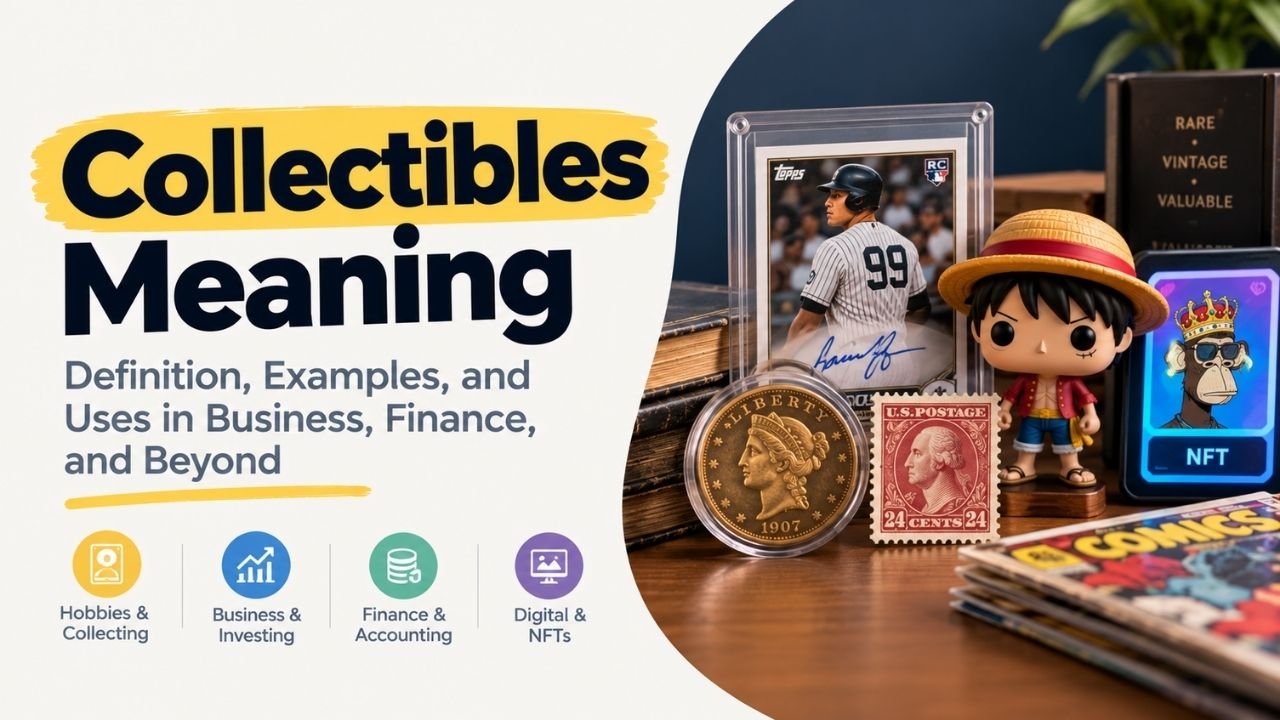
Collectibles are items that people gather and keep because they are rare, interesting, or valuable to them. Common examples include coins, stamps, trading cards, comic books, and signed sports items. The word is a noun, and it is usually used in the plural.
The meaning can change with the context. In everyday English, it means objects that people collect as a hobby or investment. In accounting and business, mainly in the Philippines and parts of South Asia, it can mean money owed to a company that is waiting to be collected. In the digital world, it can mean online items like NFTs.
What Does Collectibles Mean?
Collectibles are objects that people want to collect because of their rarity, age, history, beauty, or personal appeal. Many collectibles also hold or gain monetary value, but this is not required. A rare coin and a childhood toy can both be collectibles.
Here is the quick summary:
- Meaning: Items valued by collectors.
- Part of speech: Noun (plural). Also used as an adjective in the singular form, “collectible.”
- Common contexts: Hobbies, investing, retail, taxes, accounting, digital assets.
- Simple example: “She keeps her vintage dolls with her other collectibles.”
💡 Tip: If you see the word in a hobby, store, or auction setting, it means items to collect. If you see it in an accounts or billing setting, it may mean amounts to be collected.
See More: Smirking Face Meaning
Collectibles Meaning in English
In standard English, “collectible” first works as an adjective. It describes something that people want to collect. When it is used as a noun, as in “collectibles,” it refers to the items themselves.
Dictionaries list this noun meaning as an item that people collect, often because it is rare, old, or in demand. The word does not describe how much an item costs. A cheap souvenir spoon can be a collectible if someone collects it.
Collectibles as a noun
- “The shop sells coins, stamps, and other collectibles.”
- “Her collectibles are kept in a glass cabinet.”
Collectible as an adjective
- “This is a collectible watch from the 1960s.”
- “Limited edition cards become more collectible over time.”
How to Pronounce Collectibles
The word has four syllables. The stress falls on the second syllable.
| Item | Guide |
| Simple spelling | kuh LEK tuh bulz |
| IPA (American) | /kəˈlɛktəbəlz/ |
| Stress | Second syllable: col-LEC-ti-bles |
Many speakers shorten the middle sounds, so it can sound like “kuh-LEK-tbulz” in fast speech. Both are acceptable in everyday talk.
Collectibles or Collectables: Which Spelling Is Correct?
Both spellings are accepted. Major dictionaries list “collectible” and “collectable” as variants of the same word. In American English, “collectible” is the more common form. “Collectable” is also seen, and some businesses prefer it as a brand style.
| Spelling | Status | Note |
| Collectible | Standard | More common in the USA |
| Collectable | Accepted variant | Seen in some regions and brand names |
⚠️ Common mistake: Do not treat one spelling as an error. Pick one and use it consistently throughout your writing.
Collectibles Meaning in Different Contexts
The word shifts slightly depending on where you see it. Here are the main meanings, kept separate so they do not blur together.
Meaning 1: Items people collect (hobby and market)
This is the main meaning in the USA. It covers anything collected for enjoyment or investment, including toys, cards, coins, stamps, figurines, and memorabilia.
Meaning 2: Collectibles in finance and tax
In US tax rules, “collectibles” has a specific meaning. The Internal Revenue Code lists items like artwork, rugs, antiques, metals, gems, stamps, coins, and certain alcoholic beverages. This definition matters for two reasons:
- Profit from selling collectibles held for more than a year may be taxed at a different maximum rate than most other long term investments.
- Retirement accounts like IRAs generally cannot hold collectibles, though there are limited exceptions for certain precious metal coins and bullion.
Tax rules can change, so check the IRS or a qualified tax professional before acting on this.
Meaning 3: Collectibles in accounting and business
In some countries, “collectibles” is used to mean money owed to a business that it expects to receive. This is closer to accounts receivable. It is common in business English in the Philippines and is sometimes seen in South Asia.
You may also see these related phrases:
- Collectible accounts: Customer balances the business expects to be paid.
- Collectable amount: The amount that can realistically be collected.
- Uncollectible accounts: Balances unlikely to be paid, often called bad debts.
In US accounting, “accounts receivable” is the standard term. Using “collectibles” this way in a US business setting may confuse readers, so choose the standard term for American audiences.
⚠️ Note: “Collectibles” in the tax sense and “collectibles” in the accounting sense are two different ideas. One means physical items. The other means money owed.
Meaning 4: Digital collectibles and NFTs
Digital collectibles are online items whose ownership is tracked on a blockchain. An NFT, or nonfungible token, is a unique digital record. It can be linked to art, music, game items, or other digital files.
Owning an NFT does not automatically mean owning the copyright to the work it points to. The rights depend on the terms set by the creator or seller. Values can also rise and fall sharply, and some items may become difficult to sell.
Meaning 5: Metaverse collectibles
Metaverse collectibles are digital items made for use in virtual worlds and online games. They may include avatar clothing, virtual land, accessories, or special items. Their usefulness depends on the platform that supports them.
Types of Collectibles With Examples
Here is a quick view of common collectible categories.
| Category | Examples | Why people collect them |
| Antiques | Furniture, clocks, porcelain | Age, craftsmanship, history |
| Sports collectibles | Trading cards, signed jerseys, game worn items, tickets | Fandom, rarity, memories |
| Coins and currency | Rare coins, old banknotes | History, metal content, rarity |
| Stamps | Postage stamps, first day covers | Design, scarcity, history |
| Toys and games | Action figures, model cars, board games | Nostalgia, limited editions |
| Comics and books | First editions, signed copies | Rarity, condition, story |
| Vintage items | Records, clothing, cameras | Style, era, nostalgia |
| Digital collectibles | NFTs, virtual items | Ownership records, community |
Sports collectibles meaning
Sports collectibles are items linked to athletes, teams, or events. Trading cards, signed balls, programs, and jerseys are common examples. Condition, authenticity, and the athlete’s popularity often affect their value.
Antiques and collectibles meaning
People often say “antiques and collectibles” together, but the words are not identical. An antique is usually an item of considerable age. A common rule of thumb, including in US customs rules, is at least 100 years old. A collectible does not need to be that old. A toy from the 1990s can be a collectible but not an antique.
Vintage collectibles meaning
“Vintage” usually describes something from a past era, often at least a few decades old. It is a looser term than “antique.” A vintage collectible is an older item that collectors want, such as a 1970s lunch box.
Antiques, Vintage Items, and Collectibles: What Is the Difference?
| Term | Typical meaning | Example |
| Antique | Very old, often 100 years or more | A 19th century clock |
| Vintage | From an earlier era, often 20 years or more | A 1980s video game console |
| Collectible | Any item people want to collect, old or new | A limited edition figure |
| Memorabilia | Items linked to a person, event, or team | A concert poster |
An item can belong to more than one group. A 1920s comic book can be vintage and collectible, and in some definitions, antique as well.
Collectibles Meaning in Other Languages
Many readers search for the word in their own language. These translations are meant as a general guide. Exact wording can vary by region and context.
| Language | Common rendering | Note |
| Hindi | संग्रहणीय वस्तुएँ (sangrahaniya vastuen) | Items worth collecting |
| Urdu | جمع کرنے کی اشیاء (jama karne ki ashya) | Items for collecting |
| Bengali | সংগ্রহযোগ্য জিনিস (sangrahayogya jinis) | Items fit for collecting |
| Tamil | சேகரிப்புப் பொருட்கள் (sekarippu porutkal) | Collection items |
| Tagalog | Mga koleksyon, mga bagay na kinokolekta | In Philippine business, “collectibles” can also mean amounts due |
| Bisaya (Cebuano) | Often the English word is used as is | Context decides the meaning |
In Tagalog and Philippine business settings, “collectibles” often refers to money that a company still needs to collect from customers. If you are reading a business document there, this is the likely meaning.
Collectibles Synonyms and Related Words
Synonyms depend on the meaning you need. Here is how the main ones differ.
| Word | Meaning | How it differs |
| Memorabilia | Items linked to a person, event, or period | Focus is on the connection, not rarity |
| Keepsake | A small item kept for memories | Personal, not always valuable |
| Antique | Very old item | Age is the main factor |
| Curio | A small, unusual object | Interest comes from being odd or rare |
| Heirloom | An item passed down in a family | Value comes from family history |
| Receivables | Money owed to a business | Used only in the accounting sense |
How to Use Collectibles in a Sentence
Here are a few natural examples.
- “He has been buying baseball collectibles since he was ten.”
- “The auction house specializes in antiques and collectibles.”
- “Under the tax rules, coins and artwork are treated as collectibles.”
- “The company is chasing its collectibles from last quarter.” (Business sense, mostly outside the USA.)
Is it singular or plural?
“Collectibles” is the plural noun. The singular noun is “collectible.” For example: “This coin is a rare collectible.” Use a plural verb with the plural form: “The collectibles are on display.”
Common Mistakes With the Word Collectibles
1. Mixing up the spellings in one document
❌ Incorrect: “Our collectibles shop sells rare collectables.”
✅ Correct: “Our collectibles shop sells rare collectibles.”
Both spellings are valid, but using both in one text looks careless.
2. Using it as an uncountable word
❌ Incorrect: “She bought a lot of collectible.”
✅ Correct: “She bought a lot of collectibles.”
3. Assuming every collectible is valuable
Collectibles are not always expensive. Value depends on rarity, demand, condition, and authenticity.
4. Confusing antiques with collectibles
An antique is typically very old. A collectible can be new. Not every collectible is an antique.
5. Using the accounting meaning with a US audience
In the USA, “accounts receivable” is clearer than “collectibles” when you mean money owed.
Names You May See Online
Some search terms combine “collectibles” with a name, such as “chalice collectibles,” “cerebral collectibles,” or “empty collectibles.” These appear to be brand, shop, or project names rather than dictionary terms. They do not carry a separate meaning in standard English. If you are researching one of them, check the official website or a trusted source directly, since details about specific brands can change.
Are Collectibles a Good Investment?
This is a financial question rather than a language one, but readers often ask it. Collectibles can rise in value, but there is no guarantee. Prices depend on demand, condition, and trends. They can also be hard to sell quickly, and storage and insurance cost money.
Authenticity matters a great deal. Many buyers rely on grading services or trusted dealers. This article is not financial advice, so speak with a qualified financial advisor before investing a large amount.
See More: TBM Meaning
Frequently Asked Questions
What does collectibles mean?
Collectibles are items that people collect because they are rare, old, interesting, or valuable. Examples include coins, stamps, trading cards, and toys.
Is collectibles a noun or an adjective?
It is mainly a plural noun. The singular “collectible” can be a noun or an adjective.
How do you pronounce collectibles?
Say it as kuh LEK tuh bulz. The stress is on the second syllable.
What is the difference between collectibles and collectables?
There is no real difference in meaning. They are two accepted spellings. “Collectibles” is more common in the USA.
What is the difference between antiques and collectibles?
Antiques are usually very old, often 100 years or more. Collectibles can be old or new, as long as people want to collect them.
What does collectibles mean in accounting?
In some regions, it means money owed to a business that is expected to be received. This is similar to accounts receivable.
What are digital collectibles?
Digital collectibles are online items, often NFTs, whose ownership is recorded on a blockchain. They may include art, game items, or other digital files.
What are examples of sports collectibles?
Examples include trading cards, signed jerseys, game worn equipment, tickets, and programs.
Are collectibles taxed differently in the USA?
They can be. US tax rules define a specific group of items as collectibles, and gains on them may be taxed at a different maximum rate. Check current IRS guidance or ask a tax professional.
Conclusion
Collectibles meaning is simple at its core: items people gather because they are rare, appealing, or meaningful. The word also has special uses in tax rules, accounting, and the digital world. Context tells you which meaning applies.
When you read or write the word, check the setting first. For hobbies and shops, it means items to collect. For US tax topics, it follows a specific legal list. For business in some regions, it can mean money waiting to be collected. Choose one spelling, pick the clearest term for your audience, and you will use the word correctly.

Hassan Ibrahim is the author behind Mean Fixer, with 4 years of experience researching and writing about names, words, slang, meanings, and everyday language. Their goal is to make confusing words and meanings simple, clear, and easy to understand through accurate, useful, and reader-friendly explanations.