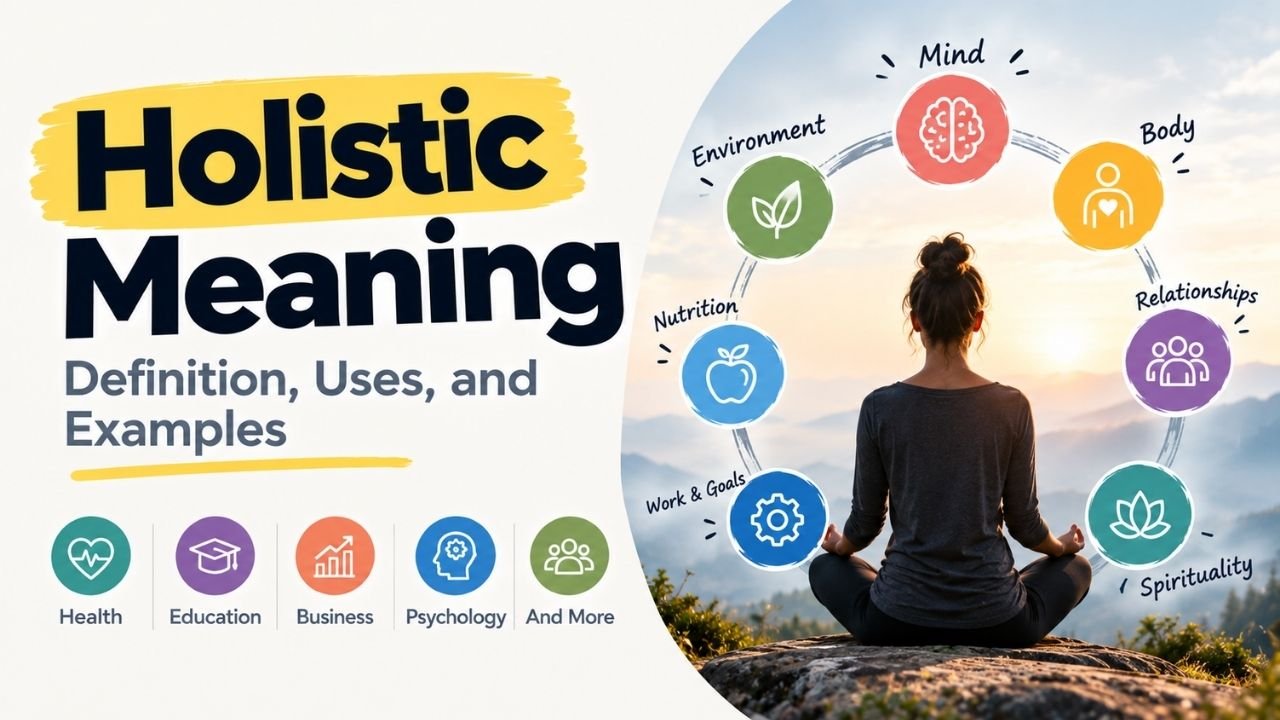
Holistic means looking at the whole of something instead of only its separate parts. It describes an approach that treats a person, a system, or a problem as one connected unit. The word is an adjective, and you will see it in health, education, business, and everyday talk.
The idea behind it is simple. Parts affect each other, so you understand them better when you see how they fit together. That is why a holistic doctor looks at your lifestyle and a holistic teacher looks at the whole child. This guide explains the meaning, the spelling debate, and the main contexts, with pronunciation, origin, and examples.
What Does Holistic Mean?
Holistic (adjective): concerned with the whole of something, and with how its parts connect, rather than treating the parts separately.
A quick test: if you are asking “How does everything fit together?”, you are thinking holistically. If you are asking “What is wrong with this one piece?”, you are thinking in parts.
Holistic Meaning in Simple Words
Imagine a car that will not start. A part-by-part mechanic checks the battery and stops there. A holistic mechanic asks whether the battery, the wiring, and the way the car is driven are all connected to the problem.
For kids: “Holistic means looking at the whole picture, not just one little piece of it.”
Quick Facts
| Feature | Detail |
| Part of speech | Adjective |
| Adverb | Holistically |
| Noun | Holism |
| Simple meaning | Looking at the whole, not just the parts |
| Common fields | Health, education, business, psychology, anthropology |
See More: Pursue Meaning
How to Pronounce Holistic
- American English: hoh-LIS-tik, IPA /hoʊˈlɪstɪk/
- British English: hə-LIS-tik or hoh-LIS-tik, IPA /həˈlɪstɪk/ or /hoʊˈlɪstɪk/
The stress falls on the middle syllable, “LIS.” Both pronunciations are accepted. The “h” is always pronounced.
Holistic Meaning and Grammar
Holistic is an adjective, so it describes a noun.
- She takes a holistic approach to teaching.
- The clinic offers holistic care.
Related forms:
| Form | Part of speech | Example |
| Holistic | Adjective | A holistic view of the problem |
| Holistically | Adverb | We need to think holistically. |
| Holism | Noun | Holism says the whole is more than its parts. |
| Holist | Noun (rare) | A holist believes in studying wholes. |
Holistic is usually placed before a noun: holistic care, holistic education, holistic development. It can also follow a linking verb, as in “Her approach is holistic.”
Holistic vs Wholistic: Which Is Correct?
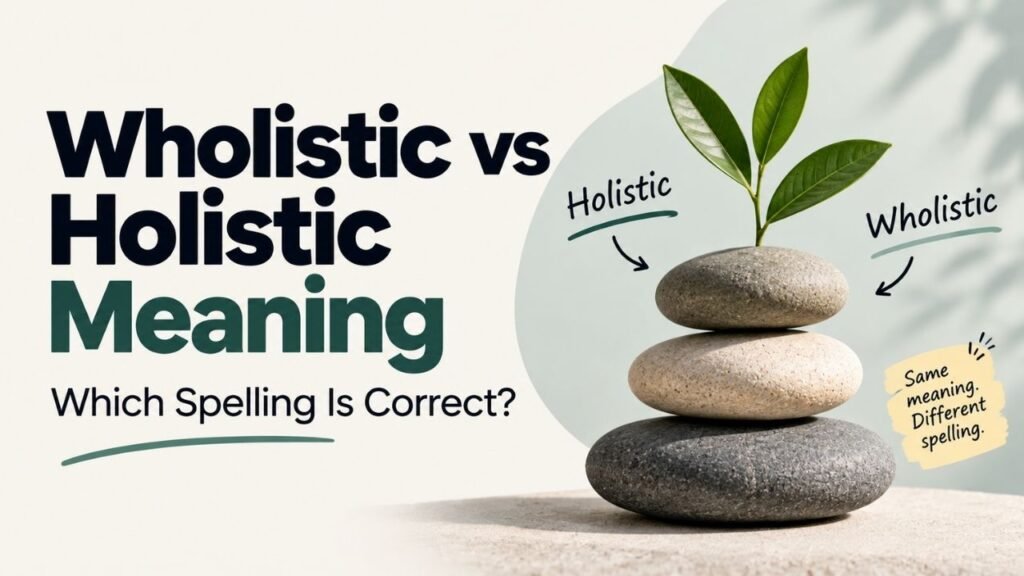
Both spellings appear in print, but holistic is the standard one. Major dictionaries list holistic as the main entry. Wholistic is a less common variant.
Some writers choose wholistic because it visibly contains the word “whole.” The link is real, because the meaning is about wholeness. Still, holistic is the safer choice in school, business, and professional writing.
| Spelling | Status | When to use it |
| Holistic | Standard | Almost every situation |
| Wholistic | Less common variant | Only if a brand or group prefers it |
💡 Tip: If you are unsure, write holistic. Readers and search tools recognize it right away.
Origin of the Word Holistic
Holistic comes from holism, a word coined by the South African statesman and thinker Jan Smuts. He used it in his 1926 book Holism and Evolution. Smuts built the term from the Greek word holos, meaning “whole” or “entire.”
His idea was that nature produces wholes that are more than the sum of their parts. The adjective holistic followed soon after. Over the decades, the word moved from philosophy into medicine, education, and business.
Holistic Meaning in Different Contexts
The core idea stays the same everywhere: look at the whole. What counts as “the whole” changes with the field.
Holistic Meaning in Health
In health, holistic means caring for the whole person. That includes the body, the mind, emotions, social life, and sometimes spiritual wellbeing. Habits such as sleep, stress, and food are treated as part of the picture.
- Holistic health: an approach that connects physical, mental, and social wellbeing.
- Holistic wellness: using lifestyle choices to support overall wellbeing.
Holistic Meaning in Medicine
Holistic medicine considers the whole person, not only the disease or symptom. Practitioners may talk with you about stress, diet, relationships, and routines, as well as test results.
⚠️ Important: The word “holistic” is not a regulated medical title. A holistic doctor may be a licensed physician who takes a whole-person approach, or someone with a very different background. Check a practitioner’s credentials. Holistic or complementary methods should not replace proven medical treatment for serious conditions. The U.S. National Center for Complementary and Integrative Health (NCCIH) offers evidence-based information on this topic.
Holistic Meaning in Nursing
In nursing, holistic care means attending to a patient’s physical, emotional, social, and spiritual needs together. A nurse using this approach does not only treat the illness. They also consider fear, family support, comfort, and the patient’s values.
Example: A holistic nurse notices that a patient is anxious about going home. She arranges a talk with the family, not just a medication check.
Holistic Meaning in Education
In education, holistic means supporting the whole child. That covers thinking skills, emotional growth, social skills, physical health, and character, not just test scores.
- Holistic development means these areas grow together and affect each other.
- “Learning is holistic” means a child does not learn in separate boxes. Emotions, relationships, and the body all shape how well they learn.
- “Development is holistic” means the same thing for growth in general: physical, cognitive, emotional, and social development are linked.
Holistic Meaning in College Applications
Holistic admissions means a college reviews your full application, not just grades and test scores. Readers may consider essays, activities, recommendations, background, and challenges you have faced.
Example: “The university uses holistic review, so a strong essay can balance a lower test score.”
Policies differ from school to school, so check each college’s own admissions page.
Holistic Meaning in Business
In business, a holistic approach looks at the whole organization or system. It asks how departments, customers, processes, and goals connect.
Example: “Instead of fixing sales alone, the company took a holistic look at its marketing, product, and support.”
Holistic Meaning in Psychology
In psychology, holistic thinking is linked to Gestalt psychology, which holds that people perceive wholes, not just collections of parts. It also appears in humanistic approaches that view a person as a complete individual, not a list of symptoms.
Holistic Meaning in Anthropology
In anthropology, holism means studying human life as a connected whole. Anthropologists look at culture, language, biology, history, and daily life together. The idea is that no single part, such as religion or economy, can be fully understood alone.
Holistic Meaning in the Bible
The word “holistic” does not appear in the Bible. It is a modern term. However, many readers and writers use it to describe a view found in scripture: that a person is a unity of body, mind, and spirit, and that faith touches all of life.
A verse often cited in this discussion is 1 Thessalonians 5:23, which speaks of spirit, soul, and body. Interpretations vary between traditions, so treat “biblical holism” as a theological idea, not a biblical quotation.
See More: GBTS Meaning in Text
Holistic Meaning in Other Languages
Many readers search for translations. The words below are common equivalents, but the best choice can depend on context, such as medicine versus education. For formal documents, confirm the wording with a native speaker.
| Language | Common equivalent | Romanized |
| Hindi | समग्र | samagra |
| Urdu | جامع / ہمہ گیر | jaame / hama geer |
| Bengali | সামগ্রিক | shamogrik |
| Tamil | முழுமையான | muzhumaiyaana |
| Telugu | సమగ్ర | samagra |
| Marathi | समग्र | samagra |
| Malayalam | സമഗ്ര | samagra |
| Kannada | ಸಮಗ್ರ | samagra |
| Farsi (Persian) | کلنگر / جامعنگر | kol negar / jame negar |
In Hindi and related languages, samagra carries the sense of “complete” or “comprehensive.” It fits phrases like holistic development.
Holistic Synonyms and Related Words
Synonyms are never perfect matches. Pick the one that fits your sentence.
| Word | Meaning | How it differs from holistic |
| Comprehensive | Covering everything | Focuses on completeness, not on connection between parts |
| Integrated | Combined into one | Stresses joining parts together |
| Whole-person | Treating the entire individual | Used mainly in health and education |
| All-encompassing | Including everything | Broader and more general |
| Overall | Considering things in general | Looser, less technical |
| Systemic | Relating to a whole system | Stresses system structure |
Antonyms and contrasts: reductionist, piecemeal, fragmented, narrow, specialized.
Reductionism is the true opposite in science. It explains something by breaking it into its smallest parts. Neither approach is always better. Many fields use both.
Holistic Approach Meaning
A holistic approach is a method that considers the whole situation and how its parts affect one another. It usually involves gathering information from several areas before making decisions.
Typical features:
- It looks at connections, not just single causes.
- It considers context, such as environment or background.
- It aims for balance across several goals.
- It adjusts the solution to the whole picture.
Holistic Care, Holistic View, and Holistic Doctor
These phrases come up often, so here are short definitions.
- Holistic view: a broad way of seeing something, with attention to how everything connects.
- Holistic care: treatment or support that addresses physical, emotional, and social needs together.
- Holistic doctor: a doctor who says they treat the whole person. Check what training and license they hold.
- Holistic development: growth in all areas, such as mind, body, emotions, and social skills, at once.
Examples of Holistic in a Sentence
Here are a few natural examples.
- “The school takes a holistic approach to student wellbeing.”
- “Her doctor looked at her sleep, diet, and stress, not just her blood pressure.”
- “We need a holistic plan, not a quick fix.”
- “The admissions team reads each application holistically.”
Common Mistakes with Holistic
Mistake 1: Using it as a vague buzzword
❌ Incorrect: “Our holistic shampoo is the best.”
✅ Correct: “Our shampoo uses plant-based ingredients.”
Why: Holistic needs a real “whole” to refer to. A shampoo has no whole system, so the word adds nothing.
Mistake 2: Confusing it with “holy”
Holistic is not about religion or holiness. It comes from the Greek word for whole, not from “holy.”
Mistake 3: Assuming it means “natural” or “alternative”
❌ Incorrect: “Holistic means herbal medicine only.”
✅ Correct: “Holistic care can include conventional medicine and lifestyle support.”
Why: Holistic describes the scope of attention, not the type of treatment.
Mistake 4: Spelling it “hollistic”
The correct spelling has one “l” after the “o”: holistic.
See More: Nudibranch Meaning
Frequently Asked Questions
What does holistic mean?
Holistic means considering the whole of something, and how its parts connect, instead of focusing on one part alone.
What is the simple meaning of holistic?
It means looking at the big picture, not just the small pieces.
Is holistic a noun or an adjective?
It is an adjective. The related noun is holism, and the adverb is holistically.
How do you pronounce holistic?
In American English, say hoh-LIS-tik, with the stress on the middle syllable.
What is the difference between holistic and wholistic?
They mean the same thing. Holistic is the standard spelling. Wholistic is a less common variant.
What does holistic mean in medicine?
It means treating the whole person, including lifestyle, emotions, and social factors, not only the symptoms. The term is not a protected medical title, so check credentials.
What does holistic mean in a college application?
It means the college looks at your entire profile, such as essays, activities, and background, not only grades and test scores.
What is a holistic approach in business?
It is a way of solving problems by looking at the whole organization and how its parts affect each other.
Is the word holistic in the Bible?
No. It is a modern word, though many people use it to describe the biblical view of a person as body, mind, and spirit.
What is the opposite of holistic?
Reductionist, piecemeal, or fragmented, depending on the context.
Conclusion
Holistic means looking at the whole and at how its parts connect. It comes from the Greek word holos and entered English through Jan Smuts’s idea of holism in 1926. Today it appears in health, nursing, education, college admissions, business, psychology, and anthropology, and the core meaning stays the same in each.
The easiest way to use the word well is to ask what “whole” you mean. If you can name it, such as the whole patient, the whole child, or the whole company, holistic fits. If you cannot, choose a clearer word, and keep holistic for moments when connection really matters.

Hassan Ibrahim is the author behind Mean Fixer, with 4 years of experience researching and writing about names, words, slang, meanings, and everyday language. Their goal is to make confusing words and meanings simple, clear, and easy to understand through accurate, useful, and reader-friendly explanations.