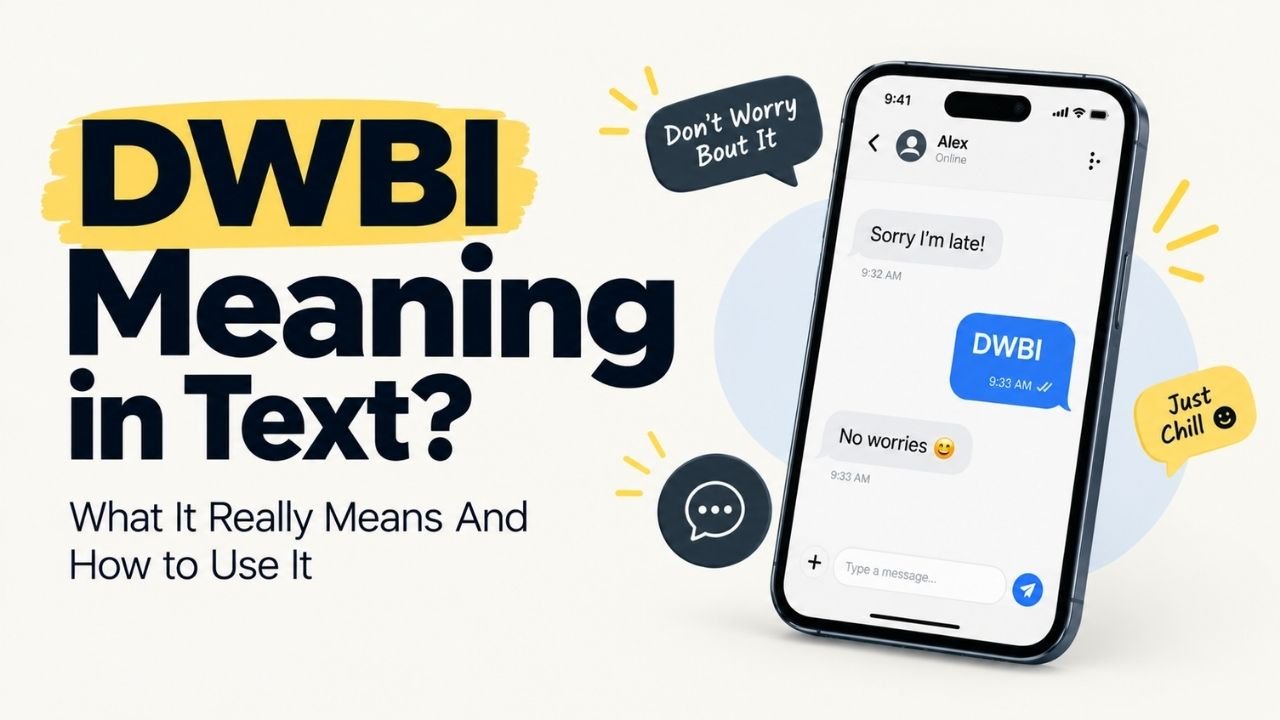
If someone just texted you “DWBI” and you have no idea what it means, you are not alone. DWBI is a short piece of texting slang that shows up in casual chats, group messages, and comments. In most everyday conversations, DWBI meaning in text comes down to one simple idea: don’t worry about it.
People use it to calm a friend down, brush off a small mistake, or keep a conversation light. It is informal, friendly, and almost never used in professional writing. Once you understand the tone behind it, you will never misread a DWBI text again.
What Does DWBI Mean In Text?
DWBI stands for “Don’t Worry ‘Bout It,” which is a casual, contracted version of “don’t worry about it.” It is a reassurance phrase, not an instruction or a question.
When someone sends DWBI, they are usually telling you:
- It’s fine.
- No big deal.
- Forget about it.
- You don’t need to stress over this.
Here is a quick example.
Friend: “Sorry I’m late, traffic was awful.” You: “DWBI, I just got here too.”
In that exchange, DWBI is doing the same job as saying “no worries” out loud. It softens the moment and moves the conversation forward without making a small issue feel bigger than it is.
DWBI At A Glance
| Term | Full Form | Tone | Common Use |
| DWBI | Don’t Worry ‘Bout It | Casual, friendly | Reassuring someone after a mistake or apology |
| DW | Don’t Worry | Casual, brief | Quick reassurance, shorter than DWBI |
| NBD | No Big Deal | Casual, dismissive | Downplaying a minor issue |
| NP | No Problem | Casual, polite | Responding to thanks or a request |
See More: OBO Meaning
DWBI Meaning In Text From A Girl
DWBI does not carry a different dictionary meaning depending on who sends it. From a girl, a guy, or anyone else, the core meaning stays the same: don’t worry about it.
What can change is the emotional context. When a girl texts DWBI after you apologize for something, it usually signals that she genuinely is not upset and wants you to relax. If it follows a longer pause or a shorter reply than usual, the tone might feel a bit more guarded, similar to how “it’s fine” can sometimes carry extra weight depending on the situation. Reading DWBI correctly means paying attention to the conversation around it, not just the letters themselves.
DWBI Meaning In Text From A Guy
The same rule applies here. DWBI meaning in text from a guy is still “don’t worry about it.” Guys commonly use it in casual group chats, gaming chats, or one-on-one conversations to brush off small mix-ups, like forgetting to reply or mixing up plans.
Example:
You: “Hey, I think I left your charger at your place.” Him: “DWBI, I’ve got another one.”
There is no separate “guy version” or “girl version” of the acronym. The letters and the full phrase behind them do not change based on gender. Only the surrounding tone of the conversation can shift how casual or reassuring it feels.
Is There More Than One DWBI Meaning?
Yes, but the casual reassurance meaning is by far the most common one in everyday texting. A few other, much less frequent uses exist depending on the setting.
DWBI In Slang And Chat
In slang and chat contexts, DWBI almost always means “Don’t Worry ‘Bout It.” Acronym reference sites that track internet and chat slang list this as the recognized definition in the slang and pop culture category.
DWBI In Business And Technology
Outside of texting, DWBI has a completely unrelated meaning in professional and technical settings. In business and IT contexts, DWBI stands for Data Warehousing and Business Intelligence, which refers to systems and processes used to store, organize, and analyze company data. This meaning has nothing to do with texting slang, and the two uses are never confused in context. Nobody discussing a data warehousing project means “don’t worry about it,” and nobody texting a friend means a database system.
DWBI As A Trend Or Inside Joke
You may also come across DWBI used in a playful or satirical way on platforms like TikTok, sometimes paired with unrelated tags or used as part of a joke format rather than a literal reassurance. In these cases, the acronym is being used loosely, almost like a meme label, rather than as a straightforward message. If you see DWBI attached to a joke, a meme, or a video caption that does not clearly connect to “don’t worry about it,” it is likely being used in this looser, trend-based way rather than its standard slang meaning.
A quick note on accuracy: a handful of newer web pages suggest expansions like “Don’t Worry, Be Inspired” or “Don’t Worry, Be Informed.” These are not established or widely recognized meanings. There is no reliable evidence that either phrase is in common use. If you see DWBI used that way, treat it as an uncommon or invented variation rather than a standard definition.
DWBI Meaning In Text Message, Snapchat, And Instagram
DWBI works the same way across text messages, Snapchat, Instagram DMs, and most other chat platforms. It is a platform-independent piece of slang, similar to “lol” or “brb.” You might see it:
- In a text message after apologizing for a late reply
- In a Snapchat chat after a small miscommunication
- In an Instagram DM thread when someone brushes off a minor issue
- In a group chat when multiple people are casually reassuring one member
There is no special Snapchat-only or Instagram-only version of DWBI. The meaning and tone stay consistent no matter where the message is sent.
Grammar And Part Of Speech
DWBI is an acronym, and more specifically an initialism, because you say each meaning behind the letters rather than pronouncing them as one word. It functions as an interjection or a short reassuring statement, similar to saying “it’s okay” on its own.
- Part of speech: Interjection or standalone phrase
- Capitalization: Usually written in all capital letters, though lowercase “dwbi” is also common in casual texting
- Punctuation: Often stands alone with no punctuation, or is followed by a comma before more text, such as “DWBI, I’ll handle it”
Because it is slang, DWBI does not follow formal grammar rules the way a standard word would. It is not conjugated, does not have a plural form, and is not typically modified with prefixes or suffixes.
How To Pronounce DWBI
DWBI is read letter by letter rather than as a single word.
Pronunciation: dee-double-you-bee-eye
Some people say it out loud in casual conversation, spelling out each letter quickly, similar to how people say “OMG” or “TBH.” It is far more common in written texting than in spoken conversation, so you will see it typed out much more often than you will hear someone say it.
See More: Undulating Kiss Meaning
Origin Of DWBI
DWBI comes from the everyday spoken phrase “don’t worry about it,” which has been a common reassurance in English for a long time. As texting became a primary way people communicate, users began shortening frequently used phrases to save time and keystrokes.
There is no single documented moment when DWBI first appeared. Instead, it developed gradually as part of a much larger pattern in digital communication, where common expressions like “no worries,” “no big deal,” and “don’t worry about it” were shortened into acronyms such as NW, NBD, and DWBI. Its growth mirrors the rise of instant messaging, group texting, and social media chat, all of which reward short, quick replies over longer typed-out phrases.
How To Use DWBI In A Sentence
DWBI usually appears as a short, standalone reply, though it can also be worked into a longer sentence.
As a standalone reply:
Friend: “I owe you five dollars from lunch.” You: “DWBI.”
Followed by more context:
“DWBI, I already fixed it on my end.”
As a reassurance before explaining something:
“DWBI, just send it whenever you get the chance.”
In each case, DWBI is doing the same job: lowering the stakes of whatever was just said and keeping the tone relaxed.
DWBI Versus Similar Texting Slang
A few other acronyms carry a similar reassuring tone, but they are not identical to DWBI.
| Acronym | Meaning | How It Differs From DWBI |
| DW | Don’t Worry | Shorter and slightly more casual; drops “about it” entirely |
| NBD | No Big Deal | Focuses on minimizing the issue rather than offering reassurance |
| NP | No Problem | Often used as a response to thanks, not just after a mistake |
| ITS OK | It’s Okay | Full words rather than an acronym; feels slightly warmer |
DWBI sits closest to “no worries” in everyday meaning. The main difference between DWBI and DW is length. DW is a shorter version of the same basic message, while DWBI keeps the full “about it” idea in a compressed form.
Common Mistakes With DWBI
❌ Incorrect: Using DWBI in a formal email or workplace message. ✅ Correct: Save DWBI for casual texting, chat apps, or informal conversations with friends.
DWBI is informal slang. In a professional setting, writing out “don’t worry about it” or “no need to worry” communicates the same reassurance without sounding out of place.
❌ Incorrect: Assuming DWBI always means “Data Warehousing and Business Intelligence” in a casual text. ✅ Correct: In everyday texting, DWBI almost always means “Don’t Worry ‘Bout It.” The business and technology meaning only applies in workplace or IT-specific conversations.
❌ Incorrect: Reading DWBI as sarcastic or dismissive by default. ✅ Correct: DWBI is generally sincere and friendly. Tone should be judged from the full conversation, not assumed from the acronym alone.
See More: Stay Tuned Meaning
Frequently Asked Questions
What does DWBI mean in text?
DWBI stands for “Don’t Worry ‘Bout It.” It is a casual way to reassure someone that a situation is not a big deal.
What does DWBI mean in text from a girl?
The meaning does not change based on who sends it. From a girl, DWBI still means “don’t worry about it,” though the surrounding tone of the conversation can add context.
What does DWBI mean in text from a guy?
Just like with any sender, DWBI from a guy means “don’t worry about it.” It is commonly used to brush off small mistakes or delays in a friendly way.
Is DWBI used the same way on Snapchat and Instagram?
Yes. DWBI keeps the same meaning and tone across texting, Snapchat, Instagram DMs, and most other messaging platforms.
Does DWBI have an official dictionary definition?
There is no formal dictionary entry for DWBI, but slang reference sites consistently list “Don’t Worry ‘Bout It” as the recognized meaning in casual chat and internet slang.
Is DWBI appropriate for work emails or professional messages?
No. DWBI is informal slang and is best kept to casual texting with friends or peers, not formal or professional communication.
What is the difference between DWBI and DW?
Both mean “don’t worry,” but DW drops “about it” entirely, making it slightly shorter and more casual than DWBI.
Does DWBI ever mean something other than “don’t worry about it”?
In business and IT settings, DWBI can refer to Data Warehousing and Business Intelligence, which is unrelated to texting slang. Some newer web pages also suggest expansions like “Don’t Worry, Be Inspired,” but these are not well established or widely recognized.
How do you pronounce DWBI?
DWBI is typically read letter by letter: dee-double-you-bee-eye.
Can DWBI be used sarcastically?
It can, depending on tone and context, but its default and most common use is sincere reassurance rather than sarcasm.
Final Thoughts
DWBI meaning in text comes down to a simple, friendly idea: don’t worry about it. Whether it shows up from a friend apologizing for being late, a group chat brushing off a small mix-up, or a casual reply after a minor mistake, the acronym is meant to lower tension and keep conversations relaxed. Outside of texting, DWBI can also refer to Data Warehousing and Business Intelligence in professional settings, but that meaning rarely overlaps with everyday chat.
The next time DWBI shows up in your messages, you can read it with confidence. It almost always means someone wants you to relax, let a small issue go, and move on with the conversation.

Hassan Ibrahim is the author behind Mean Fixer, with 4 years of experience researching and writing about names, words, slang, meanings, and everyday language. Their goal is to make confusing words and meanings simple, clear, and easy to understand through accurate, useful, and reader-friendly explanations.