
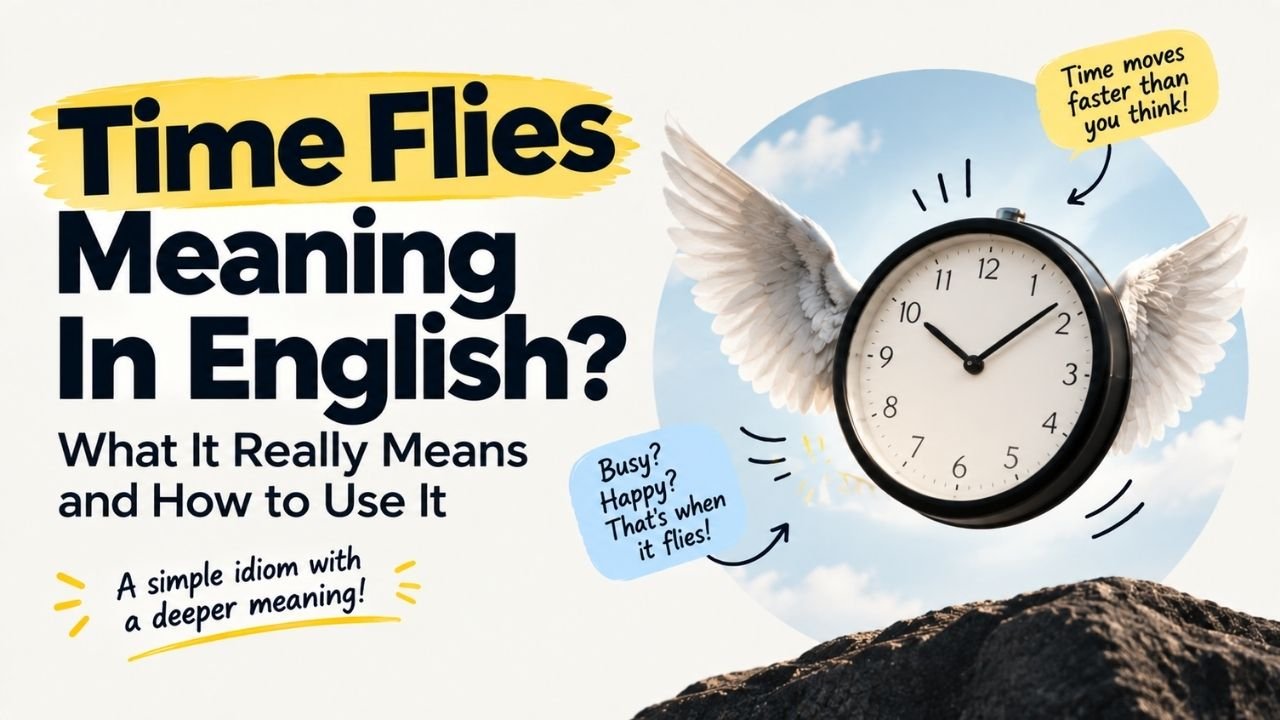
You just realized the year is almost over, and you have no idea where the months went. That feeling has a name in English. People say “time flies,” and once you hear it, you cannot stop noticing how often it fits. The time flies meaning is simple: time seems to move faster than we expect, especially when we are busy, happy, or simply not paying attention to the clock.
This saying shows up in casual chats, greeting cards, song titles, and dictionary entries alike. It is one of the most natural ways to express surprise about how quickly days, months, or years pass. In the sections below, you will find a clear definition, grammar notes, pronunciation tips, the phrase’s real history, and answers to the questions people ask most often about this everyday expression.
What Does Time Flies Mean?
At its core, time flies means that time passes quickly, often more quickly than a person expects or wants. It is not a literal claim about time having wings. It is a figure of speech, and English speakers use it to describe a feeling rather than a fact.
People usually say it in one of two situations.
- They are enjoying themselves so much that hours or days seem to disappear.
- They look back at how much time has passed since an event and feel surprised by the number.
Both uses point to the same underlying idea. Our sense of time does not always match the clock. A boring afternoon can feel endless, while an exciting weekend can feel like it lasted ten minutes. When someone says “time flies,” they are naming that mismatch between how time feels and how time actually moves.
Quick definition
Time flies: an idiom used to say that time seems to pass very quickly, especially when someone is busy, having fun, or reflecting on how much time has gone by.
Time Flies Meaning According to Dictionaries
Major English dictionaries agree on the core meaning, even though they phrase it slightly differently. Comparing a few respected sources helps confirm that this is a settled, well documented idiom rather than internet slang.
| Source | How the phrase is defined |
| Merriam Webster | An idiom used to say that time passes quickly, as in “My, how time flies!” |
| Cambridge style dictionaries | Time passes very quickly, often used with surprise when reflecting on how much time has gone by |
| Dictionary.com | Time passes quickly, as in “It’s midnight already? Time flies when you’re having fun.” |
Every dictionary definition of time flies centers on the same point: time is passing faster than expected. None of them treat it as a literal statement. All of them treat it as a common, everyday idiom that native speakers use without a second thought.
This agreement across sources matters. When you search “cambridge dictionary time flies meaning” or “merriam webster time flies meaning,” you will find slightly different wording, but the underlying explanation stays consistent. That consistency is a good sign you are dealing with the accepted, standard meaning of the phrase, not a regional or unusual one.
See More: Outie Meaning
Why Time Seems to Fly: The Idea Behind the Saying
The idiom works because it names something almost everyone experiences directly. Our internal sense of time does not run at a fixed, mechanical pace, even though clocks and calendars do. When attention is fully absorbed by something enjoyable, engaging, or unfamiliar, people tend to lose track of how many minutes or hours have gone by. Afterward, when they check the clock, the gap between how much time felt like it passed and how much time actually passed can feel surprising.
The reverse also happens. A dull task, a long wait, or a stressful moment can feel like it stretches on, even though the actual clock time is short. English does not have a single common idiom for that slower feeling, but “time flies” captures the fast side of this everyday mismatch clearly and briefly. This is part of why the phrase feels so natural in conversation. It puts a simple, familiar label on an experience that almost every person recognizes, without needing any further explanation.
Time Flies as an Idiom
Time flies meaning idiom is a phrase many learners search for, and the short answer is yes: this expression is classified as an idiom.
An idiom is a group of words whose meaning cannot be worked out just by reading each word separately. If you translate “time flies” word for word, you get a strange image of time literally flying like a bird or an insect. Native speakers never intend that literal image. They use the phrase to describe a feeling about how quickly time seems to move.
Because it is an idiom, “time flies” behaves as a fixed unit in conversation. Speakers do not usually change the wording much. You will hear:
- Time flies.
- How time flies.
- Time really flies.
- Time sure flies.
You will rarely hear made up variations that swap out the verb or noun, because that would break the idiom and confuse the listener. This fixed quality is typical of well established idioms, similar to phrases like “break the ice” or “hit the sack.”
Part of Speech
“Time flies” is not a single word, so it does not have one simple part of speech label like a noun or a verb on its own. Instead, it functions as a short sentence or idiomatic expression.
- Time acts as the subject, a noun.
- Flies acts as the verb, describing what the subject does.
Grammatically, “time flies” is a complete sentence: subject plus verb. It just happens to be used idiomatically rather than literally, similar to how “it’s raining” is grammatically complete but describes weather, not a literal falling object called “it.”
Grammar of Time Flies
Understanding the grammar behind this phrase clears up several common questions, including one of the most searched confusions: time flys or time flies meaning.
Time Flies or Time Flys
The correct spelling is always “time flies,” never “time flys.” Here is why.
The word “fly” is a verb, and when a verb ending in a consonant plus “y” is used in the third person singular present tense, English grammar changes the “y” to “ies.” That rule applies here because “time” is treated as a singular subject.
- Fly becomes flies (correct), following the same pattern as: cry becomes cries, try becomes tries, and dry becomes dries.
- Flys is not a standard English spelling for this verb form.
The only common use of “flys” appears in specific proper nouns or older regional terms unrelated to this idiom. For everyday English writing, “time flies” is the only correct choice.
Verb Form and Tense
“Flies” here is the present tense, third person singular form of the verb “fly.” Because “time” is singular, the verb takes the “s” ending, spelled as “ies.”
| Subject | Verb form | Example |
| Time (singular) | flies | Time flies when you travel. |
| I (first person) | fly | I fly to Chicago every month, unrelated idiom sense |
| They (plural) | fly | Years fly by quickly, a close variant |
Notice that the idiom almost always stays in the present tense, even when describing something from the past. People say “time flew” less often than “time flies,” even when reflecting on a specific past period, because the present tense captures the timeless, general truth the idiom expresses.
Past Tense: Time Flew
If you do need the past tense, the correct form is “time flew,” not “time flied.” Fly is an irregular verb, so the past tense does not follow the regular pattern.
- Present: Time flies.
- Past: Time flew.
- Present perfect: Time has flown.
Example: “Time flew while we were on vacation.” This version works well when talking about a specific, finished period rather than a general truth.
Is Time Flies an Idiom or a Proverb?
The two terms overlap in everyday conversation, but they are not identical. An idiom is any fixed expression whose overall meaning differs from a literal, word by word reading. A proverb is a short, traditional saying that usually offers advice or a general truth about life, often passed down across generations.
“Time flies” fits comfortably into both categories. It is an idiom because its meaning cannot be worked out literally. It also functions like a proverb, since it expresses a general observation about life that has been repeated and understood the same way for generations. Most dictionaries simply label it an idiom, which is the more common and accurate classification for how it is actually used in everyday speech.
Subject Verb Agreement in Longer Sentences
Because “time” is always treated as a singular, uncountable noun in this idiom, the verb must stay in its singular form even when the sentence around it grows longer or more complex.
- Correct: Time flies when a project keeps everyone busy.
- Correct: Time, especially during the holiday season, really flies.
- Incorrect: Time fly when a project keeps everyone busy.
Notice that adding extra words between the subject and the verb, such as “especially during the holiday season,” does not change the agreement rule. The verb still needs to match “time,” not any word that happens to sit closer to it in the sentence.
How to Pronounce Time Flies
Pronunciation rarely causes confusion with this phrase, since both words are common in everyday English. Still, a quick guide helps English learners feel confident saying it out loud.
- Time: pronounced /taɪm/, rhyming with “dime” or “lime.”
- Flies: pronounced /flaɪz/, rhyming with “eyes” or “skies.”
Put together, the phrase sounds like “taime flyze,” said smoothly as one connected unit, with a light stress on both words. In natural speech, the stress often falls slightly heavier on “flies,” especially when the speaker wants to express surprise, as in “Time FLIES!”
There is no significant difference between American and British pronunciation for this phrase. Both accents pronounce the vowel sounds the same way, though overall rhythm and intonation may vary slightly by region.
British English and American English Usage
The idiom is shared equally between British and American English, with no difference in spelling, grammar, or meaning. Both varieties of English use the exact phrase “time flies,” and both accept the same set of common variations, such as “how time flies” and “time flies when you’re having fun.”
The only differences that occasionally appear are stylistic rather than grammatical. British writing sometimes favors the fuller, slightly more formal “how time flies” in written contexts such as cards or speeches, while American writing leans more often toward the shorter, more casual “time flies” or “wow, time flies” in everyday conversation and informal writing. These are tendencies, not fixed rules, and either version is understood clearly and considered correct in both regions.
Origin of Time Flies
The origin of “time flies” reaches back further than many people expect. It has a documented history rather than an unclear or invented one, which is worth knowing before repeating any origin claim.
The Latin Root: Tempus Fugit
The most widely accepted and well documented origin traces back to the Roman poet Virgil. In his poem the Georgics, written around 29 BCE, Virgil included the line “fugit inreparabile tempus,” which translates closely to “it escapes, irretrievable time.” This line is the source of the well known Latin phrase “tempus fugit,” usually translated into English as “time flies.”
The Latin phrase became a popular motto over the centuries. You can still find “tempus fugit” engraved on sundials, old clocks, and gravestones, where it served as a reminder that time is limited and should not be wasted.
English Precursors
Before the modern English idiom became fixed, several writers expressed a similar idea in their own words. Merriam Webster notes that Shakespeare used a comparable phrase, describing “the swiftest hours, as they flew,” and poet Alexander Pope later wrote “swift fly the years.” Neither of these lines is the exact modern idiom, but both show that English writers were already linking flight and speed to the passage of time well before 1800.
When the Modern Idiom Appeared
According to Merriam Webster, the specific phrase “time flies,” used in its current idiomatic form, was first recorded around 1800. From that point forward, it settled into everyday English as a short, memorable way to describe time passing quickly, eventually becoming far more common in daily speech than the original Latin version.
So when someone searches for the time flies meaning origin, the honest answer combines both threads: the sentiment is ancient, rooted in Virgil’s Latin phrase from around 29 BCE, while the specific English wording as we use it today became common around the early 1800s.
See More: SH Meaning In Text
Time Flies in Different Contexts
The phrase adapts easily to many everyday situations. Reading a few real contexts makes the meaning click faster than any dictionary definition alone.
Everyday Conversation
This is the most common setting for the phrase. Someone glances at a clock or calendar and reacts with surprise.
- “Wait, it’s already 6pm? Time flies.”
- “I can’t believe our vacation is over. Time really flies.”
Nostalgic or Reflective Moments
People often say it while thinking back on how much life has changed.
- “My daughter just started high school. How time flies.”
- “It feels like yesterday we moved here, and it’s already been ten years. Time flies.”
Business and Professional Settings
The phrase also fits naturally into workplace conversation, usually in a lighter, more casual tone.
- “Time flies during busy quarters. We barely noticed summer ending.”
- “Thanks for a productive meeting. Time flew by faster than expected.”
Funny or Lighthearted Use
Many people add “funny” to the phrase to highlight the surprise, especially in birthdays, anniversaries, or reunions.
- “Funny how time flies, isn’t it? You’re all grown up now.”
- “Funny how time flies when you’re avoiding your inbox.”
Milestones and Aging
The phrase appears often around birthdays, graduations, weddings, and other markers of age or change, since these events naturally invite people to compare the present with a much earlier point in time.
- “Happy eighteenth birthday. Time flies, and we are so proud of who you’ve become.”
- “Twenty years married today. Time flies when you find the right person.”
Technology and Screens
A more modern use of the phrase describes how quickly time disappears while using a phone, scrolling social media, playing a game, or watching a show.
- “I opened the app for five minutes and somehow lost an hour. Time really flies on that thing.”
- “We meant to watch one episode. Time flies once you start a good series.”
Deadlines and Procrastination
The phrase also works as a gentle warning when someone realizes a deadline is closer than they thought.
- “Time flies, so let’s finish this draft before Friday instead of waiting.”
- “I know the deadline feels far away, but time flies. Start early.”
Common Expressions Built Around Time Flies
The idiom rarely stands completely alone. English speakers usually attach a small introductory word or phrase to it, and each version carries a slightly different tone.
| Expression | Typical tone | Example |
| How time flies | Simple surprise | How time flies, I still remember your first day here. |
| Oh how time flies | Warm, reflective | Oh how time flies when the kids are growing up. |
| My how time flies | Slightly formal, older generation tone | My, how time flies! You’ve grown so tall. |
| Wow time flies | Casual, spoken | Wow, time flies! Is it Friday already? |
| Funny how time flies | Ironic or bittersweet | Funny how time flies when you’re avoiding a decision. |
| See how time flies | Instructive, observational | See how time flies once you stop watching the clock. |
Each version communicates the same basic meaning, but the small opening word changes how emotional, formal, or casual the sentence feels. “My, how time flies” tends to sound a bit old fashioned and is common among older speakers or in greeting cards. “Wow, time flies” feels far more casual and modern, closer to everyday spoken English.
Time Flies When You’re Having Fun
This extended version is arguably more recognizable than the short form on its own. It adds a specific reason for the fast passing of time: enjoyment.
The idea is straightforward. When people are engaged in something pleasant, whether a conversation, a hobby, or a celebration, they tend to lose track of time. Afterward, they are often shocked by how much time has actually passed. The phrase captures that exact moment of surprise.
- “We talked for four hours and it felt like twenty minutes. Time flies when you’re having fun.”
- “The concert felt like it lasted ten minutes. Time really does fly when you’re having fun.”
This version works well in casual writing, social captions, and spoken conversation. It is warmer and more specific than the plain “time flies,” since it names the reason behind the fast feeling rather than leaving it open.
Time Flies in Pop Culture
Because the phrase captures such a universal feeling, it shows up often in music, movies, and everyday media, which explains why so many people search for it alongside artist names.
Drake, “Time Flies”
Drake released a song titled “Time Flies” on his 2020 mixtape Dark Lane Demo Tapes. The track reflects on a past relationship and the sense that time slipped by faster than the narrator realized, tying the everyday idiom to a mood of regret and reflection. The song became a modest chart hit in the United States and Canada. Listeners searching “drake time flies meaning” are usually looking for this specific track rather than a separate definition of the idiom itself. The song uses the same everyday meaning discussed throughout this article: time moving faster than expected, here applied to a fading relationship.
Other Songs and Titles
The phrase has been reused as a title across different genres for decades, including releases by Huey Lewis and the News, Oasis, and several other artists. This repetition is not a coincidence. “Time flies” is short, emotionally resonant, and instantly understood, which makes it a natural choice for song titles, memoirs, and retrospective collections that look back on a stretch of years.
Time Flies Quotes
A small number of well documented quotations use this exact sentiment, and it is worth separating genuine, sourced quotes from vague, unattributed lines that circulate online without a real origin.
One of the most frequently cited and verifiable examples comes from American novelist Nathaniel Hawthorne, who wrote in his novel The Marble Faun: “Time flies over us, but leaves its shadow behind.” This line captures a slightly different angle on the idiom. It agrees that time moves quickly, while adding that it still leaves a lasting mark behind it.
The original Latin source itself functions as a quotation in its own right. Virgil’s line from the Georgics is often rendered in English translation as time flying, or flying away, never to be recovered, which is the poetic root behind the entire idiom discussed in this article.
English writer and Quaker leader William Penn is also commonly quoted on the general subject of time, having written that time is what people want most, yet what they use worst. While this line focuses on how people spend their time rather than the speed of its passing, it is often paired with “time flies” quotations because both reflect on the same limited, fast moving resource.
When looking for time flies meaning quotes online, be cautious of pages that attribute short, vague lines to famous names without any real source, such as a book title or dated publication. A genuine quote should be traceable to an actual work, the way the Hawthorne line above is traceable to The Marble Faun.
How to Use Time Flies in Writing
The idiom works well across many types of writing, though the right variation depends on the tone you want.
For casual writing, such as texts, social captions, or blog posts, the short form works best: “Time flies,” “Wow, time flies,” or “Time really flies these days.” These versions sound natural and conversational.
For warmer, more personal writing, such as birthday cards, anniversary messages, graduation notes, or toasts, the fuller forms tend to fit better: “How time flies,” “Oh, how time flies,” or “My, how time flies.” These versions carry a gentler, more reflective tone that suits sentimental occasions.
For formal writing, such as speeches, essays, or official messages, many writers reach for the original Latin phrase, “tempus fugit,” or a slightly more literal paraphrase, such as “time passes quickly,” instead of the casual idiom. This keeps the tone consistent with the rest of a formal piece while still expressing the same idea.
A simple guideline: match the phrase’s formality to the formality of the surrounding text, and avoid mixing a very casual version like “wow, time flies” into an otherwise formal paragraph, since the shift in tone can feel jarring to the reader.
Time Flies in Other Languages
The underlying idea behind time flies is far from unique to English. Many languages have their own way of expressing the same feeling, though the exact wording rarely translates word for word.
- In French, the equivalent idea is commonly expressed as “le temps passe vite,” meaning time passes quickly.
- In German, a close equivalent is “die Zeit vergeht wie im Flug,” which literally compares time passing to something flying by.
- In Mandarin Chinese, a traditional four character expression, guāngyīnsìjiàn, compares the passing of light and shadow to an arrow in flight.
- In Hindi, a common way to express the idea is “samay guzar jātā hai,” meaning time passes by.
If you are searching for the time flies meaning in Malayalam, Marathi, Tamil, Tagalog, Telugu, Kannada, Bengali, Urdu, or Nepali, know that each of these languages has its own natural expression for “time passes quickly,” rather than one single fixed idiom borrowed directly from English. Because exact wording, spelling, and script vary by dialect and region, a reliable translation tool or a native speaker is the safest way to get the precise local phrasing you need, rather than relying on a single universal translation. What stays constant across every language is the underlying meaning explored in this article: time feels like it moves faster than expected.
Synonyms and Related Expressions
Several other idioms describe a similar feeling. Comparing them side by side highlights small differences in tone and usage.
| Expression | Meaning | Slight difference |
| Time passes quickly | Time moves fast | More literal, less idiomatic than time flies |
| Before you know it | Something happens sooner than expected | Focuses on suddenness rather than an overall feeling |
| In the blink of an eye | Something happens extremely fast | Stronger, more dramatic emphasis on speed |
| Time waits for no man | Time keeps moving regardless of effort | Carries a warning tone, urging action |
| Tempus fugit | Time flies, in Latin | Formal, literary, often used on clocks or mottos |
| Time goes by fast | Time passes quickly | Slightly more casual, spoken alternative |
| The years go by | Time passes over a long stretch | Focuses on years rather than days or hours |
| Where did the time go | Time passed without notice | Phrased as a question, expressing surprise |
“Time flies” remains the most common, casual, and widely understood option among these choices. The others add nuance, whether that means urgency, drama, or formality, but none fully replaces the light, conversational tone that “time flies” carries in everyday English.
Common Mistakes With Time Flies
A few small errors show up often, especially among English learners and casual writers. Correcting them helps your writing look polished and accurate.
❌ Incorrect: Time flys when you’re busy. ✅ Correct: Time flies when you’re busy.
Why: “Fly” changes to “flies” in the singular present tense, following the same spelling pattern as “cry” becoming “cries.”
❌ Incorrect: Times flies so fast these days. ✅ Correct: Time flies so fast these days.
Why: “Time” stays singular in this idiom. Adding an “s” to make it “times” breaks the fixed expression and confuses the sentence structure.
❌ Incorrect: Time flied while we waited. ✅ Correct: Time flew while we waited.
Why: “Fly” is an irregular verb. The correct past tense form is “flew,” not a regularized “flied.”
⚠️ Common mix up: Some learners confuse “time flies,” the idiom about speed, with “time flies,” an entomology term referring to small insects sometimes called by that name in certain regional contexts. Context almost always makes the intended meaning clear, since the idiom appears far more often in everyday speech and writing.
❌ Incorrect: Time is flying by so much fast. ✅ Correct: Time is flying by so fast.
Why: “So much” and “so” serve overlapping roles here, and combining them creates a double modifier. Choose one intensifier, not both, when describing how fast time is moving.
❌ Incorrect: How the time flies it. ✅ Correct: How time flies.
Why: The idiom does not take an object pronoun such as “it” after the verb. “Flies” is intransitive in this expression, meaning it does not act on anything else in the sentence.
Time Flies for English Learners
Learners of English sometimes hesitate to use idioms in conversation, worried about getting the wording wrong. “Time flies” is a good idiom to start with, since it is short, common, and forgiving of small variation.
A few practical tips help when learning to use this phrase naturally.
- Keep the verb in the present tense for general statements, and only switch to “flew” when describing one specific, finished period of time.
- Do not translate the idiom word for word from another language. Instead, learn the fixed English phrase as a single unit, the same way native speakers do.
- Practice attaching different openers, such as “how,” “wow,” or “funny how,” to get comfortable with the range of tone the idiom can carry.
- Listen for the phrase in everyday media, such as conversations, interviews, or song lyrics, since hearing it in natural speech reinforces both the pronunciation and the rhythm of the sentence.
Because the phrase appears so often in daily English, from workplace small talk to birthday cards, learning it well pays off quickly. It is one of the more useful idioms a learner can add to everyday conversation.
Example Sentences Using Time Flies
Seeing the phrase in varied, natural sentences helps reinforce how flexible it is across different situations.
- Time flies when you’re on a good vacation, and this one was no exception.
- I still remember my first day at this company. How time flies.
- We used to be new parents, and now our son is graduating. Time really flies.
- Funny how time flies once the semester actually starts.
- Wow, time flies! I didn’t realize it was already dark outside.
- The meeting felt short, and time flew by faster than we planned.
- My, how time flies. It feels like just yesterday we met.
- Time flies during the holidays, doesn’t it?
See More: FMB Meaning In Text
Frequently Asked Questions
What does time flies mean?
It means that time seems to pass quickly, often more quickly than expected, especially during enjoyable or busy periods.
Is time flies an idiom?
Yes. It is a well established idiom, meaning its overall message cannot be understood by reading each word literally.
Is time flies a noun or a verb?
Neither on its own. It is a short sentence made of a noun, “time,” acting as the subject, and a verb, “flies,” describing the action.
How do you pronounce time flies?
It is pronounced “taim flaiz,” with time rhyming with “dime” and flies rhyming with “eyes.”
What is the correct spelling, time flies or time flys?
“Time flies” is correct. “Flys” is not the standard spelling for this verb form in modern English.
Where does the phrase time flies come from?
It traces back to the Latin phrase “tempus fugit,” from Virgil’s Georgics, written around 29 BCE. The specific modern English wording was first recorded around 1800.
What does time flies when you’re having fun mean?
It means that enjoyable activities make time feel like it passes faster, since people often lose track of the clock while having a good time.
Is there a difference between time flies and time flew?
Yes. “Time flies” is present tense and describes a general truth. “Time flew” is past tense and describes a specific, finished period.
What is a good synonym for time flies?
Common alternatives include “time passes quickly,” “before you know it,” and the original Latin phrase, “tempus fugit.”
Is the Drake song called Time Flies related to the idiom’s meaning?
Yes, the song title uses the same everyday idiom, applying its meaning of time slipping away to a reflection on a past relationship.
Is time flies an idiom or a proverb?
It functions as both. Most dictionaries classify it as an idiom, though it also carries the general, timeless wisdom typical of a proverb.
Can you say time flies about the past and the future?
Yes. It usually describes time that has already passed, as in looking back on a year, but it can also describe an expectation, as in warning that a deadline will arrive faster than expected.
Does time flies mean the exact same thing as tempus fugit?
Very closely, yes. “Tempus fugit” is the original Latin phrase, and “time flies” is its accepted English translation, though the Latin version is often used in more formal or decorative contexts, such as on clocks and sundials.
Final Thoughts
The time flies meaning comes down to one relatable feeling: time seems to move faster than we expect, especially when we are enjoying ourselves or simply not paying close attention. It is an idiom with real history behind it, traced back through English writers like Shakespeare and Pope, and further back to Virgil’s Latin line from the Georgics, written more than two thousand years ago.
Next time you catch yourself saying “how time flies,” you are using a phrase with a long, documented past, not a modern shortcut or slang term. Whether you say it after a fun weekend, a milestone birthday, or a quiet moment of reflection, the phrase captures something every person eventually notices about life: the days feel short, even when the years add up.

Hassan Ibrahim is the author behind Mean Fixer, with 4 years of experience researching and writing about names, words, slang, meanings, and everyday language. Their goal is to make confusing words and meanings simple, clear, and easy to understand through accurate, useful, and reader-friendly explanations.


One Comment