
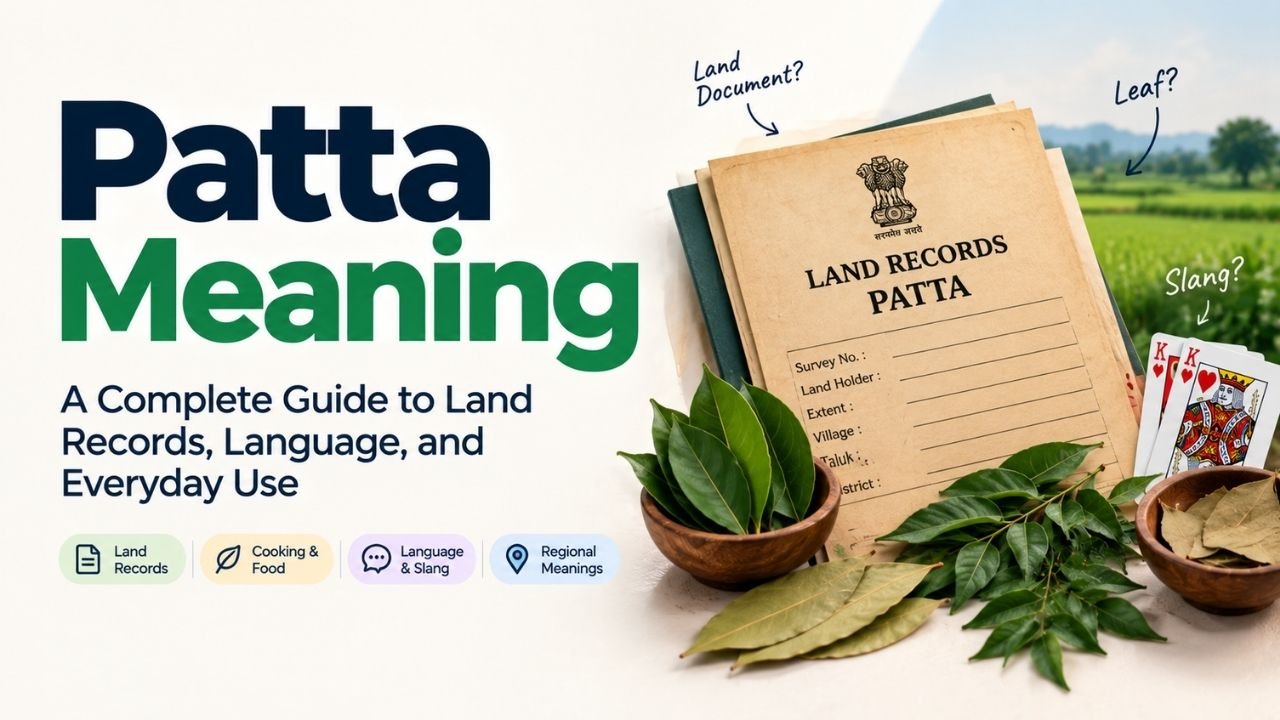
Patta meaning depends on where you encounter the word. In Indian land law, a patta is a government-issued document that records who holds rights over a piece of land. In Indian kitchens, “patta” simply means “leaf,” which is why you see it in tej patta and curry patta. The word also shows up in a Dutch streetwear brand, in card-game slang, and in several Indian languages with slightly different shades of meaning.
This guide untangles all of that. You will get a plain-English definition first, then a state-by-state and language-by-language breakdown, the grammar and pronunciation, the word’s origin, and answers to the specific questions people search for, from “DKT patta meaning in Telugu” to “curry patta meaning in English.” Every fact here is checked against dictionaries, land-law sources, and language references, so you can trust what you read.
Patta Meaning at a Glance
| Detail | Information |
| Word | Patta (also spelled Pattah, Patta) |
| Primary meaning | A government land document that records ownership or rights over land, mainly in India |
| Secondary meaning | Leaf, as in tej patta (bay leaf) and curry patta (curry leaf) |
| Part of speech | Noun |
| Language of origin | Sanskrit, via Hindi, Tamil, Telugu, and other Indian languages |
| Pronunciation | PUT-uh (UK/US approximation), Hindi: पट्टा |
| Used in | India, Bangladesh, Sri Lanka, Nepal, and English-language legal and culinary writing about South Asia |
See More: PMB Meaning
What Does Patta Mean?
The short answer is that “patta” is not one word with one meaning. It is closer to two or three different Indian-language words that all get spelled “patta” once they are written in English. Understanding which one you are dealing with makes everything else about this word much easier to follow.
Meaning 1: A Land Ownership or Revenue Document
This is the meaning most people are searching for. A patta is an official paper issued by a state revenue department in India. It names the person who holds rights to a specific plot of land and records details like the survey number, the size of the plot, and how the land is classified.
Meaning 2: A Leaf
In Hindi and several related languages, “patta” (पत्ता) also means a leaf, the flat green part of a plant. This is a completely different word from the land-document one, even though both are romanized the same way. It shows up constantly in Indian food writing: tej patta, curry patta, and patta gobhi all use this sense.
Meaning 3: A Playing Card
Because a playing card is roughly leaf-shaped and thin, Hindi and Urdu speakers also use “patta” informally for a card in a card game. The popular Indian card game “teen patti” literally translates to “three cards.”
Meaning 4: A Brand Name
Patta is also the name of an Amsterdam streetwear and sneaker label. This use has no connection to the Indian meanings; it comes from a completely different language, Sranan Tongo, the creole language of Suriname.
<br>
💡 Quick tip: If you saw “patta” in a property document, real estate article, or legal form, you want Meaning 1. If you saw it in a recipe or spice list, you want Meaning 2.
Patta Meaning in Land Law: The Full Picture
What Is a Land Patta?
A land patta is a document issued by a state government’s revenue department in India. It identifies the person recorded as holding rights over a specific piece of land. Most sources also call it a Record of Rights, or RoR. The document is issued by the Tahsildar or Village Administrative Officer in the relevant district, and it tracks landholders primarily for tax collection and administrative purposes.
A patta usually includes:
- The landholder’s name
- The survey number of the plot
- The size and boundaries of the land
- The classification of the land, such as agricultural, residential, or commercial
- The local revenue village and taluk
Is a Patta the Same as a Title Deed?
No, and this is the single most important correction to make. Indian courts have repeatedly held that a patta is a revenue record, not a title deed, and it cannot by itself establish or extinguish ownership rights. A registered sale deed is the document that legally transfers ownership. The patta is updated afterward to reflect the new owner for tax and administrative purposes.
Put simply: the sale deed proves you bought the land. The patta shows the government’s records agree with you. You generally want both.
| Document | What It Proves | Issued By |
| Sale deed | Legal transfer of ownership | Sub-registrar’s office, under the Registration Act |
| Patta / Record of Rights | Government’s revenue record of who holds the land | Tahsildar or Revenue Department |
| Encumbrance certificate | Whether the property has pending loans or legal claims | Sub-registrar’s office |
Nature of Land Patta Meaning
When people search “nature of land patta meaning,” they are usually asking about the classification field printed on the patta document itself. This field tells you what kind of land it is and what it can legally be used for. Common classifications include:
- Agricultural land (used for farming; often further split into wetland and dryland)
- Residential land (used or approved for housing)
- Poramboke or government land (land that belongs to the state and is not privately assignable in the usual way)
- Commercial or industrial land (zoned for business use)
The “nature of land” matters because it determines what you are legally allowed to build or grow there, and whether you need special permission to convert it, for example from agricultural to residential use.
Types of Patta You Will Encounter
Terminology shifts from state to state, so the same underlying idea can carry a different name depending on where the land sits. In Karnataka, the equivalent record is called a Khata. In Uttar Pradesh and several northern states, it appears as the Khatauni. Andhra Pradesh and Telangana maintain similar records under names like Pahani or Adangal. Here are the specific patta types people search for most.
| Patta Type | What It Means |
| Periodic Patta | A patta issued for land under the regular, ongoing settlement system, as opposed to a temporary or special-scheme patta. It is the standard, renewable-by-default record most landholders deal with. |
| UDR Patta | A UDR, or Updated Registry, patta indicates that a property was recently surveyed and its records updated as part of an effort to digitize and modernize older land data. In Tamil Nadu, this classification was created under the Updated Registry system. |
| DKT Patta | DKT stands for Darakastu land, government land allotted for free to the poor for cultivation under a DKT patta. These plots are found mainly in Andhra Pradesh, Telangana, and Tamil Nadu, and they cannot legally be bought or sold once assigned. The rule is the same whether the record is called a DKT patta in Tamil Nadu or a DKT patta in Telugu-speaking states; only the local language of the paperwork changes. |
| Natham Patta | Issued for land in villages or on city outskirts that is used for residential purposes but did not originally belong to any private individual. This is the standard patta for older village housing plots. |
| Myadi Patta | Used mainly in Assam, where “myadi” means permanent or long-term settlement, so a myadi patta grants full, transferable rights over agricultural or residential land. Confusingly, some regional usages describe a myadi patta as a fixed-term, renewable lease instead, so always confirm the exact status with the local revenue office rather than assuming from the name alone. |
| Kheraj Myadi Patta | A term used in Assam and parts of Bengal for tax-paying (“kheraj”) land held under a myadi settlement, as opposed to revenue-free land. It shows up often in older land-transfer disputes from that region. |
A note on regional revenue jargon: Terms like “jirayathi patta,” “theervai patta,” and “sarkari vari patta” surface in older Telugu and Tamil revenue documents. “Theervai” relates to tax or revenue assessment, and “sarkari” simply means government-owned. Because usage of these specific labels varies by district and has evolved with digitization, treat them as descriptive local labels rather than fixed legal categories, and verify the exact meaning with the relevant Tahsildar’s office or state land portal if the term appears on your own documents.
⚠️ Common mistake: Assuming a patta alone lets you sell or mortgage land freely. A patta can be sold, but the sale must be formalized through a registered sale deed; the patta document by itself is not sufficient for transferring ownership.
Patta Meaning in Different Indian Languages
The land-document sense of “patta” travels across most Indian languages with the same core meaning, though the exact word, script, and local nuance shift slightly.
| Language | Word | Meaning |
| Hindi | पट्टा (paṭṭā) | Legal deed of lease or land rights; also a leather strap or belt |
| Tamil | பட்டா (paṭṭā) | Land ownership or revenue record, closely tied to the Chitta register |
| Telugu | పట్టా (paṭṭā) | A lease, or a grant specifying the land occupied by a cultivator and the assessment due on it |
| Kannada | ಪಟ್ಟಾ (paṭṭā) | Land record, though Karnataka’s main equivalent document is officially called a Khata |
| Malayalam | പട്ടയം (paṭṭayam) | A deed of lease or gift, a patta granted by the Collector |
| Bengali | পাট্টা / পাট্টা (pāṭṭā) | Land settlement or lease document, used alongside the Khatian record of rights |
| Marathi | पट्टा (paṭṭā) | A deed of lease or tenure, along with senses like a strip of cloth or a belt |
| Urdu | پٹّہ (paṭṭā) | A deed, contract, or lease, sharing the same Persian-influenced administrative root used across North India |
Patta Meaning in Hindi
In Hindi, पट्टा (paṭṭā) is the standard word for a lease or land-rights deed. Historically, it referred to the document a tenant farmer received from a landlord granting the right to cultivate land for a fixed period, after which the landlord regained full use of it. Today it mainly appears in the context of government-issued land or property leases.
Patta Meaning in Tamil
Patta is most strongly associated with Tamil Nadu among Indian states, where it functions as the core land-ownership record. Tamil Nadu recognizes several patta types, including Private Patta for individuals, Government or Poramboke Patta for state-owned land, and Natham Patta for village residential plots. Since 2015, Tamil Nadu has merged the older Patta and Chitta registers into a single Patta Passbook, available through the state’s online portal.
Patta Meaning in Telugu
In Telugu-speaking states, “patta” carries the same land-rights sense, though Andhra Pradesh and Telangana also use Record of Rights, Pahani, or Adangal for related documents. DKT patta meaning in Telugu follows the same rule as in Tamil Nadu: it is government land handed to landless or poor cultivators, non-transferable, for farming use.
Patta Meaning in Kannada
Karnataka’s official land record is called a Khata rather than a patta, but “patta” is still understood and occasionally used informally or in older documents to mean the same kind of land record.
Patta Meaning in Bengali
In West Bengal and Bangladesh, land records more commonly go by the name Khatian, though “patta” and “myadi patta” still appear in older documents and in Assam’s neighboring land system, where they describe a settlement grant over a specific plot.
Patta Meaning in Urdu
In Urdu, پٹّہ (paṭṭā) keeps the deed or lease meaning, consistent with Hindi. The separate word “kari patta” (curry leaf), sometimes searched as “kari patta meaning in Urdu,” uses the unrelated “leaf” sense borrowed from the culinary vocabulary shared across North Indian and Pakistani kitchens rather than the legal one.
Patta Meaning in Cooking: Tej Patta, Curry Patta, and More
Here, “patta” switches entirely to its other sense: leaf. This is the meaning behind several of the most common Indian cooking terms in English-language recipes.
Tej Patta Meaning in English
Tej patta, botanically Cinnamomum tamala, is commonly called Indian bay leaf in English. The name literally translates to “pungent leaf” in Hindi. It is a key part of garam masala and is added whole to hot oil at the start of cooking many curries, dals, and biryanis to release its fragrance.
Here is the detail most recipes skip: tej patta is not the same plant as the Western bay leaf. Tej patta comes from the malabathrum tree, which is related to cinnamon, while the true bay leaf comes from Laurus nobilis, a completely different genus used in Mediterranean cooking. Tej patta has three lengthwise veins and a flavor closer to cinnamon or clove, while the Western bay leaf has one central vein and a piney, resinous flavor. If a recipe specifically says “Indian bay leaf,” do not substitute the Western version; the taste will be noticeably different.
Curry Patta and Kadi Patta Meaning in English
Curry leaves, or kadi patta, come from the tree Murraya koenigii, in the citrus family Rutaceae. In English, they are simply called curry leaves. The English name comes from the Tamil word “kari,” meaning a spiced dish, because the leaves were the signature flavoring in these preparations.
⚠️ Common mistake: Thinking curry leaves are an ingredient in curry powder. Curry leaves have nothing to do with curry powder, which is a British-invented spice blend; curry leaves are a distinct fresh aromatic with their own flavor.
“Kadi patta” and “curry patta” refer to the same leaf; the naming differs by region and by which local dish the leaf is associated with. Hindi’s Kadhi Patta ties the leaf to the dish kadhi, while Tamil’s Karuveppilai ties it to curry preparations more broadly.
Patta Gobhi Meaning in English
“Patta gobhi” simply means cabbage. “Gobhi” refers to cabbage or cauliflower depending on context, and “patta” here describes its leafy structure, distinguishing leafy cabbage from other gobhi varieties like cauliflower (phool gobhi, literally “flower gobhi”).
| Spice or Vegetable | Hindi Name | English Name | Botanical Name |
| Tej Patta | तेज पत्ता | Indian bay leaf | Cinnamomum tamala |
| Kadi / Curry Patta | करी पत्ता / कढ़ी पत्ता | Curry leaf | Murraya koenigii |
| Patta Gobhi | पत्ता गोभी | Cabbage | Brassica oleracea var. capitata |
Patta Grammar: Part of Speech and Word Forms
“Patta” functions as a common noun in every Indian language it appears in. A few grammar notes matter for accurate use.
- Part of speech: Noun in all contexts, whether it means a land deed, a leaf, or a playing card.
- Gender: In Hindi and related languages, पट्टा (the land-deed sense) is a masculine noun. Its plural form is पट्टे (patte).
- Two different underlying words: This is the detail most English-language guides miss. In Hindi, पट्टा (paṭṭā, with a hard “tt” sound) means a deed, lease, or strap. पत्ता (pattā, with a softer “t” sound) is a separate word meaning leaf or playing card, and it comes from a different Sanskrit root. Both are commonly Romanized as “patta” in English text, which is why the word looks like it has unrelated meanings, because it genuinely does.
- As an English loanword: In English-language writing about Indian land law or food, “patta” is treated as a regular noun. Its plural in English is usually written simply as “pattas.”
How to Pronounce Patta
The pronunciation shifts slightly depending on which of the two underlying words is meant, though most English speakers will not notice the difference and both are understood in context.
- Land-deed sense (पट्टा): PUT-taa, with a firm, slightly retroflex “t” sound common in Hindi consonants. In IPA, roughly /pəʈːaː/.
- Leaf sense (पत्ता): PUT-taa as well, but with a softer dental “t,” closer to the “t” in the English word “stop.” In IPA, roughly /pətːaː/.
For everyday English conversation, saying “PUT-uh” or “PUT-taa” with stress on the first syllable will be understood correctly in both cases.
See More: Nachas Meaning
Origin and Etymology of Patta
The land-document sense of patta traces back to the Sanskrit word पट्ट (paṭṭa), which referred to a plate, slab, or a piece of cloth or silk, and by extension, an official written document. This makes sense once you know that early official grants and charters in India were sometimes recorded on metal plates or engraved copper sheets.
In Sanskrit inscriptions, “paṭṭaka” specifically meant a passport, a charter, or a copper-plate grant. In Tamil, the related word “pattayam” describes a royal grant inscribed on a copper plate, or more generally a deed conferring a title, including the document given to a cultivator showing the terms on which they may farm land for the year.
Over centuries, this sense of “an official document, especially about land” settled into the modern administrative word patta used across Hindi, Tamil, Telugu, Malayalam, Bengali, and Marathi. One regional history traces the specific administrative use of the word to the Telugu and Urdu governance lexicon associated with the Hyderabad region.
The leaf sense follows an entirely separate path. Hindi पत्ता (pattā) descends from the Sanskrit पत्त्र (patra), meaning leaf, feather, or wing, the same root that gives Hindi its word for “letter” (patra) since early written messages were sometimes inscribed on leaves.
So when someone asks whether “patta” comes from Sanskrit, the honest answer is: yes, but from two different Sanskrit words that happen to have converged into the same spelling once transliterated into English.
Patta and Its Related Words
Several other Indian-English words share the same paṭṭa root and are worth knowing, since they explain why “patta” keeps surfacing in unrelated contexts.
| Word | Meaning | Connection to Patta |
| Pattadar | The registered holder of a patta; a leaseholder or recognized landholder | Direct derivative: patta + dar (holder) |
| Pattabhishekam | Coronation, or the ceremonial installation of a king or ruler | From patta meaning a diadem or crown-band, plus abhisheka, a ceremonial anointing |
| Pattadar Passbook | An official land ownership booklet issued to a Pattadar, the recorded owner of a plot of land | Modernized, booklet form of the traditional patta |
| Pattampoochi | A Tamil word meaning “butterfly,” also the title of Tamil films and songs | Not confirmed to share the same root as land-deed patta; treat this as a separate Tamil word rather than a derivative |
Is Pattaya (the Thai City) Related to Patta?
No. Pattaya, the city in Thailand, is an unrelated Thai place name with its own separate history and etymology. The resemblance to “patta” is coincidental, a result of both words being transliterated into English with similar letters, not a shared linguistic root.
What Is Patta the Brand?
Patta is a Dutch streetwear and sneaker boutique based in Amsterdam, founded by Edson Sabajo and Guillaume Schmidt in 2004. The name comes from Surinamese slang meaning “shoe,” a nod to the founders’ Surinamese and Antillean roots in Amsterdam’s multicultural music scene.
What began as a sneaker-curating store has grown into a globally recognized streetwear label known for collaborations with brands like Nike, Converse, and Jordan. This use of “patta” has no linguistic connection to the Indian land-deed or leaf meanings; it is a separate word from a separate language family entirely.
Patta Meaning Slang
Outside formal land law and cooking, “patta” shows up informally in a few everyday ways.
- As a playing card: In Hindi and Urdu, “patta” casually refers to a playing card. This usage is common enough that it shows up in the name of the widely played card game “teen patti,” which literally means “three cards.”
- As shorthand for land rights: In everyday conversation in parts of India, saying someone has “patta” on a piece of land is a casual way of saying they hold the government paperwork proving their claim to it, even outside strict legal contexts.
- As “shoe” in Surinamese-influenced Dutch slang: Through the streetwear brand’s popularity, some younger, fashion-conscious speakers now recognize “patta” as slang for a stylish shoe or sneaker, borrowed directly from the brand’s Surinamese-derived name.
None of these informal uses override the two primary, dictionary-recognized meanings: the land document and the leaf.
Similar and Easily Confused Words
| Word | Meaning | How It Differs From Patta |
| Chitta | A Tamil Nadu land register recording cultivation and land-use details | Chitta is the companion document to a patta, not a synonym; the two were merged into a single passbook in Tamil Nadu |
| Khata | Karnataka’s official land and property record | Serves the same practical function as a patta but is a distinct document under a different name |
| Khatian / Khatauni | Land records used in West Bengal, Bangladesh, and North Indian states | Regional equivalents of a patta, not the same word |
| Jamabandi | A land record used in Haryana, Punjab, and parts of North India | Functionally parallel to a patta, with its own separate name and format |
| Sale Deed | The legal document that transfers property ownership | Proves an ownership transaction; a patta only reflects the government’s revenue record afterward |
Patta in a Sentence: Example Usage
Seeing the word in context often clarifies its meaning faster than any definition. Here are a few natural examples covering both senses.
Land-document sense:
- “We need the original patta before the bank will approve the loan against the property.”
- “The revenue office updated the patta after my father passed the land down to me.”
- “Her name was finally added to the patta after the mutation process was completed.”
Leaf sense:
- “Don’t forget to add a tej patta to the rice before you seal the cooker.”
- “She picked fresh curry patta from the plant growing near the kitchen window.”
- “The cabbage, or patta gobhi, needs to be shredded finely for this salad.”
Common Mistakes with Patta
A few mix-ups come up often enough to call out directly.
❌ Incorrect: “I have the patta, so I fully own the land.”
✅ Correct: “I have the patta, which supports my claim, but the registered sale deed is what legally establishes ownership.”
Why: A patta is a revenue record, not proof of title on its own.
❌ Incorrect: Using “bay leaf” and “tej patta” as if they are botanically identical.
✅ Correct: Treating tej patta as Indian bay leaf, a related but different plant from the Western bay laurel used in European cooking.
Why: The two leaves come from different tree genera and taste noticeably different in a finished dish.
❌ Incorrect: Assuming “patta” always means the same thing across every sentence.
✅ Correct: Checking whether the sentence is about land, food, or slang before deciding which “patta” is meant.
Why: Patta represents at least two unrelated Indian-language words that share the same English spelling.
How to Check or Verify a Patta
Since this question naturally follows for many readers, here is the general process most Indian states now follow. Exact steps and portal names vary by state.
- Visit your state’s land records portal. Most states now host digitized patta and Record of Rights data online, searchable by survey number, patta number, or owner name.
- Enter the survey number or patta number. This is printed on the physical document or available from the local Tahsildar’s office.
- Cross-check the landholder’s name and land classification. Confirm these match your sale deed and other property paperwork.
- Download or print the verified record. Keep a copy alongside your sale deed and encumbrance certificate.
- Visit the Tahsildar’s office in person if the online record looks outdated or incorrect. Digitization is ongoing in many districts, so a mismatch does not automatically mean a legal problem, but it should always be corrected.
See More: Shpilkes Meaning
Frequently Asked Questions
What does patta mean?
Patta most commonly means a government-issued land document in India that records who holds rights over a specific plot of land. It also separately means “leaf” in Hindi and related languages, as in tej patta or curry patta.
Is a patta proof of land ownership?
Not by itself. A patta is a revenue record, not a title deed. A registered sale deed is what legally establishes ownership; the patta is updated to match it afterward.
What is tej patta called in English?
Tej patta is called Indian bay leaf in English. It comes from the Cinnamomum tamala tree and is different from the Western bay laurel leaf, despite sharing a similar English name.
What is curry patta called in English?
Curry patta, also called kadi patta, is called curry leaf in English. It comes from the Murraya koenigii tree and has no relation to curry powder.
Is patta a noun or a verb?
Patta is always a noun, whether it refers to a land document, a leaf, or a playing card.
How do you pronounce patta?
Roughly “PUT-taa,” with stress on the first syllable. The exact consonant sound shifts slightly depending on whether the land-deed sense or the leaf sense is meant, though both are understood the same way in casual English speech.
What is the difference between patta and chitta?
A patta records land ownership details, while a chitta records land-use and cultivation details. In Tamil Nadu, the two have been combined into a single Patta Passbook since 2015.
What is a pattadar?
A pattadar is the person officially recorded as holding a patta, meaning the recognized landholder in government revenue records.
Does patta mean the same thing in every Indian language?
The land-document sense stays fairly consistent across Hindi, Tamil, Telugu, Malayalam, Bengali, and Marathi, though the exact legal procedures and document names vary by state. The leaf sense is a completely separate word that happens to share the same English spelling.
Is patta related to the city of Pattaya or the streetwear brand Patta?
No. Both are unrelated words. Pattaya is a Thai place name, and the streetwear brand Patta takes its name from Surinamese slang for “shoe.” Neither shares an etymological root with the Indian land-deed or leaf meanings.
Conclusion
Patta meaning ultimately comes down to context. In land law, it is a government revenue record, not a title deed, that names who holds rights over a piece of land, and it comes with regional variants like UDR patta, DKT patta, natham patta, and myadi patta depending on the state. In the kitchen, patta simply means leaf, which is why tej patta and curry patta describe two completely different, commonly confused ingredients. Both senses trace back to old Sanskrit roots, but they are, in fact, two separate words that just happen to look identical once written in English.
If you remember nothing else from this guide, remember this: check the context before you assume the meaning. A patta mentioned in a property document is about land rights. A patta mentioned in a recipe is about leaves. Getting that distinction right is really the entire answer to what patta means.

Hassan Ibrahim is the author behind Mean Fixer, with 4 years of experience researching and writing about names, words, slang, meanings, and everyday language. Their goal is to make confusing words and meanings simple, clear, and easy to understand through accurate, useful, and reader-friendly explanations.



One Comment