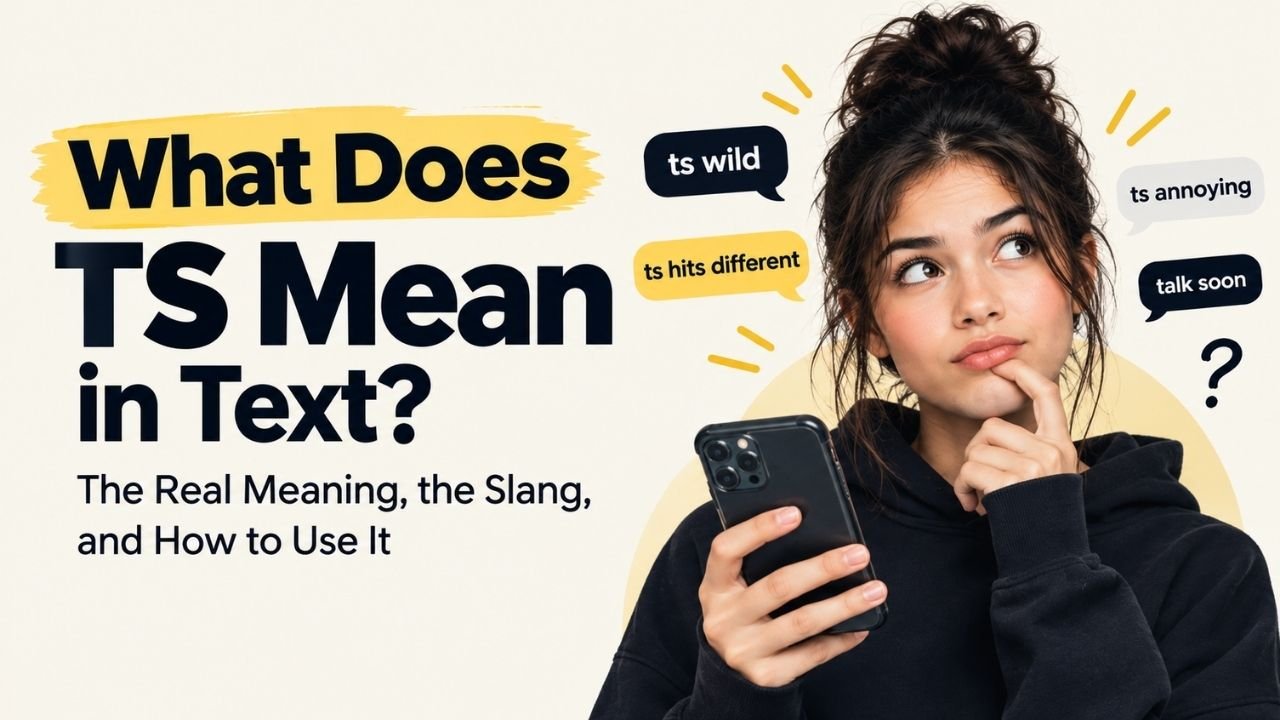
If you just got a text that says “ts” and nothing else, you are not alone in staring at it. In most texts, DMs, and comments today, TS stands for “this s#*t,” a short, informal way of adding emphasis to a statement. It can also mean “talk soon,” “true story,” “tough s#*t,” or simply function as a timestamp abbreviation, depending on where you see it.
TS is one of those two letter combinations that carries almost no meaning on its own. It only makes sense once you look at where it shows up, who sent it, and what came before or after it. That is exactly why so many people search for its meaning instead of guessing. This guide walks through every common use of TS in texting and online chat, explains the grammar behind it, and shows you how to tell one meaning from another in seconds.
TS Meaning in Text: The Short Answer
The most common meaning of TS in modern texting, especially on TikTok, Instagram, and Snapchat, is “this s#*t.” It works as an intensifier, a way to add weight or attitude to a sentence without typing extra words.
- “Ts is crazy” means “this is genuinely wild.”
- “Ts hits different” means “this thing is really good.”
- “Ts annoying” means “this situation is irritating.”
The phrase behind the abbreviation, “this s#*t,” has been used in everyday spoken English for a long time. What changed recently is that people started shortening it to two letters when typing fast, and the short version spread widely across short form video apps starting in late 2024 and through 2025.
Outside of that dominant slang use, TS has several older and unrelated meanings that still show up depending on the setting:
| Meaning | Typical Setting | Example |
| This s#*t | Texting, TikTok, Instagram, Snapchat | “Ts wild fr” |
| Talk soon | Casual chat sign off | “Gotta go, ts!” |
| True story | Casual conversation, older internet forums | “He fell asleep in class, ts” |
| Tough s#*t | Blunt, dismissive reply | “Ts, you should have left earlier” |
| Timestamp | Video comments, streaming chats | “Jump to ts 3:42” |
Because one abbreviation covers this many ideas, the rest of this guide focuses on helping you tell them apart quickly.
See More: Chitta Meaning
How to Figure Out Which TS Meaning Someone Means
Context does almost all of the work here. Before assuming a definition, check three things: the platform, the sentence structure, and the relationship between you and the sender.
Check the platform. On TikTok, Instagram captions, and Snapchat, “this s#*t” is by far the most common reading. In an older group chat or an email style message from someone who grew up before texting slang spread, “talk soon” is more likely.
Check the sentence position. “This s#*t” almost always sits in the middle of a sentence, acting like the word “this.” “Talk soon” almost always sits at the very end of a message, right before someone signs off. A timestamp version shows up next to a number, like “ts 2:15.”
Check the tone. If the message sounds emotional, reactive, or a little blunt, it is probably the slang meaning. If it sounds friendly and wraps up a conversation, it is probably “talk soon.”
What Does TS Mean in Text Slang? (The Main Gen Z Use)
In slang, TS is short for “this s#*t.” It is not a polite phrase. People use it the way they might use “this” in casual speech, except with more attitude built in. It adds emphasis, frustration, excitement, or disbelief, depending on the rest of the sentence.
A few natural examples:
- “Ts got me stressed” — this situation has me stressed.
- “Who even made ts” — an expression of disbelief or mild criticism.
- “Ts finally over” — relief that something has ended.
Where the Slang Comes From
The phrase “this s#*t,” used as a stand in for “this thing” or “this situation,” has roots in African American Vernacular English (AAVE), where it has been used in speech for years, long before it appeared as a two letter abbreviation online. The short form “ts” became visible on a much larger scale as short form video content on TikTok, and clips shared to Instagram and X, pushed casual speech patterns into text far faster than earlier internet slang ever spread.
As the abbreviation reached people outside the communities where it started, a common misunderstanding followed it.
The “This” Misunderstanding
A lot of people who saw “ts” for the first time assumed it was simply short for the word “this,” with no swear word implied at all. So a message like “ts so cool” got read as “this so cool,” missing the emphasis entirely.
That misreading became a joke of its own. Some users started typing “ts (this)” in captions or comments to poke fun at people using the wrong definition, which lands as funny once you notice that “(this)” actually takes more letters to type than the word it is supposedly explaining.
Knowing the real meaning matters here. Because the phrase behind TS comes from AAVE, using it accurately, as emphasis rather than a random stand in for “this,” shows a basic understanding of where the slang actually comes from.
What Does TS Mean in Text From a Boy or a Girl?
TS does not change meaning based on who sends it. The abbreviation works the same way whether a boy, a girl, a friend, or a coworker types it. What changes is not the definition, but the emotional context around it, which comes from the rest of the conversation, not from the sender’s gender.
If someone you are texting sends “ts crazy” after describing something that happened during their day, they mean “this is wild,” full stop. The safest way to read any TS message is to look at the sentence itself rather than assuming a hidden meaning based on who sent it.
What Does TS Mean in Text Messaging on Instagram, Snapchat, and TikTok?
The meaning stays the same across these platforms, but the frequency and tone shift slightly.
On TikTok, TS shows up constantly in comments and captions, almost always as “this s#*t.” Comment sections move fast, and short reactions like “ts wild” or “ts sent me” are common ways to react to a video.
On Instagram, TS appears in captions, comments, and direct messages with the same slang meaning. It is especially common under memes or relatable posts, where someone might comment just “ts” to agree strongly with the caption.
On Snapchat, TS is more likely to appear in a quick chat exchange between friends, where the informal, blunt tone fits naturally into back and forth messaging.
In all three cases, if the message feels casual, reactive, or emotionally loaded, it is almost certainly the “this s#*t” meaning rather than “talk soon” or “true story.”
See More: Patta Meaning
Other Meanings of TS You Might See
Slang meanings are not the only ones in circulation. A few older or more situational meanings still appear, and it helps to recognize them so you are not stuck guessing.
Talk Soon
This is one of the oldest uses of TS, going back to early chat rooms and text messaging. It works as a casual sign off, usually placed at the very end of a message.
Example: “Running late, ts!”
Here, TS is not doing the work of a noun or a swear word. It is standing in for a full phrase used to close out a conversation politely.
True Story
In casual conversation, TS sometimes means “true story,” used after someone shares something surprising, funny, or hard to believe. It works almost like a tag confirming that what was just said actually happened.
Example: “He tripped over his own shoelace in front of everyone, ts.”
Tough S#*t
This use is blunt and a little harsh. It shows up as a dismissive response to a complaint, similar to saying “that’s unfortunate, but there is nothing to be done.” It is closer in spirit to an older, more confrontational slang tradition than the emphasis based “this s#*t” meaning.
Example: “Ts, you knew the deadline was today.”
Timestamp
On video platforms, especially in comment sections, TS can simply mean “timestamp.” Someone might write “ts 1:24” to point other viewers to a specific moment in a video.
Example: “Ts 0:45 for the funniest part.”
Type Sh*t
A close cousin of “this s#*t” is the phrase “type s#*t,” often shortened the same way. It works similarly, describing a category or vibe rather than one specific thing. “That’s slime type s#*t” means “that is the kind of thing a slimy or untrustworthy person would do.” Context, again, is what separates this from the more common “this s#*t” reading.
TS Grammar: What Part of Speech Is It?
TS is not a standard word, so it does not fit neatly into a single grammar category. Depending on the meaning in use, it behaves differently in a sentence.
| Meaning | Grammar Function | Example |
| This s#*t | Stands in for a noun phrase (“this thing,” “this situation”) | “Ts is unbelievable” |
| Talk soon | Functions as a closing phrase, similar to an interjection | “Gotta run, ts” |
| True story | Functions as a short confirming tag | “…and that’s ts” |
| Tough s#*t | Functions as an interjection or dismissive reply | “Ts, deal with it” |
Because TS started as informal, spoken shorthand rather than a word coined for writing, it does not follow the same grammar rules as a formal noun or interjection. Treat it as casual shorthand, not a dictionary entry with one fixed grammatical role.
How to Pronounce TS
When spoken out loud, TS is almost always read as two separate letters: “tee” and “ess,” the same way you would say the initials in an abbreviation like “PS.” It is rarely pronounced as a blended sound.
In the slang sense, when someone reads a message out loud, they typically say the full phrase behind it rather than the letters. Someone reading “ts is wild” aloud would usually say “this s#*t is wild,” not “tee ess is wild.” The letters are a writing shortcut, not a new way of pronouncing the phrase.
Examples of TS in a Sentence
A few natural examples across different meanings, so you can see how the same two letters shift depending on context.
- “Ts got me laughing so hard.” (this s#*t, expressing amusement)
- “I can’t deal with ts today.” (this s#*t, expressing frustration)
- “Heading out now, ts later.” (talk soon, casual sign off)
- “She actually said that to his face, ts.” (true story, confirming something happened)
- “Ts, should have booked earlier.” (tough s#*t, blunt response)
- “Check ts 5:10 for the best part.” (timestamp)
Common Mistakes When Using or Reading TS
⚠️ Mistake: Assuming TS always means “this,” with no swear word attached. ✅ Correct: In most slang use, TS stands for “this s#*t,” not a plain “this.” The missing word is exactly what gives the phrase its emphasis.
⚠️ Mistake: Using TS in a professional email or client message. ✅ Correct: TS is informal, and its core meaning includes mild profanity. It does not belong in work communication, even if the tone feels casual.
⚠️ Mistake: Reading every “ts” as slang, even at the end of a sentence right before someone signs off. ✅ Correct: TS placed at the very end of a message, especially before someone leaves the conversation, is more likely “talk soon.”
⚠️ Mistake: Treating TS as having one single, fixed definition everywhere online. ✅ Correct: TS is context dependent. The same two letters can mean five different things depending on the app, the sentence, and the people talking.
TS on Urban Dictionary
Slang dictionaries, including Urban Dictionary, list multiple entries for TS, reflecting how many communities have used the abbreviation differently over time. Entries there generally track with the meanings covered in this guide: “this s#*t” as the dominant modern slang use, along with older entries for “talk soon,” “true story,” and other situational meanings. Because Urban Dictionary entries are written and voted on by users rather than edited for consistency, definitions can vary in tone and detail from one entry to the next, so it is worth reading a few entries rather than relying on just one.
Similar Slang Terms and How They Differ
A few related abbreviations often show up alongside TS, and knowing the difference helps avoid mixing them up.
| Term | Meaning | How It Differs From TS |
| Fr | For real | Confirms sincerity, rather than adding emphasis to a noun phrase |
| Pmo | Puts me on, or pisses me off | Often paired with TS, as in “ts pmo,” stacking two informal phrases together |
| Ngl | Not gonna lie | Introduces an honest opinion, rather than referring to a thing or situation |
| Idk | I don’t know | A direct stand in for a full phrase, similar to how TS can replace “this thing” |
These terms frequently appear together in the same sentence, such as “ts pmo ngl,” which strings together “this s#*t puts me on, not gonna lie.” Reading slang heavy messages usually means breaking them into these smaller pieces rather than trying to translate the whole sentence at once.
Should You Use TS Yourself?
Whether TS fits your own texting style depends on your audience and the setting.
- With close friends, in casual texting or comments: TS fits naturally and reads as normal, low effort emphasis.
- In group chats with people of different ages or backgrounds: TS might be misread as “this,” so a fuller phrase can avoid confusion.
- In school, work, or professional messages: Avoid TS entirely. Its core meaning includes mild profanity, and not everyone reading it will recognize the abbreviation at all.
A simple rule of thumb: if you would not say the full phrase, “this s#*t,” out loud in that setting, do not type the shortened version either.
See More: PMB Meaning
Frequently Asked Questions
What does TS mean in a text message?
In most casual texting today, TS means “this s#*t,” used as an emphasis word. It can also mean “talk soon,” “true story,” or “tough s#*t,” depending on the context.
What does TS mean in text from a boy or a girl?
The meaning does not change based on who sends it. Look at the sentence and the setting, not the sender, to figure out which meaning applies.
Is TS a noun or an interjection?
It depends on the meaning. As “this s#*t,” it stands in for a noun phrase. As “talk soon” or “tough s#*t,” it functions more like an interjection or a closing phrase.
How do you pronounce TS?
It is usually read as two letters, “tee ess,” similar to other abbreviations like PS. In casual speech, people typically say the full phrase it stands for instead of the letters.
What does TS mean on Instagram or Snapchat?
On both platforms, TS most commonly means “this s#*t,” used in captions, comments, and quick chat replies to add emphasis.
Where did the TS slang come from?
The phrase “this s#*t” has roots in African American Vernacular English. The two letter shorthand became widely used after spreading through TikTok and other short form video platforms in late 2024 and 2025.
Is it okay to use TS in a professional message?
No. TS is informal, and its underlying meaning includes mild profanity, so it does not fit school, work, or client communication.
What does TS mean in Gen Z slang specifically?
Among Gen Z texting and social media users, TS almost always refers to “this s#*t,” used the same way older generations might use “this” or “that,” but with more emphasis.
Does TS ever just mean “this”?
Not exactly. While some people misread it that way, the full phrase behind the slang includes the extra word, which is what gives TS its emphasis. Reading it as a plain “this” loses that tone.
What does TS mean as a timestamp?
In video comments, TS can simply mean “timestamp,” pointing to a specific moment in a video, such as “ts 2:30.”
Final Thoughts
TS is a small abbreviation with a surprisingly wide range of meanings, but one clear pattern runs through all of them: context decides everything. In most current texting, especially on TikTok, Instagram, and Snapchat, TS stands for “this s#*t,” used to add emphasis, frustration, or excitement to a message. Older meanings like “talk soon,” “true story,” and “tough s#*t” still show up depending on the setting, the platform, and where TS lands in the sentence.
The next time a message with “ts” shows up on your screen, check the sentence structure and the platform before guessing. That one habit, looking at where TS sits and what surrounds it, makes decoding almost automatic, and it means you will never have to wonder what does TS mean in text again.

Hassan Ibrahim is the author behind Mean Fixer, with 4 years of experience researching and writing about names, words, slang, meanings, and everyday language. Their goal is to make confusing words and meanings simple, clear, and easy to understand through accurate, useful, and reader-friendly explanations.