
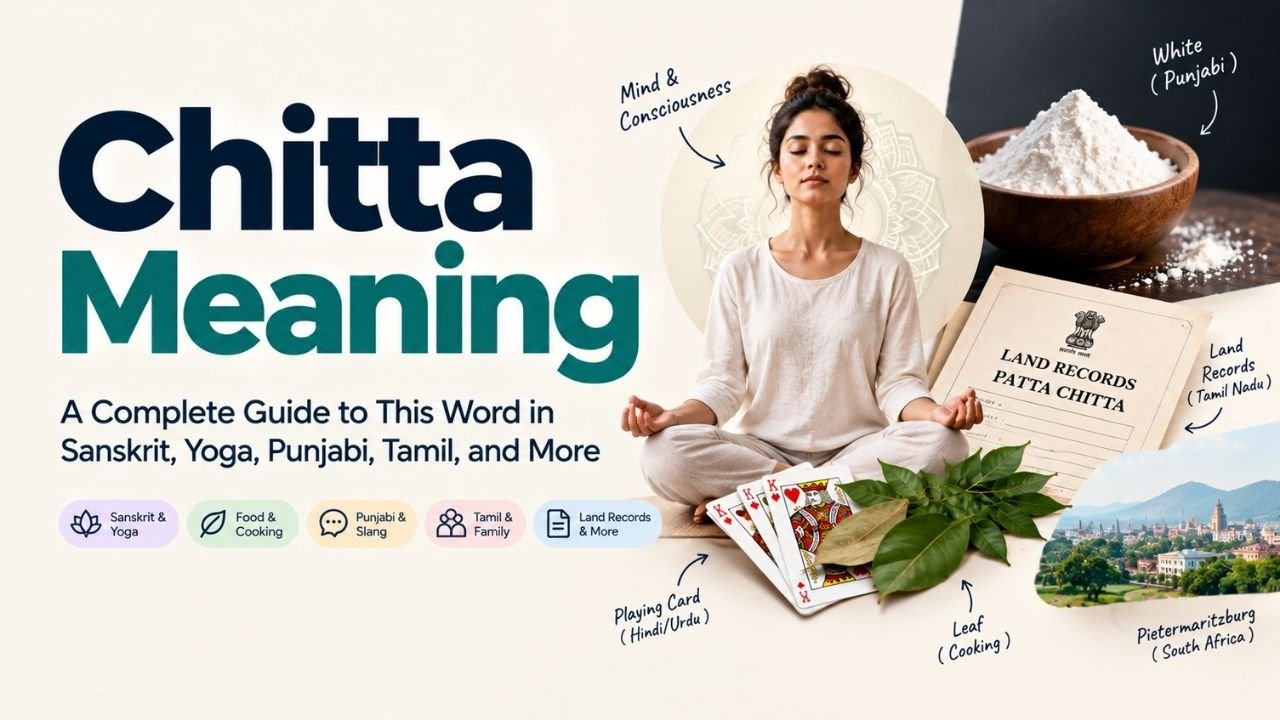
Chitta is a word with more than one life. At its root, chitta is a Sanskrit term that means mind, consciousness, or the mental field where thoughts and impressions arise. This is the meaning you meet in yoga classes, in the Yoga Sutras of Patanjali, and in everyday Hindi, Tamil, Telugu, Kannada, and Malayalam speech about the mind.
But chitta also lives a second, very different life. In Punjabi, chitta simply means white, and that same word has become the common street name for heroin in parts of North India. In Tamil Nadu, chitta shows up inside the phrase patta chitta, a completely unrelated land record term. One small word, several real meanings, and each one only makes sense once you know the context it belongs to. This guide walks through every major meaning clearly, one at a time.
Quick Answer: What Does Chitta Mean?
Chitta does not have one single meaning. The correct meaning depends entirely on where and how the word is used.
| Context | What Chitta Means |
| Sanskrit and yoga philosophy | Mind, consciousness, or the mental field that holds thoughts and impressions |
| Hindi (spiritual or literary use) | Mind or inner consciousness, borrowed directly from Sanskrit |
| Punjabi (everyday word) | White, referring to the colour |
| Punjabi and Hindi (street slang) | Heroin, named for its white powder form |
| Tamil (as chittappa) | A short form used for a paternal uncle, specifically the father’s younger brother |
| Tamil Nadu land records (patta chitta) | A government document that records land ownership and land classification |
| Buddhism (as in bodhichitta) | Mind or heart, used in the compound word for the awakened mind |
💡 Tip: If you saw “chitta” in a yoga article, it almost certainly means mind or consciousness. If you saw it in a Punjabi song, news report, or conversation, it most likely means white, or in a drug related context, heroin. If you saw “patta chitta,” it is a Tamil Nadu land document and has nothing to do with the mind.
See More: Nachas Meaning
Chitta Meaning in English
In English language dictionaries and academic writing, chitta is usually explained as a borrowed Sanskrit term rather than a native English word. The closest English translations are:
- Mind
- Consciousness
- Mind stuff
- The mental field
- Awareness
None of these English words fully captures chitta on their own. English tends to treat “mind” as a single, fairly fixed thing. Chitta, in its original Sanskrit and yogic sense, is more like a flowing field of awareness where thoughts, memories, and emotional reactions rise and settle. That is why translators often just keep the word chitta rather than force it into one English equivalent.
There is also a completely separate use of “chitta” in English language news and health writing, where it appears as a loanword for a specific street drug. In that context, chitta meaning in English is simply “heroin,” and English language articles use the word exactly as it is used in Punjabi.
Chitta Meaning in Sanskrit
This is the original and most philosophically important sense of the word. In Sanskrit, chitta comes from the root “cit,” which means to perceive, to know, or to be conscious. Chitta itself is generally translated as “consciousness” or “mind stuff.”
In classical Indian philosophy, chitta is not treated as a single simple faculty. It is described as one part of a larger picture of the mind, alongside three other closely related functions.
| Sanskrit Term | Function | Simple Meaning |
| Chitta | Storehouse of impressions and consciousness | Holds memories and past impressions, called samskaras |
| Manas | Perceiving mind | Processes what the senses take in |
| Buddhi | Intelligence | Makes decisions and judgements |
| Ahamkara | Ego or “I maker” | Creates the sense of “I” and “mine” |
Chitta is often pictured as a lake. When the water is still, it reflects things clearly. When it is disturbed, the reflection breaks apart and becomes confused. In this picture, thoughts and emotional reactions are the ripples on the surface of chitta.
Chitta in the Yoga Sutras
The most famous use of the word chitta comes from Patanjali’s Yoga Sutras, an ancient Sanskrit text on yoga philosophy. The opening definition of yoga in this text is built directly around the word chitta.
The Sanskrit phrase reads: yogas chitta vritti nirodha. It is usually translated as something close to “yoga is the stilling of the fluctuations of the mind.” Here is what each part means on its own.
- Yoga: union, or in this context, the practice and the state it leads to
- Chitta: the mind field, or consciousness
- Vritti: fluctuations, whirls, or movements of thought
- Nirodha: stilling, restraint, or quieting
Put simply, this line says that yoga is the process of calming the constant movement of thoughts inside chitta. Once those fluctuations settle, according to this philosophy, a person can experience their true nature more clearly.
Chitta Meaning in Yoga
Ask a yoga teacher what chitta means, and most will describe it in practical terms rather than strictly academic ones. In modern yoga teaching, chitta is generally explained as:
- The subtle field of the mind, deeper than everyday surface thinking
- The place where impressions from past experiences are stored
- Something that yoga practice is meant to purify and calm, not simply control
Many yoga teachers also use the phrase “chitta vritti,” which loosely translates to “mind chatter” or, more informally, “monkey mind.” This refers to the restless, jumping quality of ordinary thought. Yoga postures, breathing practices, and meditation are all traditionally described as tools for working with chitta, not ignoring it.
It helps to separate two related ideas that students often mix up.
- Chitta vritti: the fluctuations or movements happening inside the mind
- Chitta vritti nirodha: the stilling or settling of those fluctuations, which the Yoga Sutras equate with yoga itself
So when someone in a yoga class says “we are working on quieting the chitta,” they mean the practice is aimed at settling mental noise, not switching the mind off completely.
The Five States of Chitta
Classical yoga philosophy does not describe chitta as one fixed state. Vyasa’s early commentary on the Yoga Sutras describes five different states, known as chitta bhumis, that a mind can move through depending on a person’s habits, effort, and inner discipline.
| State (Sanskrit) | Simple Meaning |
| Kshipta | A restless, scattered mind, constantly pulled between thoughts |
| Mudha | A dull, heavy mind, low on energy and clarity |
| Vikshipta | A partly focused mind that drifts between moments of concentration and distraction |
| Ekagra | A one pointed, steady mind capable of sustained focus |
| Niruddha | A fully settled, mastered mind, considered the goal of yogic practice |
Most people move between the first three states during an ordinary day. Traditional yoga practice, including postures, breathing exercises, and meditation, is described as a way of gradually shifting chitta toward the more settled states of ekagra and niruddha. This framework is one reason yoga teachers so often return to the word chitta rather than simply saying “mind,” since it captures a mental state that can genuinely change and improve with practice.
See More: L4L Meaning
Chitta Meaning in Punjabi
In everyday Punjabi, chitta (ਚਿੱਟਾ) has a much simpler meaning than the yogic one. It means white, describing colour.
You will hear this in ordinary contexts that have nothing to do with drugs or philosophy, such as describing a white shirt, white hair, or a white complexion. Punjabi folk songs and film titles use the word this way often.
⚠️ Important distinction: Chitta in Punjabi is a completely different word from chitta in Sanskrit and yoga, even though they are spelled the same way in English transliteration. They come from different linguistic roots and mean entirely different things.
Gora Chitta Meaning
A common Punjabi phrase is “gora chitta,” which pairs two words that both relate to fairness or whiteness.
- Gora: fair skinned, or a term historically used for white or light skinned people
- Chitta: white
Together, “gora chitta” is generally used to describe someone or something as fair complexioned, often in songs, poetry, and everyday compliments about appearance, such as “gora chitta rang” meaning a fair, white complexion. It is a stylistic pairing of two closely related words for emphasis, a pattern that is common in Punjabi.
Chitta Kukkad Meaning
“Chitta kukkad” literally means “white rooster.” It is best known as the title of a well loved Punjabi folk song in the tappa singing style, traditionally performed at weddings. The phrase itself is simply descriptive, combining chitta (white) with kukkad (rooster), and the song has been recorded by multiple singers over the decades, including versions used in Hindi films.
Chitta Meaning as a Drug
This is one of the most searched and most serious meanings of the word, so it deserves a clear, accurate explanation.
In North India, particularly Punjab and Himachal Pradesh, “chitta” is the common street name for heroin. The name comes directly from the Punjabi word for white, since the drug typically appears as a white or off white powder. Chemically, chitta usually refers to diacetylmorphine, the same compound sold internationally as heroin, though street versions are frequently mixed with other substances.
Here is what is reliably documented about chitta as a drug.
- It is most often heroin, sometimes adulterated with other pharmaceutical compounds during trafficking
- Regional forensic reports have found it mixed with substances that make it more dangerous and less predictable than pure heroin
- It has been linked to a serious public health crisis in Punjab and neighbouring states, with rising seizure numbers reported by regional police
- The word is used both in casual conversation and in official news reporting about drug enforcement
Because purity and composition vary from batch to batch, health researchers and journalists have described the health risks around chitta as unusually unpredictable compared with more standardised drugs.
Regional news coverage in Punjab and Himachal Pradesh has repeatedly described rising seizure numbers over recent years, along with warnings from state forensic laboratories about how dangerous some batches of chitta have become. Reports have noted that certain supply routes produce chitta mixed with additional pharmaceutical compounds that can cause severe drops in blood platelet counts with regular use, making some regional batches considerably more dangerous than standard heroin. This has made the word chitta a frequent, and grim, feature of local news reporting, alongside its everyday, harmless sense of simply meaning white.
This article is written to explain what the word chitta means and how it is used, not to provide guidance on drug use of any kind. If you or someone you know is affected by heroin or chitta use, speak with a doctor, an addiction treatment centre, or a local health helpline. Support and treatment options exist, and reaching out is a reasonable first step.
Patta Chitta Meaning
Away from both yoga and drugs, chitta takes on a third, entirely administrative meaning in Tamil Nadu. Here, it refers to a land record document, always discussed alongside its companion term, patta.
Patta Chitta Meaning in English
In plain English, patta chitta is a set of official land records used in Tamil Nadu to prove who owns a piece of land and to describe that land’s details.
- Patta: a government issued document that establishes legal ownership of a specific piece of land, traditionally issued by the local Tahsildar’s office
- Chitta: a land record, traditionally maintained at the village level by the Village Administrative Officer, describing details such as land classification, for example whether it is wetland or dryland, and other survey information
Historically, patta and chitta were two separate documents. Since 2015, the Tamil Nadu government has combined them into a single unified document, often called the Patta Passbook or simply patta chitta, which now carries the same legal weight as the original two documents combined.
Why Patta Chitta Matters
People search for patta chitta meaning most often when they are dealing with real property matters, such as:
- Verifying land ownership before buying property
- Applying for a home loan or a loan against land
- Settling a property dispute
- Applying for building approval
Today, Tamil Nadu residents can view and download their patta chitta records online through the state’s official eServices portal, rather than visiting a government office in person.
📌 Note: Patta chitta has zero connection to the Sanskrit word for mind. The two words share spelling by coincidence of transliteration, not by meaning or origin. Treat them as entirely separate topics.
Chitta Meaning in Hindi
Hindi actually carries two different words that both get written as “chitta” or “chittha” in English, and it is worth separating them clearly.
Chitta (चित्त): Mind or Consciousness
Borrowed directly from Sanskrit, चित्त (chitta) in Hindi means mind, heart, or consciousness, used mainly in spiritual, literary, or philosophical Hindi rather than casual daily speech.
Chitta meaning in Hindi with example:
- उसका चित्त शांत था। (Uska chitta shant tha.) — His mind was calm.
- ध्यान से चित्त की चंचलता कम होती है। (Dhyan se chitta ki chanchalta kam hoti hai.) — Meditation reduces the restlessness of the mind.
Chittha (चिट्ठा): A Note, Account, or Record
A separate Hindi word, चिट्ठा (chittha), is related to चिट्ठी (chitthi), meaning a letter or note. Chittha refers to a written account, a record, or a slip of paper listing details. This word appears in a well known Hindi idiom.
Kachcha chittha kholna: literally “to open someone’s raw account,” meaning to expose the full, unfiltered truth about someone, including hidden weaknesses or secrets they would rather keep private. It is commonly used when someone reveals damaging or embarrassing facts about another person, often in a confrontational or exposing way, for example in political or personal disputes.
Example: “Usne sabke saamne uska kaccha chittha khol diya.” — “He exposed the whole truth about him in front of everyone.”
Chitta Meaning in Hindi With Example (Both Senses)
| Word | Meaning | Example Sentence |
| चित्त (chitta) | Mind, consciousness | मन और चित्त को साधना योग का उद्देश्य है। |
| चिट्ठा (chittha) | Note, account, raw record | उसने पूरे मामले का कच्चा चिट्ठा खोल दिया। |
Chitta Meaning in Tamil
In Tamil, chitta most commonly appears as part of the word chittappa (சித்தப்பா), a family relationship term.
Chittappa specifically refers to a father’s younger brother, so it is a more precise term than the general English word “uncle.” Tamil family vocabulary distinguishes between different uncles based on age relative to the father:
- Periyappa: father’s elder brother
- Chittappa: father’s younger brother
- Mama: mother’s brother
The matching term for the wife of a chittappa, or a mother’s younger sister, is chithi (சித்தி), sometimes written chitti.
In many Tamil families, a chittappa holds a close, informal role, often acting as a second parental figure, a mentor, or a source of support for nieces and nephews, distinct from the more formal role sometimes associated with an elder uncle.
Patta Chitta Meaning in Tamil: As covered earlier in this guide, chitta also appears in the land record term patta chitta (பட்டா சிட்டா). In that specific context, chitta refers to the land classification and survey record, completely unrelated to the family term chittappa or the yogic sense of the word.
Chitta Meaning in Malayalam, Telugu, and Kannada
Malayalam, Telugu, and Kannada are all languages with deep historical ties to Sanskrit, and each has absorbed the Sanskrit word chitta (sometimes written chittam) largely with its original philosophical meaning intact.
- Chitta meaning in Malayalam: Chitta is used in spiritual, devotional, and yogic Malayalam writing to mean mind or consciousness, closely following the Sanskrit sense. It appears in devotional literature and discussions of meditation and inner discipline.
- Chitta meaning in Telugu: In Telugu, chittam carries the same core sense of mind or consciousness, and shows up in religious, literary, and philosophical contexts rather than in everyday casual conversation.
- Chitta meaning in Kannada: Kannada likewise uses chitta to mean mind or mental state, again rooted in the same Sanskrit source, most often encountered in devotional songs, classical literature, and philosophical or yogic discussion.
Across all three languages, the meaning stays consistent with the Sanskrit original. The differences are mainly in pronunciation and script, not in core meaning.
Chitta Meaning in Marathi
Marathi also draws its use of chitta directly from Sanskrit. In Marathi, chitta generally means mind, mental state, or inner consciousness, and it appears in similar contexts to Hindi: spiritual writing, literature, and discussions of meditation or emotional composure, rather than in everyday casual speech.
Chitta Meaning in Punjabi (Recap in Script)
For completeness, here is how the two very different Punjabi related meanings compare side by side.
| Term | Script | Meaning |
| Chitta | ਚਿੱਟਾ | White, describing colour |
| Chitta (slang) | ਚਿੱਟਾ | Heroin, named after the white colour of the powder |
Chitta in Titles, Literature, and Pop Culture
Because the word carries such different meanings, it shows up in some interesting places outside dictionaries and yoga manuals.
- Chitta Lahu, meaning “white blood,” is a well known Punjabi novel written by Nanak Singh, first published in the early twentieth century. The title uses chitta in its everyday sense of white, and the novel has since been translated into English and other languages.
- Chithha, a 2023 Tamil crime drama film, takes its title directly from the Tamil family term for a father’s younger brother, reflecting the central relationship at the heart of its story.
- Chitta Kukkar, or “white rooster,” is a traditional Punjabi folk song performed at weddings, recorded by multiple generations of singers and later adapted into Hindi film music.
- Gora Chitta Rang, meaning roughly “fair, white complexion,” is the title of a modern Hindi film song, showing how the everyday Punjabi and Hindi sense of chitta, meaning white or fair, continues to appear in popular music.
- Chitta Gate, a historic gateway in the Walled City of Lahore dating back to the seventeenth century, literally translates to “White Gate,” another example of the word’s plain, descriptive use for the colour white in Punjabi place names.
None of these cultural references relate to the Sanskrit, yogic sense of chitta as mind or consciousness. They are almost all built on the simpler Punjabi meaning, white, which shows just how much more common that everyday sense is in film, music, and literature compared with the philosophical one.
Grammar: Part of Speech and Pronunciation
Chitta functions as a noun in every language and context covered in this guide. It is not used as a verb, adjective, or adverb in any of its major meanings, although in Punjabi it can function descriptively similar to an adjective when paired with another word, as in “chitta rang” (white colour).
How to Pronounce Chitta
The pronunciation is fairly consistent across languages, though stress and vowel length can shift slightly.
- Simple pronunciation: CHIT ta
- Approximate IPA: /ˈtʃɪt.tə/
- The stress generally falls on the first syllable
- The double “t” sound is pronounced firmly, without softening
In Sanskrit and most North Indian languages, both syllables are pronounced clearly and briskly, without a long drawn out vowel. In Punjabi, the pronunciation is very similar, with a slightly harder “t” sound typical of Punjabi consonants.
Origin and Etymology
The word chitta traces back to the Sanskrit root “cit,” meaning to perceive, to know, or to be aware. This root is also the source of related Sanskrit words such as “chit,” meaning pure consciousness, and “chitra,” meaning something varied, colourful, or painted, which is where the unrelated Sanskrit sense of “picture” or “variegated” comes from in some dictionary entries.
From this Sanskrit root, the word travelled in two broad directions.
- Into Pali and Buddhist philosophy, where citta became a core term for mind or mind moment, closely tied to how Buddhist teaching describes mental states
- Into most major Indian languages, including Hindi, Marathi, Tamil, Telugu, Kannada, and Malayalam, where it kept its core sense of mind or consciousness, especially in religious and philosophical writing
The Punjabi word chitta, meaning white, has a separate origin. It is not derived from the Sanskrit “cit” root at all, but comes from a different linguistic source relating to whiteness or fairness of colour. This is why the two meanings feel so unconnected in practice, because historically, they are.
Buddha Chitta and Bodhichitta Meaning
“Buddha chitta” is a search variation of the Buddhist term bodhichitta (sometimes spelled bodhicitta), a foundational concept in Mahayana Buddhism.
The word combines two Sanskrit parts:
- Bodhi: awakening or enlightenment
- Chitta: mind, or in some translations, heart
Put together, bodhichitta is usually translated as “the mind of enlightenment” or “the awakened heart mind.” It is described as a state of mind that combines compassion for all living beings with a genuine wish to reach enlightenment in order to help others.
Buddhist teaching generally divides bodhichitta into two aspects.
- Relative bodhichitta: the heartfelt wish and commitment to attain enlightenment for the benefit of others, cultivated through compassion
- Absolute bodhichitta: a direct, wisdom based insight into the true nature of reality, beyond ordinary conceptual thought
A person who holds bodhichitta as their guiding motivation is traditionally called a bodhisattva. This is a clear example of how the core Sanskrit sense of chitta, meaning mind or heart, carries directly into Buddhist vocabulary, even though Buddhism developed its own detailed philosophy around the word.
Synonyms and Related Words
Because chitta means different things in different contexts, its “synonyms” also depend entirely on which meaning you are using.
| Word | Meaning | Difference From Chitta |
| Manas | Perceiving mind | Manas focuses on processing sensory input; chitta is the broader field that stores impressions |
| Buddhi | Intelligence, discernment | Buddhi makes decisions and judgements; chitta holds the raw material those judgements draw from |
| Consciousness | General awareness | A close English translation of chitta, but broader and less tied to Indian philosophy specifically |
| Mann or man (मन) | Mind or heart in everyday Hindi | Man is used far more casually in daily conversation; chitta is more formal and philosophical |
| Safed | White, in Hindi and Urdu | A near synonym for the Punjabi sense of chitta, meaning white |
Chitta and Similar Looking Words
Several Sanskrit and Hindi words look or sound close to chitta, which adds to the confusion. It helps to see them side by side.
| Word | Meaning | How It Differs From Chitta |
| Chit | Pure consciousness, from the same Sanskrit root as chitta | Chit is the more abstract, philosophical term for consciousness itself; chitta is the functioning mental field built from that consciousness |
| Chitra | Picture, painting, or something varied and colourful | Shares the same Sanskrit root “cit,” but refers to something visual or varied, not to the mind |
| Chithi or chitthi | A letter, in Hindi and several other Indian languages | A completely different word about written correspondence, not related to mind or consciousness |
| Chittha | A note, record, or account, as seen in the idiom kachcha chittha kholna | Related to chithi, not to the Sanskrit philosophical sense of chitta |
| Chithappa or chittappa | A Tamil term for a father’s younger brother | A family relationship word that only shares its first syllable with chitta |
Seeing these together makes one thing clear: context does almost all of the work when it comes to understanding this word correctly. The spelling alone will rarely tell you which meaning is intended.
Common Mistakes
Because chitta carries so many unrelated meanings, mixing them up is an easy mistake to make, especially for learners or writers researching the word quickly online.
❌ Incorrect: Assuming “chitta” always refers to the mind, even in a Punjabi news article about drugs. ✅ Correct: Reading the context first. In Punjabi news and health reporting, chitta almost always refers to heroin, not the yogic sense of mind.
❌ Incorrect: Treating “patta chitta” as a spiritual or yogic term because it contains the word chitta. ✅ Correct: Recognising patta chitta as a completely separate Tamil Nadu land record term with no link to the Sanskrit philosophical meaning.
❌ Incorrect: Using “chittappa” and “chitta” interchangeably, as if they mean the same thing. ✅ Correct: Chittappa is a specific Tamil family term for a father’s younger brother. Chitta on its own does not mean uncle in Tamil.
❌ Incorrect: Spelling चित्त (mind) and चिट्ठा (a note or account) the same way in casual Hindi transliteration and assuming they are one word. ✅ Correct: These are two different Hindi words with different meanings, even though their English transliterations can look similar.
See More: Endocrinology Meaning
Frequently Asked Questions
What does chitta mean?
Chitta most commonly means mind or consciousness, coming from Sanskrit. However, the exact meaning changes by context: in Punjabi it means white and, as slang, heroin; in Tamil Nadu it appears in the land record term patta chitta; and in Tamil family vocabulary it appears inside chittappa, meaning a father’s younger brother.
What is chitta in yoga?
In yoga, chitta refers to the subtle field of the mind that holds impressions, memories, and thought patterns. Yoga philosophy, especially the Yoga Sutras of Patanjali, describes yoga itself as the stilling of the fluctuations, or vrittis, within chitta.
Is chitta a Sanskrit word?
Yes, in its philosophical sense, chitta comes from the Sanskrit root “cit,” meaning to perceive or to be conscious. The unrelated Punjabi meaning, white, comes from a different linguistic source.
What is the difference between chitta and manas?
Chitta is generally described as the broader field of consciousness that stores impressions, while manas is the part of the mind that actively processes sensory information. In classical Indian philosophy, both are treated as related but distinct functions of the mind.
What does chitta mean in Punjabi?
In everyday Punjabi, chitta means white. In slang and drug related contexts, the same word refers to heroin, named for the drug’s typically white or off white powder form.
What is patta chitta?
Patta chitta is a set of official Tamil Nadu land records. Patta proves land ownership, while chitta records land classification details such as whether the land is wetland or dryland. Since 2015, the two have been combined into a single unified document.
What does chittappa mean in Tamil?
Chittappa is a Tamil word specifically meaning a father’s younger brother. It is a more precise term than the general English word uncle, which does not distinguish between an elder or younger paternal uncle.
What is bodhichitta or buddha chitta?
Bodhichitta is a Buddhist term combining bodhi, meaning enlightenment, and chitta, meaning mind or heart. It refers to the compassionate wish to attain enlightenment for the benefit of all beings, and it is central to Mahayana Buddhist philosophy.
How do you pronounce chitta?
Chitta is pronounced CHIT ta, with the stress on the first syllable and a firm double “t” sound.
Is chitta the same in Hindi, Tamil, Telugu, Kannada, and Malayalam?
In its Sanskrit derived, spiritual sense, yes, chitta generally keeps the same core meaning of mind or consciousness across all these languages, since they all borrowed the word from Sanskrit. Tamil, however, also uses chitta as part of unrelated words like chittappa and patta chitta, where the meaning shifts completely.
What are the chitta bhumis in yoga?
The chitta bhumis are five traditional states of mind described in early commentary on the Yoga Sutras: kshipta, a restless state; mudha, a dull state; vikshipta, a partly focused state; ekagra, a one pointed and steady state; and niruddha, a fully mastered state. Yoga practice is traditionally described as a way of moving the mind toward the last two states.
What is chitta vritti?
Chitta vritti refers to the fluctuations, or the constant rising and falling of thoughts, within the mind. It is sometimes described informally as monkey mind or mind chatter, and it is exactly what yoga practice, according to Patanjali, aims to still.
Does chitta mean the same thing as heart?
Not exactly, though the two ideas overlap. In some Buddhist translations, particularly around bodhichitta, chitta is rendered as heart or heart mind rather than mind alone, since it carries an emotional as well as a purely intellectual quality. In most Hindu philosophical writing, however, chitta is translated as mind or consciousness rather than heart.
Is chitta always a positive or spiritual word?
No. Whether chitta feels positive, neutral, or serious depends entirely on context. In yoga and Buddhist philosophy, it carries a calm, spiritual tone. In Punjabi news reporting about drugs, the same word carries a serious, often distressing tone tied to addiction and public health.
Conclusion
Chitta is genuinely one word carrying several distinct lives. At its philosophical core, coming from Sanskrit, chitta means mind or consciousness, the deep mental field described in the Yoga Sutras and echoed across Hindi, Tamil, Telugu, Kannada, Malayalam, and Marathi spiritual writing. This is also the sense behind bodhichitta in Buddhism, where chitta pairs with the word for enlightenment to describe an awakened, compassionate mind.
Alongside that meaning sit two entirely separate ones that native speakers navigate through context rather than confusion. In Punjabi, chitta simply means white, and by extension, it names a dangerous street drug. In Tamil Nadu, chitta appears in patta chitta, a government land record with no connection to philosophy at all, and in chittappa, a warm family term for a father’s younger brother. Knowing which meaning applies is really just a matter of noticing where you encountered the word, whether that was a yoga class, a Punjabi song, a news report, or a property document.

Hassan Ibrahim is the author behind Mean Fixer, with 4 years of experience researching and writing about names, words, slang, meanings, and everyday language. Their goal is to make confusing words and meanings simple, clear, and easy to understand through accurate, useful, and reader-friendly explanations.


One Comment