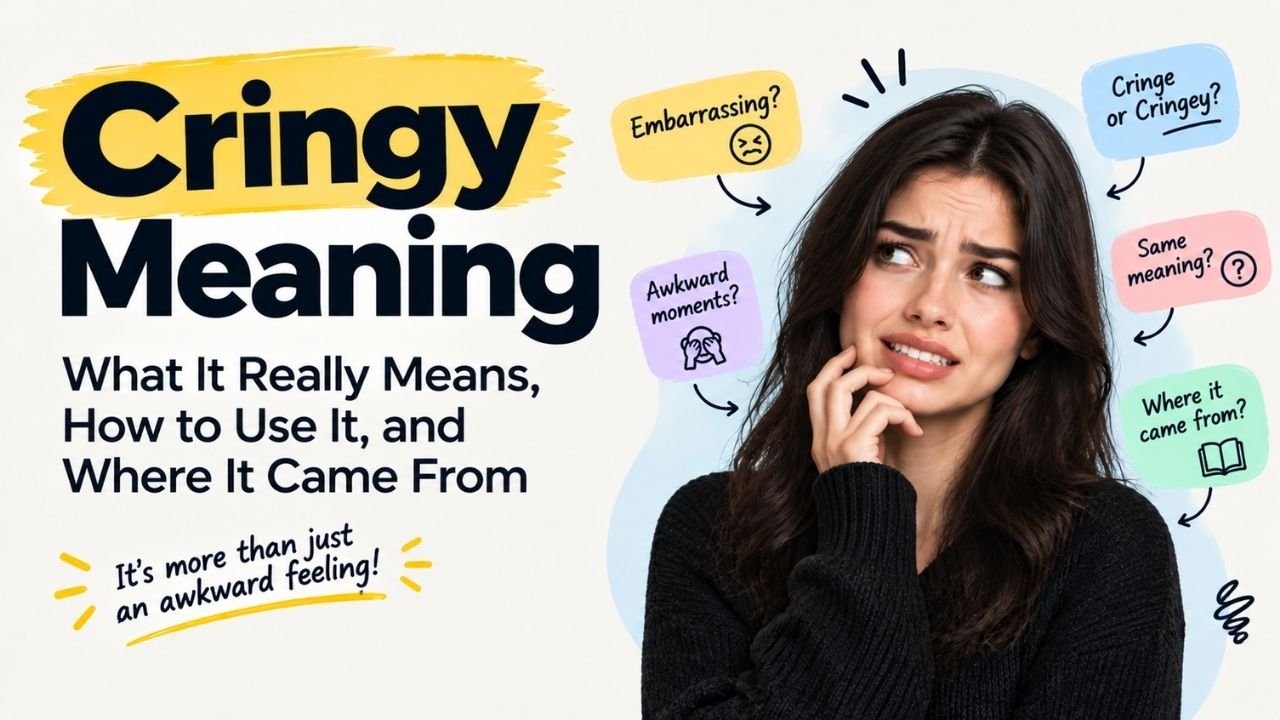
Cringy means embarrassing in a way that makes you want to look away. When something is cringy, it feels awkward, forced, or badly judged, and watching it happen to someone else can feel almost as uncomfortable as if it happened to you. People use cringy meaning to describe everything from an outdated joke to a painfully awkward video.
The word has become one of the most common ways young people talk about secondhand embarrassment online. Understanding cringy meaning helps you use the word correctly, spell it the right way, and avoid a few small grammar mistakes that trip up even confident English speakers. This guide covers the definition, grammar, pronunciation, origin, and real usage of the word in full detail.
Cringy Meaning At A Glance
Before going deeper, here is the short version.
| Question | Quick Answer |
| What does cringy mean? | Embarrassing, awkward, or uncomfortable to watch or hear |
| Part of speech | Adjective |
| Correct spelling | Both “cringy” and “cringey” are accepted; “cringey” is slightly more common |
| Pronunciation | KRIN-jee |
| Word type | Informal, mostly used in casual speech and online writing |
| Comparative / superlative | cringier / cringiest (or cringey, cringeyer, cringeyest) |
| Origin | From the verb “cringe,” which comes from Old English |
What Does Cringy Mean?
Cringy describes something that causes embarrassment just by being seen or heard. It is not about physical pain or danger. It is about social discomfort.
You feel cringy secondhand embarrassment when someone does something awkward without realizing it. A best man’s wedding speech full of bad jokes can be cringy. An old photo of yourself from ten years ago can be cringy. A brand trying too hard to sound like a teenager on social media can be cringy too.
The word almost always describes the thing causing the discomfort, not the person feeling it. You do not usually say “I am cringy” to mean “I feel embarrassed.” Instead, you say something else is cringy, and that thing makes you cringe.
See More: IONO Meaning
The Core Idea Behind Cringy
Three ideas sit at the center of cringy meaning.
- Secondhand embarrassment. You feel uncomfortable watching someone else, even though nothing bad is happening to you personally.
- A mismatch between effort and result. The person or thing is trying hard to look good, cool, or funny, and it fails in an obvious way.
- A lack of self-awareness. Cringy moments often involve someone who does not realize how they come across to others.
That third point matters a lot. A person who trips and immediately laughs at themselves is rarely called cringy. A person who does something awkward and acts completely confident about it is the classic cringy example.
Cringy vs Cringey: Which Spelling Is Correct?
This is one of the most searched questions about the word, and the honest answer is that both spellings are correct.
| Spelling | Status | Common Use |
| Cringey | Listed as the main entry in most dictionaries | Slightly more common in everyday writing |
| Cringy | Listed as an accepted variant | Very common online and in casual speech |
Major dictionaries treat cringy and cringey as the same word with two spellings. Neither one is “more correct” in a formal sense, though cringey appears more often in dictionary headwords. In practice, people switch between the two without much thought, the same way some writers use “gray” and others use “grey.”
If you are writing something formal, either spelling is acceptable, but staying consistent within one piece of writing looks more polished. If you are texting a friend, it truly does not matter which one you pick.
Cringy Meaning In English Grammar
Cringy is an adjective. It describes a noun, and it usually appears in one of these grammar patterns.
- Before a noun: That was a cringy joke.
- After a linking verb: The speech felt cringy.
- With an intensifier: This is so cringy.
Comparative And Superlative Forms
Cringy follows regular adjective rules because it ends in a consonant plus “y.”
| Form | Word |
| Base | cringy |
| Comparative | cringier |
| Superlative | cringiest |
Example: “That video was cringy, but his last one was even cringier, and honestly, this new one might be the cringiest thing he has ever posted.”
If you use the “cringey” spelling instead, the forms shift slightly because the base word ends in a vowel plus “y.”
| Form | Word |
| Base | cringey |
| Comparative | cringeyer or more cringey |
| Superlative | cringeyest or most cringey |
Both comparative styles show up in real usage, but “more cringey” and “most cringey” tend to sound more natural to most English speakers, since “cringeyer” can look awkward on the page.
How To Pronounce Cringy
Cringy is pronounced KRIN-jee, with the stress on the first syllable.
- IPA: /ˈkrɪndʒi/
- Rhymes with: stingy, dingy, springy
The “cringe” part sounds exactly like the word cringe, as in “that made me cringe.” Then add a soft “ee” sound at the end, similar to the ending of “happy” or “funny.” There is no difference in pronunciation between “cringy” and “cringey.” Both are said the same way.
Origin And Etymology Of Cringy
Cringy comes from the verb cringe, and cringe has a long history that goes back centuries before anyone used it to describe an awkward internet video.
Cringe traces back to the Old English word cringan, which meant to yield, to fall in battle, or to become bent. Over time, in Middle English, this shifted into crengen, meaning to bend or bow in a submissive way, often out of fear or flattery. By the time English reached its modern form, cringe had settled into the meaning most people know today: to physically flinch, shrink back, or recoil, especially from fear, disgust, or embarrassment.
The adjective cringey (and its variant cringy) is much newer. Dictionary records show cringey in use by the mid to late 1960s, with clearer documented use by 1986. For decades it stayed a fairly minor word. Its huge rise in popularity came later, driven almost entirely by internet culture, YouTube compilations, and social media in the 2000s and 2010s, when “cringe” and “cringy” became everyday shorthand for secondhand embarrassment online.
So the word carries an old root about physically bending or shrinking away, and a modern meaning about the emotional flinch you feel when you watch something painfully awkward.
So Cringy Meaning
“So cringy” simply means very embarrassing or extremely awkward. The word “so” works here as an intensifier, the same way it works in “so funny” or “so annoying.”
- “That audition was so cringy, I had to leave the room.”
- “His pickup line was so cringy that everyone at the table went quiet.”
“So cringy” is one of the most common ways the word appears in real conversation, especially in reactions to videos, texts, or social media posts.
It’s Cringy Meaning (And The Apostrophe Rule)
“It’s cringy” means “it is cringy,” and this is a good place to clear up a very common grammar mix-up.
- It’s is a contraction of “it is” or “it has.”
- Its is a possessive word meaning “belonging to it.”
So “it’s cringy” is correct when you mean “that thing is embarrassing.” “Its cringy meaning” is only correct if you are talking about a possessive relationship, which almost never fits with this word. In nearly every real sentence people write, the correct choice is “it’s cringy,” with the apostrophe.
| Correct | Incorrect |
| It’s cringy how he still talks like that. | Its cringy how he still talks like that. |
| The show lost its charm after season two. | The show lost it’s charm after season two. |
A simple test: if you can replace the word with “it is,” you need the apostrophe. “It is cringy” makes sense, so “it’s cringy” is correct.
See More: What Does SYFM Mean?
Cringy Meaning Slang And Urban Dictionary Use
In slang, cringy is almost always negative, but it is a soft kind of negative. It is not the same as calling something offensive, dangerous, or genuinely harmful. Cringy content is usually harmless, just awkward.
On sites like Urban Dictionary, user-submitted definitions generally describe cringy as something that makes you feel embarrassed for another person, often because that person seems unaware of how they look or sound. These informal definitions tend to line up closely with the more formal dictionary meaning, just with looser, more conversational wording and blunt examples pulled from memes, videos, and everyday social situations.
A useful way to think about slang cringy: it describes the reaction, not the intent. Nobody sets out to be cringy on purpose (with a few exceptions, like intentionally cringy comedy). It is a label applied by an audience, not a goal the person was trying to reach.
Being Cringy Meaning
“Being cringy” describes someone’s behavior in the moment, not their entire personality. It refers to acting in a way that comes across as awkward, forced, or overly eager, usually without the person realizing it.
Common situations people call “being cringy” include:
- Trying too hard to sound cool or funny and missing the mark
- Oversharing personal details at the wrong time
- Using slang or trends in a way that feels forced or outdated
- Acting overly confident about something that clearly did not land well
It is worth noting that “being cringy” is often subjective. What feels cringy to one person might feel charming or harmless to another. Confidence, timing, and audience all affect whether something gets labeled cringy.
Cringy Meaning In A Relationship
In relationships, cringy usually describes public displays of affection or behavior that feels excessive, performative, or awkward to watch from the outside.
Examples people commonly call cringy in a relationship context:
- Extremely public, over-the-top proposals or anniversary posts
- Nicknames or pet names used loudly in front of other people
- Couples who narrate their relationship constantly on social media
- Jealous or controlling behavior dressed up as “romantic” in a caption
It is worth separating two different uses here. Sometimes “cringy” is used playfully, almost affectionately, to describe a couple being a little much in a harmless way. Other times, it points to behavior that feels uncomfortable to witness for more serious reasons, like oversharing private details or performing affection for an audience rather than for the partner. Context and tone usually make clear which one is meant.
Cringy In Different Contexts
The word shifts slightly depending on where it shows up. The table below breaks down common contexts.
| Context | What Cringy Usually Means There |
| Social media | Content that feels forced, outdated, or too eager to go viral |
| Movies or TV | Dialogue, acting, or scenes that feel awkward or badly written |
| Workplace | Jokes, emails, or presentations that miss the tone of the room |
| Parenting | A parent trying to act “cool” in a way that embarrasses their kids |
| Dating | Pickup lines, messages, or gestures that feel forced or overdone |
| Comedy | Jokes that fall flat but the performer keeps going anyway |
| Nostalgia | Looking back at your own old posts, photos, or fashion choices |
Nostalgic cringe deserves a special mention, because it is one of the most universal uses of the word. Almost everyone has looked back at an old photo, an old text conversation, or an old social media post and thought, “that is so cringy.” This use is directed at your past self rather than someone else, and it usually comes with a laugh rather than real embarrassment.
Cringy Meaning In Urdu
There is no single perfect one-word Urdu translation for the modern slang sense of cringy, because the word grew out of English internet culture and describes a very specific social feeling. Many Urdu speakers, especially younger ones, simply use the English word “cringe” or “cringy” directly inside Urdu sentences, the same way many borrowed English words are used in everyday speech.
The older, more formal meaning of the verb “cringe” (to shrink back or bow in fear or flattery) does have Urdu equivalents in traditional dictionaries, generally centered on the ideas of shrinking back out of fear, or flattering someone in a servile way. However, this older meaning is different from the modern “that’s so embarrassing to watch” sense that most people searching for cringy meaning are actually looking for. In everyday conversation, describing something as cringe-inducing or awkward in Urdu is usually done with a short explanatory phrase rather than one exact word.
Cringy Meaning In Nepali
As with Urdu, the internet slang sense of cringy does not map onto a single traditional Nepali word, because the concept itself is closely tied to global internet and meme culture. Many Nepali speakers, particularly on social media, use the English loanword “cringe” or “cringy” directly, often written in Latin script within otherwise Nepali sentences.
The closest native concepts relate to feeling embarrassed, ashamed, or uncomfortable watching something awkward, and these ideas are usually expressed through a descriptive phrase rather than a single fixed translation. This is common with newer internet slang across many languages: the word travels faster than an exact local equivalent gets created.
Cringy Meaning In Tamil
The same pattern holds for Tamil. Tamil has rich vocabulary for embarrassment, shame, and awkwardness, but the specific internet-era meaning of cringy, watching someone else’s awkward behavior and feeling embarrassed on their behalf, is a fairly recent cultural concept. Many Tamil speakers online use the English word directly, especially in comments, captions, and casual conversation mixing Tamil and English.
When Tamil speakers do explain the concept in Tamil, it is usually described through a short phrase about feeling embarrassed or uncomfortable while watching something, rather than translated with one single traditional word.
Cringy Meaning In Bengali
Bengali follows a similar path. There is no single long-established Bengali word that captures the exact modern, internet-driven meaning of cringy. Many Bengali speakers, especially younger internet users, use the English word “cringe” or “cringy” directly in casual writing and speech.
Bengali does have strong vocabulary around embarrassment and shame, and these words are often used to explain the feeling behind cringy in conversation, even though they do not function as an exact one-word replacement for the English slang term.
Cringy Meaning In Hindi
In more formal Hindi dictionaries, the base verb “cringe” is generally translated around ideas of bowing or shrinking back out of fear, or acting in a flattering, servile way. These older definitions reflect the traditional meaning of the English verb rather than the modern internet slang sense.
For the newer, casual meaning, most Hindi speakers, particularly younger ones on social media, use the English words “cringe” or “cringy” directly within Hindi sentences. This is extremely common in Hinglish (mixed Hindi-English) conversations, captions, and comments. When people do explain the feeling in Hindi, they usually describe it as a kind of secondhand embarrassment or discomfort, rather than reaching for one exact traditional Hindi word.
Synonyms And Related Words
These words overlap with cringy, but each one carries a slightly different shade of meaning.
| Word | Meaning | How It Differs From Cringy |
| Cringeworthy | Deserving of a cringe reaction | Closest in meaning, slightly more formal, often used to describe planned content like ads or scripts |
| Embarrassing | Causing a feeling of shame or discomfort | Broader and more neutral; can apply to any embarrassing situation, not just secondhand ones |
| Awkward | Socially uncomfortable or clumsy | Milder; describes discomfort without necessarily implying secondhand shame |
| Mortifying | Extremely embarrassing | Much stronger; used for serious, memorable embarrassment rather than everyday awkwardness |
| Corny | Overly sentimental or old-fashioned in a way that feels unoriginal | Focuses on lack of originality rather than pure embarrassment |
| Try-hard | Trying too obviously to impress others | Focuses on visible effort, which often leads to something being labeled cringy |
Antonyms Of Cringy
| Word | Meaning |
| Cool | Socially confident, impressive, or well-regarded |
| Smooth | Naturally confident and graceful in behavior |
| Effortless | Achieved without visible strain or forced effort |
| Genuine | Sincere and natural, without seeming performative |
Common Mistakes With Cringy
A few small mistakes come up often, even among confident English speakers.
Mistake 1: Confusing “cringe” and “cringy” as interchangeable in every sentence.
- ❌ Incorrect: That was so cringe joke.
- ✅ Correct: That joke was so cringy.
- ✅ Also correct (casual, adjective use of cringe): That joke was so cringe.
In very casual, modern slang, “cringe” itself is sometimes used as an adjective, especially online. But in standard grammar, “cringy” or “cringey” is the adjective form, and “cringe” is the verb or noun form.
Mistake 2: Mixing up “it’s” and “its.”
- ❌ Incorrect: Its cringy how he acts around her.
- ✅ Correct: It’s cringy how he acts around her.
Mistake 3: Treating cringy as something you feel rather than something you perceive.
- ❌ Slightly off: I am cringy right now.
- ✅ More natural: I feel embarrassed right now. / That situation was cringy.
Cringy almost always describes the outside behavior or content, not your internal feeling. What you feel is embarrassment; what you call cringy is the thing causing it.
Mistake 4: Overusing the comparative form incorrectly.
- ❌ Incorrect: This is more cringier than the last one.
- ✅ Correct: This is cringier than the last one.
- ✅ Correct: This is more cringy than the last one.
Avoid combining “more” with the “-ier” ending at the same time. Pick one comparative form, not both.
Examples Of Cringy In A Sentence
- “The best man’s speech was so cringy that half the room stared at their shoes.”
- “I found my old diary, and reading it now is honestly cringy.”
- “The commercial tried so hard to be funny that it ended up cringy instead.”
- “It’s cringy watching him flirt like that in front of everyone.”
- “That was the cringiest thing I have seen all week.”
See More: ICR Meaning Instagram
Frequently Asked Questions
What does cringy mean?
Cringy means embarrassing or uncomfortable in a way that makes you want to look away, usually because you feel secondhand embarrassment watching someone else.
Is cringy a real word?
Yes. It is an informal adjective recognized by major dictionaries, listed as a variant of “cringey.”
Cringey or cringy, which spelling should I use?
Both spellings are correct and widely accepted. “Cringey” appears slightly more often as the main dictionary entry, but “cringy” is extremely common, especially online.
How do you use cringy in a sentence?
Place it before a noun (“a cringy video”) or after a linking verb (“that felt cringy”). It can also follow an intensifier, as in “so cringy.”
Is cringy a noun or an adjective?
Cringy is an adjective. The related noun form is “cringe,” as in “I felt a wave of cringe.”
What is the difference between cringe and cringy?
Cringe is primarily a verb and a noun (“I cringe,” “that gave me the cringe”). Cringy is the adjective form used to describe something that causes that reaction, as in “that was cringy.”
Where did the word cringy come from?
It comes from the verb cringe, which traces back to the Old English word cringan, meaning to yield, bend, or fall. The adjective form cringey or cringy developed centuries later and became widely popular through internet and social media culture.
Is cringy formal or informal English?
Cringy is informal. It fits casual conversation, texting, and social media, but it is generally avoided in formal writing, academic work, or professional documents.
What is the opposite of cringy?
Common opposites include cool, smooth, and effortless, all of which describe confident or natural behavior rather than awkward or forced behavior.
Why do people say “so cringy” instead of just “cringy”?
“So” acts as an intensifier, making the description stronger. “So cringy” emphasizes just how embarrassing something feels, similar to “so funny” or “so annoying.”
Final Thoughts On Cringy Meaning
Cringy meaning comes down to one simple idea: something that feels awkward, forced, or embarrassing enough that watching it makes you want to look away. It grew from the older word cringe, which once described physically shrinking back in fear, and it now mostly lives in casual conversation, social media captions, and everyday reactions to awkward moments.
Whether you write it as cringy or cringey, use it as “so cringy,” or run into the common it’s versus its mix-up, the core meaning stays the same across every context, from relationships to old photos to internet content. Once you understand where the word came from and how it actually behaves in a sentence, using it correctly becomes second nature.

Hassan Ibrahim is the author behind Mean Fixer, with 4 years of experience researching and writing about names, words, slang, meanings, and everyday language. Their goal is to make confusing words and meanings simple, clear, and easy to understand through accurate, useful, and reader-friendly explanations.