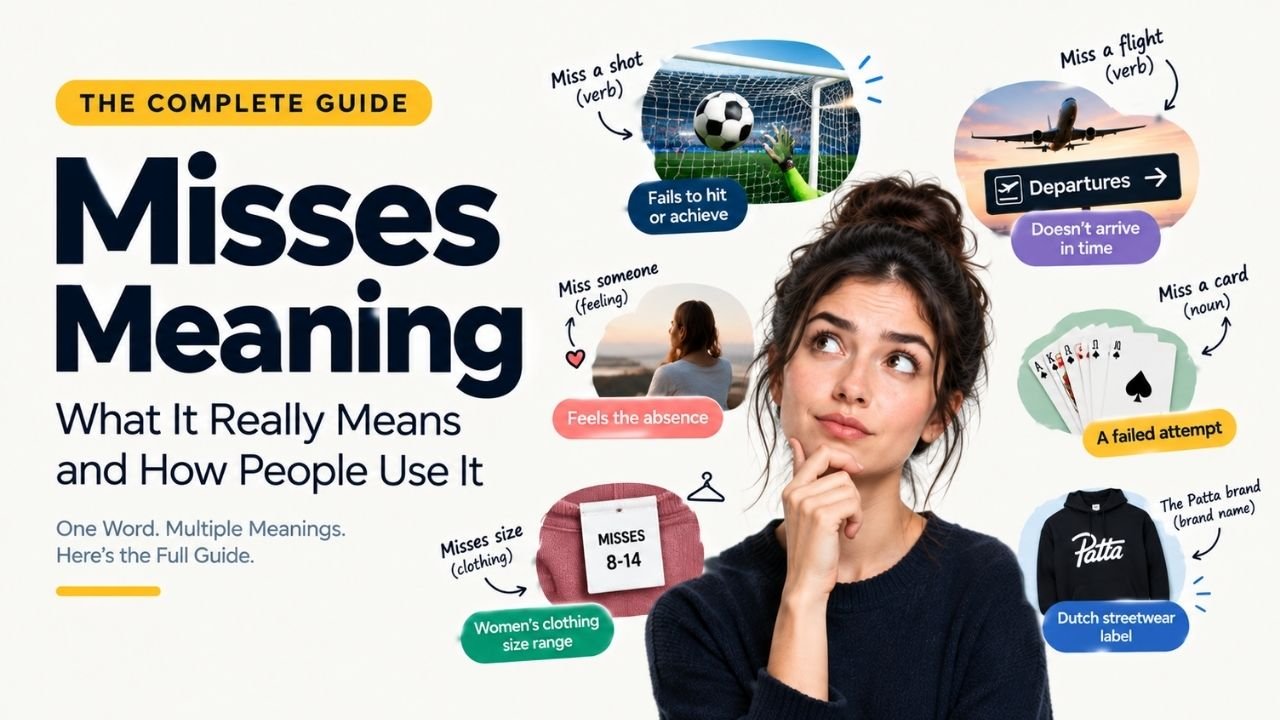
“Misses” mostly means one of three things: the plural of the verb “miss” (she misses the bus), an old‑fashioned informal word for someone’s wife, or a clothing size category for adult women. The correct meaning depends entirely on how the word is used in the sentence around it. Context always decides.
This word confuses people because it looks like one word but behaves like several different ones. A shopper sees “misses” on a clothing tag, a reader sees “the misses” in an old novel, and a sports fan sees “she never misses” in a comment section, and none of these feel connected at first glance. Once you see the pattern behind each use, the confusion disappears completely.
Misses Meaning At A Glance
Before going deeper, here is the short version. “Misses” is one spelling that covers a few unrelated jobs in English.
| Use | Part Of Speech | Simple Meaning | Example |
| Verb form | Verb (present tense, third person) | Fails to hit, catch, attend, or notice something | She misses every deadline. |
| Verb form (longing) | Verb (present tense, third person) | Feels sad about someone’s or something’s absence | He misses his old apartment. |
| Informal noun | Noun | An old-fashioned, informal word for “wife” | He’s cooking dinner for the misses. |
| Title plural | Noun (rare, formal) | The plural of “Miss,” used for two or more unmarried women | The Misses Bennett arrived at noon. |
| Clothing size | Noun (industry term) | A standard adult women’s clothing size range | This dress comes in misses sizes 4 to 16. |
Each of these meanings is explained in full below, with pronunciation, grammar, examples, and common mistakes.
See More: L4L Meaning
What Does Misses Mean As A Verb?
Most of the time, “misses” is simply the verb “miss” with an “‑es” added for the third person singular present tense. That means it goes with he, she, it, or a singular noun.
- I miss the train.
- You miss the train.
- She misses the train.
This single grammar rule explains a huge number of the searches connected to this word, including “she never misses,” “near misses,” and “me and the misses.”
Meaning 1: Fails To Hit Or Achieve Something
In sports, games, and general accuracy, “misses” means a shot, throw, guess, or attempt does not succeed.
- The striker misses the penalty kick.
- He rarely misses a free throw.
Meaning 2: Fails To Attend Or Reach Something In Time
“Misses” can describe someone not making it to an event, a flight, or a deadline.
- She misses her connecting flight.
- He misses the morning meeting again.
Meaning 3: Feels The Absence Of Someone Or Something
This is the emotional meaning, and it is the one behind many of the searches about relationships and longing.
- She misses her family during the holidays.
- He misses the city he grew up in.
Meaning 4: Fails To Notice Or Understand Something
- The report misses an important detail.
- He misses the point of the joke.
💡 Tip: If you can swap “misses” for “does not hit,” “does not attend,” “feels sad about the absence of,” or “does not notice,” you are looking at the verb form, not the noun.
Word Forms: Miss, Misses, Missed, Missing
English verbs change shape depending on tense and subject, and “miss” follows the normal pattern used by most regular verbs.
| Form | Grammar Term | Example |
| Miss | Base form / present tense (I, you, we, they) | I miss my old job. |
| Misses | Present tense (he, she, it) | She misses her old job. |
| Missed | Past tense, all subjects | They missed the show last night. |
| Missed | Past participle | He has missed three classes this month. |
| Missing | Present participle / gerund | She is missing her flight right now. |
Notice that “missed” covers both simple past tense and the past participle, which is typical for regular verbs in English. There is no irregular version of “miss.” It never becomes “mist” or “moss” in the past tense, even though that mistake occasionally shows up in early spelling attempts by language learners.
Miss As A Noun
Separately from the verb, “miss” can also work as a noun meaning a failed attempt.
- That shot was a clear miss.
- After three misses in a row, the archer adjusted her stance.
Here, “misses” is simply the standard plural of this noun, formed the normal way, by adding “‑es” after a word ending in a sibilant sound like “ss.” This is the same pattern that turns “class” into “classes,” “kiss” into “kisses,” and “boss” into “bosses.”
Miss Vs Misses Meaning: What Is The Difference?
“Miss” and “misses” are the same verb. The only difference is grammatical subject and number.
| Subject | Correct Form | Example |
| I, you, we, they | miss | They miss the old café. |
| He, she, it | misses | He misses the old café. |
| A plural noun | miss | My friends miss the old café. |
| A singular noun | misses | My friend misses the old café. |
A separate, unrelated confusion is “Miss” versus “Misses” as titles. “Miss” is a title placed before the name of an unmarried woman or a young girl. “Misses” as a title is the old-fashioned plural of that title, used for two or more women who share a surname, such as “the Misses Smith.” This plural title is rare today and mostly appears in older literature and very formal writing.
⚠️ Common Mistake: Writers sometimes use “misses” as the plural of the title “Miss” when they actually mean the honorific “Mrs.” These are two separate words with two separate histories, explained in the next section.
Origin Of Misses: Where Each Meaning Comes From
Because “misses” covers more than one unrelated word, it also has more than one word history. Understanding both origins clears up most of the confusion at once.
Origin Of The Verb “Miss”
The verb “miss” traces back to Old English “missan,” meaning to fail to hit or fail to reach, which itself connects to older Germanic roots shared with words in Dutch and German that carry a similar sense of “going wrong” or “failing to reach.” This is a native English word, not a borrowing from Latin or French, and its core meaning, failing to hit or reach a target, has stayed remarkably stable for well over a thousand years. The emotional sense, feeling the absence of someone, grew naturally out of the original meaning: missing a person is, in a sense, failing to “reach” them.
Origin Of “Misses” Meaning Wife
This meaning has a completely different history. It comes from “mistress,” a word borrowed into English from Old French, ultimately built on the Latin word for “master” with a feminine ending attached. In casual, everyday speech, “mistress” was gradually worn down and contracted over the seventeenth and eighteenth centuries into an oral shorthand. Written attempts to capture this spoken form produced several spellings, including “missis,” “missus,” and “misses.” By the late 1700s and into the 1800s, “the missus” or “the misses” was firmly established in everyday speech as a casual reference to one’s wife, and the more formal written title “Mrs” developed from the exact same root word, simply staying closer to the original written spelling of “mistress” while the pronunciation shifted underneath it.
Origin Of “Misses” As A Clothing Size Term
This use is much newer and belongs to twentieth-century American retail and garment manufacturing history, when the clothing industry began separating women’s sizing into standardized categories, including juniors, misses, and women’s, to make shopping and pattern-making more predictable across brands. The word “misses” was borrowed here from its older, general sense of “young or adult women” rather than from any grammar rule, simply as a convenient label for a size range aimed at average adult women’s proportions.
Misses Meaning Wife: The Informal Term Explained
“The misses” is an informal, somewhat old-fashioned way of referring to one’s wife. It is almost always used with “the,” “my,” or a similar possessive word in front of it.
- “I’ll have to ask the misses.”
- “Me and the misses are heading out.”
- “How’s the misses doing?”
Where “Misses” Meaning Wife Comes From
This use is a spoken, worn-down form of “mistress.” Over time, “mistress” was shortened in casual speech until it became “missus” or “misses,” the same casual shortening that eventually produced the formal title “Mrs.” Dictionaries describe it as an informal or old-fashioned term of address for someone’s wife, historically used far more in working-class or rural speech than in formal writing.
Misses Or Missus: Which Spelling Is Correct?
Both spellings exist for this meaning, and dictionaries treat “misses” as an accepted variant spelling of “missus.” “Missus” is the more common spelling in modern dictionaries, but “misses” appears often enough in casual writing, texting, and older printed sources that readers should recognize both.
| Spelling | Status | Typical Use |
| Missus | Most common dictionary spelling | Informal writing, dialogue, casual speech |
| Misses | Accepted variant spelling | Informal writing, older texts, casual speech |
| Mrs | Formal written title | Placed before a married woman’s surname |
See More: Endocrinology Meaning
Is “The Misses” The Same As “Mrs”?
They come from the same root word, “mistress,” but they are not used the same way today. “Mrs” is a formal written title placed directly before a surname, such as Mrs Johnson. “The misses” is a spoken, informal phrase that refers to a wife without using her name at all. You would write “Mrs Johnson called,” but you would say “the misses called” only in casual conversation.
Misses Meaning Woman: A Broader Informal Use
Beyond “wife” specifically, “missus” or “misses” can also serve as a casual, informal way to address a woman directly, particularly in older or regional British English, similar to saying “ma’am” but far less formal and sometimes slightly cheeky.
- “Need a hand carrying that, missus?”
This use does not necessarily mean the woman is married. It simply treats her as an adult woman in a friendly or familiar way.
⚠️ Note On Tone: “The misses” meaning wife can come across as old-fashioned, and to some listeners, it can sound dismissive, since it refers to a person without using her name. Many modern speakers use it affectionately or jokingly, but it is worth knowing the tone before using it in a formal or professional setting.
British English Versus American English Usage
The word “misses” behaves a little differently depending on which side of the Atlantic you’re reading.
| Aspect | British English | American English |
| “The misses” meaning wife | Fairly common in casual, working-class, or older speech | Less common overall, sometimes sounds distinctly old-fashioned or regional |
| “Missus” as a direct address to a woman | Used informally, sometimes with a cheeky or familiar tone | Rare; “ma’am” is far more typical |
| “Misses” clothing sizing | Not a standard British retail term; UK sizing uses a different numbering system entirely | A standard, widely used American retail size category |
| Formal title “Mrs” | Written without a period in most British style guides (Mrs Smith) | Written with a period in most American style guides (Mrs. Smith) |
This is worth knowing because a reader unfamiliar with British informal speech might assume “the misses” is universal slang, when in fact its frequency and social tone shift noticeably by region. American readers are statistically far more likely to encounter “misses” through clothing size charts than through the wife-related meaning, while the reverse can be true for British readers of older or regional fiction.
Misses In Conversation: Tone And Context
Even once the dictionary meaning is clear, tone matters. The same word can sound warm, neutral, or slightly outdated depending on who says it and where.
- Between close friends, casually: “Tell the misses I said hi” usually reads as friendly and familiar, similar to saying “tell your wife I said hi.”
- In writing aimed at a general audience: Using “the misses” in a formal article, a business email, or an official document reads as oddly informal or dated, and “my wife” or “my spouse” fits better.
- In fiction and dialogue: Writers often use “the misses” or “the missus” to establish a character’s voice quickly, signaling a working-class, older, or regionally specific way of speaking without needing extra description.
- As direct address: Calling a stranger “missus” can come across as either good-natured or slightly presumptuous, depending entirely on delivery, familiarity, and regional norms.
💡 Tip: If you are writing dialogue and want a character to sound natural, informal, and a little old-fashioned, “the misses” does that instantly. If you are writing anything meant to sound neutral or professional, it is almost always safer to write “my wife,” “his wife,” or “her husband” instead.
My Misses Meaning And Similar Phrases
Several of the most searched phrases around this word are simple variations of the same informal structure: possessive word plus “misses.”
| Phrase | Meaning |
| My misses | My wife |
| The misses | My wife, or a general term for “the wife” |
| You and the misses | You and your wife |
| Me and the misses | My wife and I |
| How’s the misses | A casual question asking how someone’s wife is doing |
| For the misses | Intended for someone’s wife |
| Hello misses | A casual greeting directed at a woman, or occasionally a wife |
These phrases are almost entirely spoken and informal. They fit casual conversation, text messages, and dialogue in fiction, but they generally do not belong in formal writing, business communication, or academic work.
Little Misses Meaning
“Little misses” usually refers to young girls, using “Miss” as a title for an unmarried girl or woman, with “little” added to indicate she is a child. It shows up in phrases like “little miss sunshine” or “the little misses were playing in the yard,” where “misses” functions as the plural of the title “Miss” for more than one girl. This use leans playful, old-fashioned, or literary rather than everyday modern speech.
Near Misses Meaning
“Near misses” is the plural of the noun phrase “near miss.” A near miss is an event that almost happens, especially something dangerous or damaging, but does not actually occur.
- The pilots reported two near misses during the flight.
- The factory tracks near misses to prevent future accidents.
Why It Is “Near Misses,” Not “Near Miss’s”
Here, “miss” is a noun, not a verb, and the plural of a noun formed this way simply takes “‑es,” the same way “class” becomes “classes.” There is no apostrophe involved, because the word is not showing possession.
| Incorrect | Correct |
| Near miss’s | Near misses |
| Near misses’ | Near misses |
⚠️ Common Mistake: Adding an apostrophe to “misses” almost always causes a grammar error. Apostrophes show possession or contraction, not simple plurals. “The dog’s bone” needs an apostrophe because the bone belongs to the dog. “Near misses” never needs one, because nothing belongs to anything.
Near Miss In Safety And Workplace Language
In workplace safety and aviation, “near miss” is a specific reporting term. It describes an incident that could have caused injury or damage but did not, and organizations track near misses closely because they reveal risks before a real accident happens.
Hits And Misses Meaning
“Hits and misses” describes a mixed result: some things succeed, and some things fail. It is often used to describe a set of ideas, products, songs, or moments where quality is uneven.
- The new menu is a mix of hits and misses.
- Her jokes tonight were mostly hits and misses.
A closely related phrase is “hit or miss,” which describes something unpredictable or inconsistent overall, without necessarily meaning it succeeds and fails at the same time. “Hits and misses” tends to look back at a group of separate results, while “hit or miss” often describes the general reliability of one thing.
She Never Misses Meaning
“She never misses” is a compliment. It literally means she consistently succeeds at whatever she attempts, whether that is a shot in a game, a prediction, a joke, or a decision. The same phrase works with “he,” “they,” or a name in place of “she.”
- In basketball commentary: “She never misses from three.”
- In casual praise online: “That singer never misses.”
This phrase leans on the plain verb meaning of “miss” (to fail to hit or achieve something), simply flipped into a strong positive statement by adding “never.” It has become especially common as an informal compliment on social media, applied to anything from sports performance to consistently good creative work, and it works because the underlying grammar is instantly familiar to any English speaker.
Misses Meaning In Size: Clothing And Fashion
In clothing and fashion, “misses” is an industry term for a specific size category of women’s clothing.
What Misses Size Actually Means
Misses sizing is built for an average adult woman’s proportions, generally an hourglass-leaning shape and an average height, roughly between 5 feet 4 inches and 5 feet 8 inches. It is one of several standard United States clothing size categories, alongside juniors, women’s or plus sizes, and petite.
| Category | Typical Sizes | Body Shape Target | Common Buyer |
| Juniors | Odd numbers, such as 1, 3, 5, 7 | Less curved, straighter figure | Teens and young women |
| Misses | Even numbers, such as 2, 4, 6, 8 | Average adult proportions, hourglass leaning | Adult women |
| Women’s or plus | Even numbers from about 18 up | Fuller figure, sometimes lower bust line | Adult women needing larger sizing |
| Misses petite | Misses numbers with a “P” | Same as misses, shorter height | Adult women under about 5 feet 4 inches |
Why Misses Sizes Use Even Numbers
Misses clothing traditionally uses even-numbered sizes, such as 2, 4, 6, 8, 10, and up. Junior sizing, by contrast, traditionally uses odd numbers, such as 1, 3, 5, and 7. This numbering split has existed in the American clothing industry for decades and still appears on many size charts and clothing tags today, even though individual brands vary in exactly how they cut and label their garments.
Misses Versus Juniors: The Real Difference
- Fit: Misses clothing is generally cut for a more defined waist and a fuller bust than juniors clothing, which is cut straighter with less shaping.
- Audience: Misses clothing targets adult women, while juniors clothing targets teenagers and very young adults.
- Style: Misses collections tend to include more business casual and classic pieces, while juniors collections lean toward trend-driven, youth-focused styles.
Misses Versus Women’s Or Plus Sizes
Misses sizing generally stops in the mid to high teens as a number, while women’s or plus sizing usually starts around size 18 and continues upward. The two categories are also cut differently, since women’s or plus sizing is proportioned for a fuller figure rather than simply being a larger misses garment.
💡 Tip: When shopping online, “misses” and “missy” usually refer to the same size category. “Missy” is simply a shortened, informal version of “misses” used by some retailers.
Misses Petite And Other Related Categories
Retailers often break misses sizing down further to account for height and proportion differences among adult women.
| Label | Meaning |
| Misses (standard) | Average height, roughly 5 feet 4 inches to 5 feet 8 inches |
| Misses petite | Same body proportions as standard misses, but for shorter women, usually under about 5 feet 4 inches; marked with a “P,” as in 10P |
| Misses tall | Same proportions, but for taller women, usually 5 feet 8 inches and above; marked with a “T,” as in 10T |
| Half sizes | For shorter women with a fuller, more hourglass shape than standard petite sizing; marked with a fraction, as in “10 and a half” |
Why This Sizing System Still Causes Confusion
Two garments labeled the same misses size, such as size 8, can fit differently depending on the brand, because there is no single legally enforced standard that every American clothing company follows. The misses, juniors, and women’s categories describe a general target body shape and age range rather than one exact, universal measurement. This is why two shoppers can wear “the same size” at two different stores and get two very different fits. Understanding what “misses” signals, an adult, roughly average proportion range, is more reliable than assuming the number alone guarantees an exact fit.
Thug Misses Meaning
“Thug misses” is not a standard English phrase, and it does not appear in dictionaries or established usage. It is most likely either a misspelling, a mishearing of another phrase, or a reference to a specific song, video, or social media post rather than general vocabulary. If you encountered this phrase in a particular context, such as a song lyric or a video caption, the safest approach is to check that specific source directly, since it likely relies on wordplay or slang tied to that one piece of content rather than a broader meaning of “misses” itself.
Misses In Music: Dominic Fike’s Song
“Misses” is also the title of a short 2024 song by American singer-songwriter Dominic Fike, released on his EP 14 Minutes. The song reflects on a past relationship with genuine affection, and Fike uses the word “miss” repeatedly throughout the track, a repetition that connects to why the song carries the plural title “Misses.” The track became widely popular on social media after being featured in videos by other public figures, which helped push it onto charts internationally.
If you searched “misses meaning” hoping for song lyrics or an explanation of specific lines, note that reproducing full lyrics is protected by copyright, so this article focuses on the plain-English meaning of the word rather than quoting the song directly.
Common Idioms And Expressions Built On “Miss”
Because “miss” and “misses” are everyday verbs, they show up inside several fixed expressions. Recognizing these helps readers avoid confusing an idiom with a literal meaning.
| Expression | Meaning |
| Miss the boat | To lose an opportunity by acting too late |
| Miss the point | To fail to understand the main idea of something |
| Miss the mark | To fail to achieve the intended result or goal |
| Wouldn’t miss it for the world | To be extremely eager to attend something |
| Miss out | To fail to take part in or benefit from something |
| Give it a miss | A British informal phrase meaning to skip or avoid doing something |
| Near miss | An event that almost happens but does not, often dangerous |
| Hit or miss | Unpredictable; sometimes successful and sometimes not |
These expressions all lean on the core meaning of “miss,” failing to hit, reach, or take part in something, even when the literal image behind the phrase, such as a boat or a target, is no longer meant literally.
Miss The Mark Versus Hits And Misses
These two phrases are often confused because they both involve success and failure, but they work differently. “Miss the mark” describes one single failed attempt at a specific goal. “Hits and misses,” on the other hand, describes a mixed set of results across several attempts, where some succeed and others fail. A single review can say a film “misses the mark” entirely, while a full season of a show can be described as “a mix of hits and misses” because some episodes worked and others did not.
Synonyms And Antonyms Of Miss
Choosing the right substitute word depends on which meaning of “miss” is intended.
| Meaning | Synonyms | Antonyms |
| Fail to hit or achieve | fumble, botch, err | hit, achieve, succeed |
| Fail to attend | skip, be absent from | attend, make it to |
| Feel someone’s absence | long for, yearn for, pine for | have, be with, enjoy the presence of |
| Fail to notice | overlook, fail to catch | notice, catch, spot |
Synonyms are useful for varying sentence structure in writing, but they are rarely perfect one-to-one swaps. “Yearn for” carries a stronger, more emotional tone than the everyday “miss,” while “overlook” fits an oversight better than an emotional loss. Choosing the closest synonym for the specific context keeps writing both accurate and natural.
How To Pronounce Misses
Pronunciation can shift slightly depending on which meaning is intended, though the difference is subtle.
| Word | Simple Pronunciation | Meaning |
| Misses (verb, “fails to hit / longs for”) | MISS-iz | She misses the bus. |
| Misses / Missus (wife) | MISS-iz | He’s with the misses. |
Both meanings are pronounced almost identically in everyday American English, roughly “MISS-iz,” with the stress on the first syllable. The word rhymes with “kisses” and “hisses.” There is no widely recognized separate pronunciation for the clothing-size meaning; it is pronounced the same way.
Misses Meaning In Other Languages
Because “misses” and the related title “Mrs” are sometimes searched by non-native English speakers looking for a translation, it helps to separate two different ideas clearly.
- The informal word “misses” meaning wife is casual, spoken English, and it typically has no single fixed equivalent word in other languages, since it is a colloquial term rather than a formal title.
- The formal title “Mrs,” used before a married woman’s surname, does have direct or close equivalents in many languages, though the exact word, the social meaning, and the formality level vary by country and by language.
If your goal is to find the equivalent of “Mrs” as a formal title in a specific language, such as Hindi, Urdu, Bengali, Telugu, Tamil, Kannada, or Marathi, the most reliable approach is to check a dedicated bilingual dictionary for that language pair, since this article focuses on English usage and cannot responsibly guess at translations without a verified source. Treating “misses” the casual English word as if it directly maps onto a single word in another language usually causes more confusion than it solves, since the casual, folksy tone of “the misses” rarely survives translation.
Similar Words And How They Differ
| Word | Meaning | How It Differs From Misses |
| Miss | Singular verb form; also a title for an unmarried woman or girl | “Misses” is either its plural title form or its third-person verb form |
| Missus | Informal word for wife | Same meaning as “misses” in this sense; different accepted spelling |
| Mrs | Formal written title before a married woman’s surname | Formal and written, while “misses” here is informal and spoken |
| Ms | Formal written title that does not indicate marital status | Neutral regarding marriage; “misses” as a wife-word always implies marriage |
| Missy | Informal, sometimes playful address to a girl or young woman; also short for “misses sizes” | Can sound scolding or affectionate depending on tone; distinct from the wife meaning |
Common Mistakes With Misses
❌ Incorrect: “He misses’s the meeting every week.” ✅ Correct: “He misses the meeting every week.” There is no apostrophe in the plain verb form. Adding one is never correct here.
❌ Incorrect: “Near miss’s are increasing at the plant.” ✅ Correct: “Near misses are increasing at the plant.” “Near misses” is a simple plural noun, so it never takes an apostrophe.
❌ Incorrect: “Me and the missus” written in a formal business email. ✅ Correct: “My wife” or “my spouse” in formal or professional writing. “The misses” or “the missus” fits casual speech, not professional correspondence.
❌ Incorrect: Treating “misses” clothing size as identical to “junior” sizing. ✅ Correct: Misses sizing targets adult women with even numbers; juniors sizing targets teens with odd numbers. These are related but distinct categories on a size chart.
See More: What Does SMH Mean In Text?
Frequently Asked Questions
What does “misses” mean?
“Misses” usually means one of three things: the verb “miss” used with he, she, or it (she misses the train), an informal word for someone’s wife (the misses), or a standard adult women’s clothing size category.
Is “misses” the plural of “miss”?
Only in one specific, fairly formal use: as the plural of the title “Miss,” used for two or more unmarried women or girls, such as “the Misses Bennett.” In everyday speech, “misses” is far more often the verb form (she misses) or the informal wife-word (the misses).
What is the difference between “miss” and “misses”?
As a verb, “miss” goes with I, you, we, or they, while “misses” goes with he, she, it, or a singular noun. As a title, “Miss” refers to one unmarried woman or girl, while “misses” is its rare plural form.
Is “the misses” the same as “Mrs”?
They share the same historical root word, “mistress,” but “Mrs” is a formal written title placed before a surname, while “the misses” is an informal, spoken phrase for “my wife” or “the wife.”
How do you spell “missus”?
Both “missus” and “misses” are accepted spellings for the informal word meaning wife. “Missus” is the more common spelling in modern dictionaries.
What does “she never misses” mean?
It is an informal compliment meaning she consistently succeeds, whether in sports, predictions, creative work, or decisions. It uses the plain verb meaning of “miss,” reversed by the word “never.”
What does “near misses” mean?
A near miss is an event, often dangerous, that almost happens but does not actually occur. “Near misses” is simply its plural form, and it never takes an apostrophe.
What size range is “misses” in clothing?
Misses sizing generally covers even numbers from about size 2 through the mid to high teens, built for average adult women’s proportions, and it typically stops before women’s or plus sizing begins around size 18.
Is “misses” formal or informal?
It depends on the meaning. As a plain verb (she misses the bus), it is completely neutral and fits any level of formality. As a word for “wife” (the misses), it is informal and mostly spoken. As a clothing size term, it is a standard, neutral industry label.
Why does “misses” sound like both a verb and a noun?
Because English has two separate words that happen to share this spelling: the everyday verb “miss,” which adds “‑es” for he, she, and it, and a completely separate set of nouns and titles, including the informal wife-word and the clothing size term, that arrived through different paths in the language’s history.
Can “misses” be used for an unmarried woman?
As a title, “Miss” (singular) is specifically used for an unmarried woman or a girl, and its rare plural form “the Misses” refers to two or more unmarried women sharing a surname. The informal wife-word “misses” or “missus,” by contrast, always implies marriage, since it means “wife.”
Is it rude to call someone “missus”?
It depends heavily on tone, familiarity, and region. Among friends or in casual, friendly speech, it usually sounds warm or teasing. Directed at a stranger in a curt or dismissive tone, it can come across as presumptuous or old-fashioned, since it avoids using the woman’s actual name. Context and delivery matter more than the word itself.
What is the plural of “miss” the noun?
When “miss” is used as a noun meaning a failed attempt, such as a missed shot, its plural is “misses,” formed the regular way by adding “‑es” after the double “s,” the same pattern used in “kiss” to “kisses.”
Final Thoughts
“Misses” is a single spelling doing several different jobs, and the meaning always comes from context rather than the word alone. As a verb, it simply means failing to hit, reach, attend, or notice something, or feeling the absence of someone. As an informal noun, it refers to a wife, a casual and old-fashioned holdover from the word “mistress.” As an industry term, it labels a standard adult clothing size category built around even numbers and average proportions.
The safest way to use this word correctly is to check what surrounds it. If a name, a pronoun like “he” or “she,” or an object comes right before or after it, the verb meaning almost always applies. If it follows “the,” “my,” or “your” with no other object nearby, it likely means wife. If it appears on a size chart or a clothing tag, it refers to sizing. Once you spot this pattern, every version of “misses meaning” becomes easy to recognize on sight.

Hassan Ibrahim is the author behind Mean Fixer, with 4 years of experience researching and writing about names, words, slang, meanings, and everyday language. Their goal is to make confusing words and meanings simple, clear, and easy to understand through accurate, useful, and reader-friendly explanations.