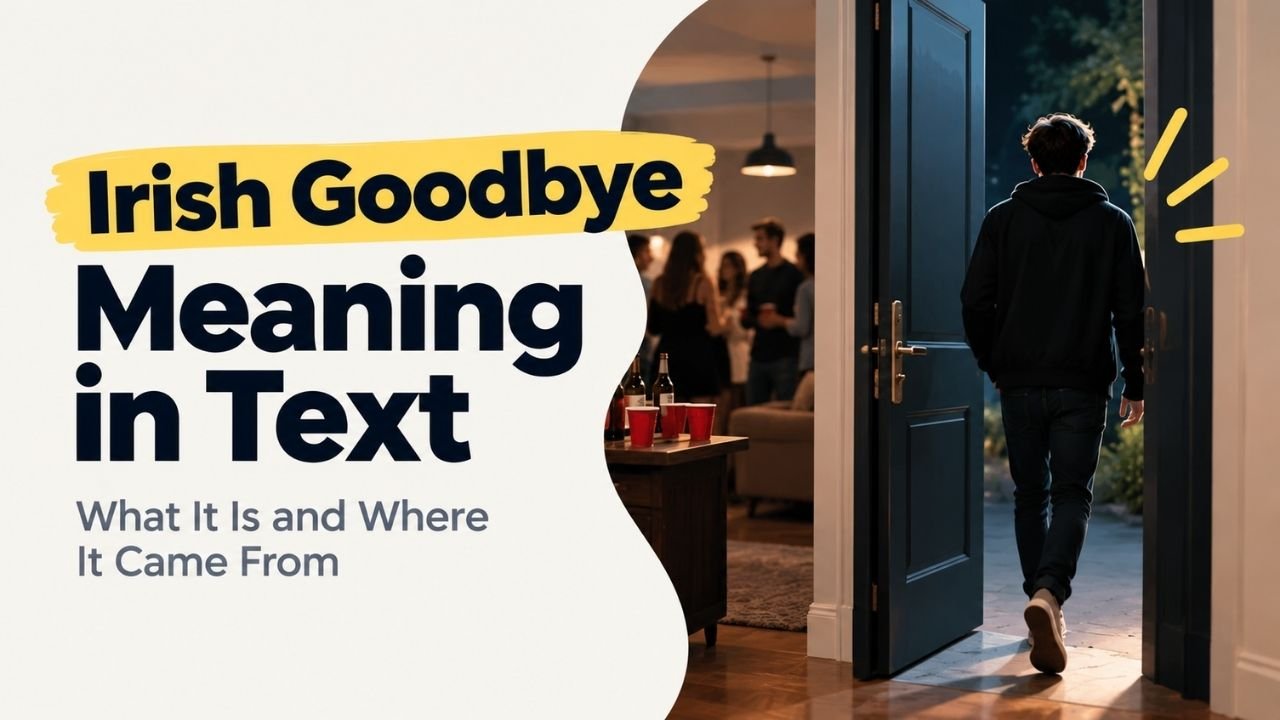
An Irish goodbye means leaving a party, bar, or event without telling anyone you are going. You slip out quietly and skip the farewells. The phrase is slang, and it is also called an “Irish exit.”
People use the term in a light, joking way. It can describe a smart, polite exit, or it can describe a rude one. The tone depends on the situation and the people involved. The origin is unclear, and the Irish connection is mostly a stereotype, not a fact.
What Does Irish Goodbye Mean?
An Irish goodbye is a quiet departure with no announcement. You do not thank the host, hug your friends, or make the rounds. You just go.
Dictionary.com defines it as abruptly leaving a party without telling anyone. Some people also tie it to drinking. One description in that entry says it is a drunk person leaving without talking to anyone, so no one sees how drunk they are, but not everyone requires the person to be drunk.
💡 Quick definition: Irish goodbye (noun phrase, informal): leaving a social gathering without saying goodbye to the host or other guests.
Quick Facts
- Meaning: Leaving without saying goodbye
- Also called: Irish exit, French leave, French exit
- Part of speech: Noun phrase
- Register: Informal, slang
- Pronunciation: EYE-rish good-BYE
- Common verbs: pull, do, make, take (“pull an Irish goodbye”)
How Do You Pronounce Irish Goodbye?
Say it as EYE-rish good-BYE. The stress falls on “EYE” and on “BYE.” Dictionary.com shows the respelling as ahy-rish good-bahy.
- IPA (American): /ˈaɪrɪʃ ɡʊdˈbaɪ/
- Syllables: I·rish good·bye (four syllables)
British speakers say it almost the same way. The phrase is used mostly in North America, so the American pronunciation is the one most people hear.
Is Irish Goodbye a Noun or a Verb?
“Irish goodbye” is a noun phrase. “Irish” is an adjective, and “goodbye” is the noun it describes. You can turn the idea into an action by pairing it with a verb.
| Form | Example | What it shows |
| Noun phrase | “That was a classic Irish goodbye.” | The act itself |
| With “pull” | “I’m going to pull an Irish goodbye.” | Planning to leave quietly |
| With “do” | “She did an Irish goodbye at 10 p.m.” | Reporting what happened |
| With “get” | “We got an Irish goodbye from Mark.” | Being on the receiving end |
⚠️ Common mistake: People sometimes write “Irish Goodbye” with a capital G in the middle of a sentence. In normal writing, only “Irish” is capitalized, because it refers to a nationality.
See More: Ketchum Meaning
How Is Irish Goodbye Used in a Sentence?
Two examples are enough to show the pattern.
- “The party was loud and crowded, so I gave it an Irish goodbye and went home.”
- “He pulled an Irish goodbye from the wedding before the cake was cut.”
You can use it about yourself, about a friend, or as a joke. Friends often tease each other with it afterward: “Where did you go last night? Classic Irish goodbye.”
Why Do People Do an Irish Goodbye?
People leave this way for several practical reasons.
- Big crowds: Saying goodbye to thirty people takes a long time.
- The goodbye loop: One farewell turns into another long chat at the door.
- Not wanting to disrupt the fun: You avoid pulling attention away from the party.
- Feeling awkward or tired: Some people simply find farewells draining.
- Avoiding pressure to stay: A quiet exit means no one talks you into “one more drink.”
Many etiquette fans argue the quiet exit is kind, because it keeps the mood going for everyone else. Babbel notes there are plenty of opinion pieces claiming it is the best way to leave a party.
Is the Irish Goodbye Rude or Polite?
It depends on the setting. The same act can be fine at one event and rude at another.
| Situation | Usually acceptable? | Why |
| Large party or bar | Yes | The host is busy and no one will notice |
| Crowded wedding reception | Often | A text to the couple later works fine |
| Small dinner party | No | The host will notice and may feel hurt |
| Work event | Depends | A word to your boss first is safer |
| Funeral or family gathering | Usually no | People expect a personal farewell |
💡 Tip: If you leave quietly, send a short thank you message afterward. It keeps the convenience of the quiet exit and removes most of the rudeness.
So, why do some people describe it as polite? The argument is that the host and guests are not interrupted, and the party goes on without you. At a small gathering, though, a missing guest is easy to spot, and silence can feel like a snub.
See More: What Does Lede Mean?
Where Does the Term Irish Goodbye Come From?
Nobody knows for sure. The phrase has no clear documented starting point, and there are only theories.
Theory 1: It Copies an Older Phrase
The idea of leaving without a farewell is much older than “Irish goodbye.” The Oxford English Dictionary records “French leave” from 1751, describing an 18th century custom of leaving a reception without taking leave of the host. Many countries have their own version of the habit.
Theory 2: A Stereotype About Irish People
Some explanations point to a common stereotype that Irish people drink heavily. One idea is that the Irish were supposedly too drunk to say a proper goodbye. There is no solid evidence for this, and it should be treated as a stereotype.
Theory 3: A Way to Put Down the Irish
Another theory suggests the English created the name as another way of looking down on Ireland during British rule. This is also unproven. It is a reasonable guess, but not a verified fact.
What We Can Say Safely
- There is no solid historical evidence that Irish people leave gatherings without goodbyes more than anyone else.
- Early uses of “Irish goodbye” or “Irish exit” do not match the modern meaning. For example, one 1963 report describes a “formal Irish goodbye” at a luncheon for an Irish police officer.
- A popular saying claims that the English leave without saying goodbye while the Irish say goodbye and never leave. The same joke has been told about other groups too.
- The phrase gained popularity in the 2000s.
- Online, it spread as a meme in the mid 2010s.
The honest answer is that the origin is a mystery. Anyone who gives you one confident story is guessing.
Irish Goodbye Around the World
Many cultures name this behavior after someone else. The country in the name is usually a neighbor, a rival, or a stereotype.
| Phrase | Where it is used | Notes |
| Irish goodbye / Irish exit | United States, Canada | Most common in American English |
| French leave / French exit | United Kingdom, United States | First recorded in 1751 in the Oxford English Dictionary |
| Filer à l’anglaise | France | Means “to leave English style” |
So the Irish are not unique. Almost every country has pinned this habit on someone else.
Is Irish Goodbye Offensive?
Most people use the phrase without any insult in mind. Babbel notes that most speakers likely do not mean to insult anyone, and many assume the Irish really invented it. Still, some people dislike it because it leans on a stereotype.
If you are not sure, you have easy alternatives. “Irish exit,” “quiet exit,” “slipping out,” or “ghosting the party” all carry the same idea. In a formal or international setting, a neutral phrase is the safer choice.
Irish Goodbye in Different Contexts
In Slang and Everyday Talk
This is the main meaning: sneaking out of a social event. Online, people compare it to ghosting, and it became a popular meme subject through GIFs and image macros. The two are not the same, though. An Irish goodbye ends one evening. Ghosting cuts off contact completely.
In Relationships
Here the phrase means ending a relationship or leaving a partner with no warning and no talk. Some people call a sudden breakup without any explanation an Irish goodbye. It feels much harsher than leaving a party, because the other person is left with unanswered questions.
In Digital Life
People also use it for online exits. Leaving a group chat, a video call, or a Discord server without a word is often called a digital Irish goodbye. The logic is the same. You go quietly and let the conversation continue.
In Death and Loss
Some people use “Irish goodbye” in a sad sense for a person who dies suddenly, or leaves life without a chance for a farewell. This is a poetic and emotional use, not a standard dictionary meaning. It appears most clearly in songs, which are covered below.
Irish Goodbye in Songs and Pop Culture
Several artists have used the phrase as a song title. Wikipedia’s disambiguation page lists songs by Maria Taylor (2007), Kacey Musgraves (2024), and Kneecap (2026), among others. Each uses the idea differently.
Kacey Musgraves
Her song “Irish Goodbye” appears on Deeper Into the Well, the expanded edition of her album Deeper Well. The lyrics use the phrase to describe a partner who left without a word, and she sings that it is hard to forgive. The meaning here is a breakup with no closure. It is closer to ghosting than to leaving a party.
Kneecap
Kneecap released “Irish Goodbye,” featuring Kae Tempest, as the final single from their album Fenian. Member Móglaí Bap described it as a tribute to his late mother and said it is about the everyday things they did together. This is a very different meaning from the party sense. Here the phrase points to grief and loss, and to the way an absence arrives without a proper farewell. Because the subject is deeply personal, it is worth reading about the song from Kneecap’s own words and from reputable interviews.
Other Uses
The phrase has also been used as the title of a 2022 short film, a 2013 comedy special by Morgan Murphy, and an episode of American Dad!
What Is the Opposite of an Irish Goodbye?
There is no single official antonym. The idea of the opposite is a long, open, personal farewell. These are the closest options.
| Term | Meaning | How it differs |
| Making the rounds | Saying goodbye to each person | A polite, thorough exit |
| A proper goodbye | Thanking the host and saying farewell | Standard etiquette |
| The long goodbye | A farewell that keeps going | Drawn out, often at the door |
| A grand exit | A dramatic, noticed departure | Meant to be seen |
💡 Tip: A middle path works well at most events. Say goodbye to the host and one or two close friends, then go.
Common Mistakes With Irish Goodbye
Mistake 1: Treating it as an Irish tradition.
❌ Incorrect: “In Ireland, people always do an Irish goodbye.”
✅ Correct: “The term ‘Irish goodbye’ is used mostly in North America.”
There is no evidence it is a real Irish custom.
Mistake 2: Confusing it with ghosting.
❌ Incorrect: “He ghosted the party.”
✅ Correct: “He did an Irish goodbye from the party.”
Ghosting usually means cutting off contact with a person. The Irish goodbye is leaving one event.
Mistake 3: Capitalizing it wrongly.
❌ Incorrect: “an Irish Goodbye”
✅ Correct: “an Irish goodbye”
Synonyms and Related Phrases
| Phrase | Meaning | Difference |
| Irish exit | Same as Irish goodbye | More common in some regions |
| French leave | Leaving without permission or notice | Older, can also mean leaving a duty |
| Slip out | Leave quietly | Neutral and more general |
| Ghosting | Cutting off contact | Applies to people, not events |
| Dip out | Leave suddenly | Very casual slang |
| Bail | Leave, often abruptly | Can sound like an escape |
See More: What Does Connotation Mean
Frequently Asked Questions
What does Irish goodbye mean?
It means leaving a gathering without saying goodbye to anyone. The person simply disappears.
What is the origin of the Irish goodbye?
The origin is uncertain. Theories link it to older phrases like French leave, or to stereotypes about the Irish, but none is proven.
Is an Irish goodbye rude?
Sometimes. It is usually fine at a large party and often rude at a small dinner or a personal event.
What is the difference between an Irish goodbye and ghosting?
An Irish goodbye is leaving one event quietly. Ghosting is cutting off all contact with someone, usually in dating or friendships.
What is the opposite of an Irish goodbye?
There is no official opposite. Making the rounds and giving a full, personal farewell come closest.
Is “Irish goodbye” offensive?
Most people do not mean it as an insult, but some find it stereotyped. “Irish exit” or “quiet exit” can be gentler choices.
What does Irish goodbye mean in a relationship?
It means ending things suddenly, without a conversation or explanation. It is often compared to ghosting.
What does Irish goodbye mean in the Kacey Musgraves song?
It refers to a partner who left without saying a word, leaving her hurt and without closure.
Is there an Irish goodbye song by Kneecap?
Yes. It is on their album Fenian and is a tribute to Móglaí Bap’s late mother.
Conclusion
An Irish goodbye means leaving a gathering quietly, with no farewell and no announcement. The phrase is informal slang, used mainly in the United States and Canada, and its origin is still unclear. Related ideas like French leave are older, and the link to Ireland rests on stereotype, not proof. The meaning can also stretch beyond parties, to relationships, group chats, and even songs about loss.
Before you use the phrase, think about the setting and the people. A quiet exit works well in a crowd, but a small dinner calls for a real goodbye. When in doubt, say a short thanks to the host and leave warmly. That way the Irish goodbye meaning stays what it should be: a harmless, practical way to go home.

Hassan Ibrahim is the author behind Mean Fixer, with 4 years of experience researching and writing about names, words, slang, meanings, and everyday language. Their goal is to make confusing words and meanings simple, clear, and easy to understand through accurate, useful, and reader-friendly explanations.